← Volume I

Read the leaves

Every photographed leaf of Volume I, in sequence, beside its transcription — 62 of 63 leaves carry text. Use / to move between them. Where a leaf was too steeply angled to read, the text is an honest AI paraphrase, badged as such.

content · Text page: The Storm and Shipwreck narrative passage

Transcribed
Text page: The Storm and Shipwreck narrative passage

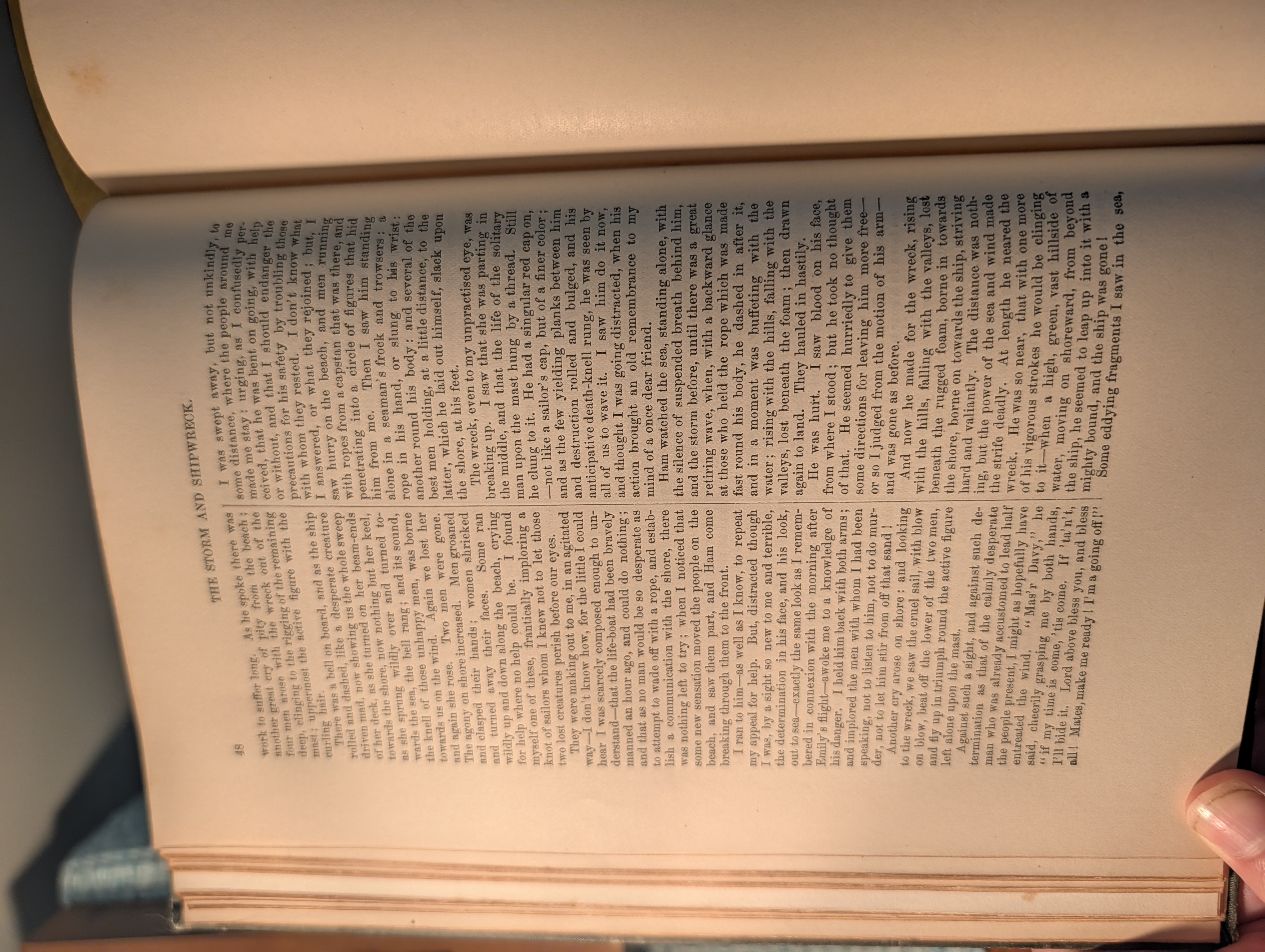
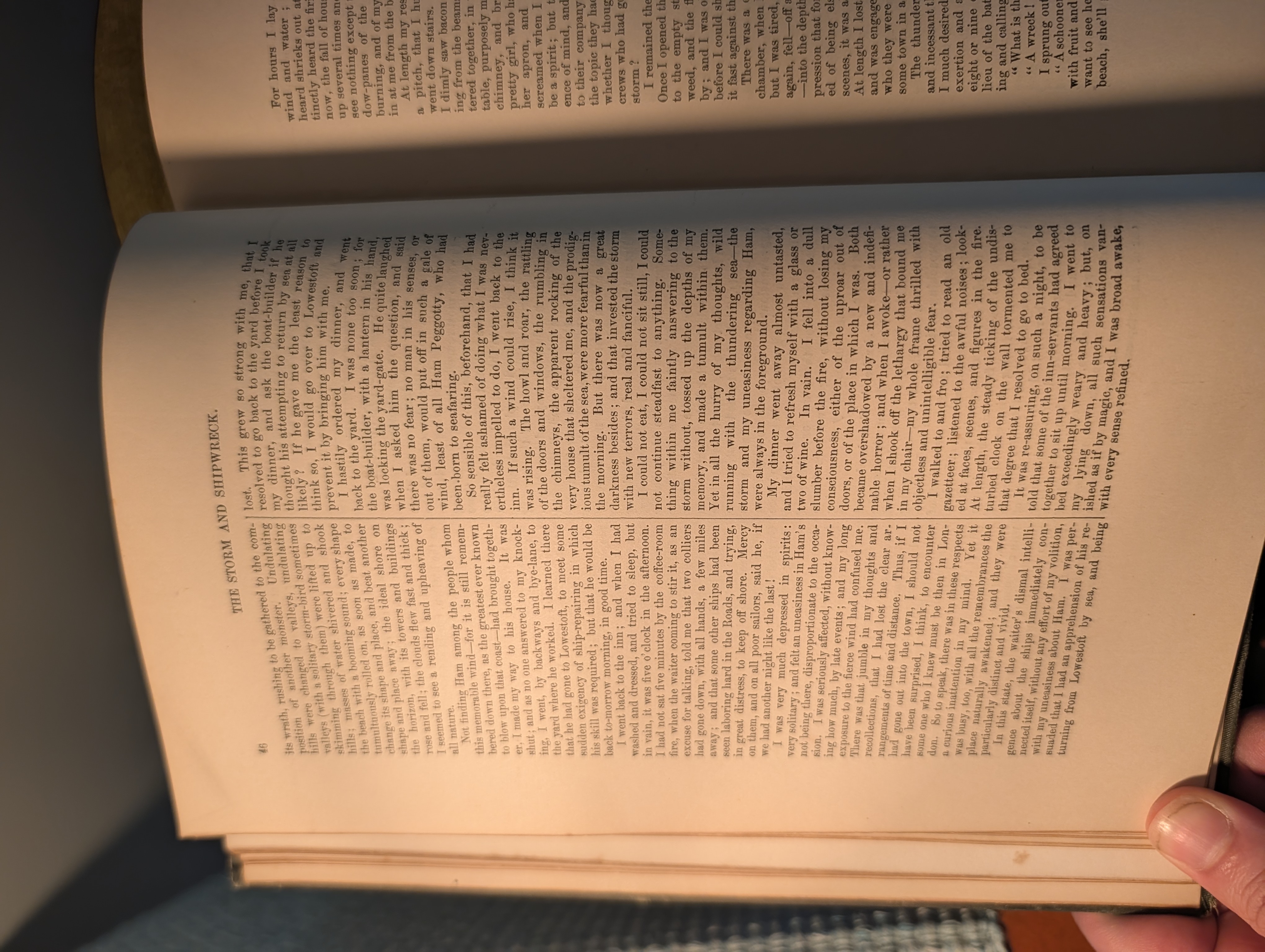
THE STORM AND SHIPWRECK. lost, This grow so strong with me, that I resolved to go back to the yard before I took my dinner, and ask the boat-builder if he thought his attempt by sea at all likely? If he gave me the least reason to think so, I would go over to Lowestoft, and prevent it by bringing him with me. I hastily ordered my dinner, and went back to the yard. I was none too soon; for the boat-builder, with a lantern in his hand, was locking the yard-gate. He quite laughed when I asked him the question, and said there was no fear; no man in his senses, or out of them, would put off in such a gale of wind, least of all Ham Peggotty, who had been born to seafaring. So sensible of this, beforehand, that I had really felt ashamed of doing what I was nevertheless impelled to do, I went back to the inn. If such a wind could rise, I think it was rising. The howl and roar, the rattling of the chimneys, the apparent rocking of the very house that sheltered me, and the prodigious tumult of the sea, were more fearful than in the morning. But there was now a great darkness besides; and that invested the storm with new terrors, real and fanciful.

p. 47

p. 47 · Claude-tidied (AI summary of a hard-to-OCR leaf)

AI summary
Claude-tidied (AI summary of a hard-to-OCR leaf)

The Storm and Shipwreck (Charles Dickens). On the night before the wreck, David Copperfield lies sleepless in his Yarmouth lodging as a violent gale builds over the sea. Resolved to consult the boat-builder before dinner, he passes hours in mounting dread, his rest broken by confused dreams of the rising storm, until he is startled awake by an alarm at the door and throws on his clothes — the tempest now at its height.

previousp. 48

p. 48 · Claude-tidied (AI summary of a hard-to-OCR leaf)

AI summary
Claude-tidied (AI summary of a hard-to-OCR leaf)

The Storm and Shipwreck (Charles Dickens). The wreck unfolds offshore: a ship is breaking up amid towering green seas while a helpless crowd watches from the beach, a single survivor clinging to the mast. Ham ties a rope about himself and struggles out through the surf in a desperate attempt to reach him.

p. 47next

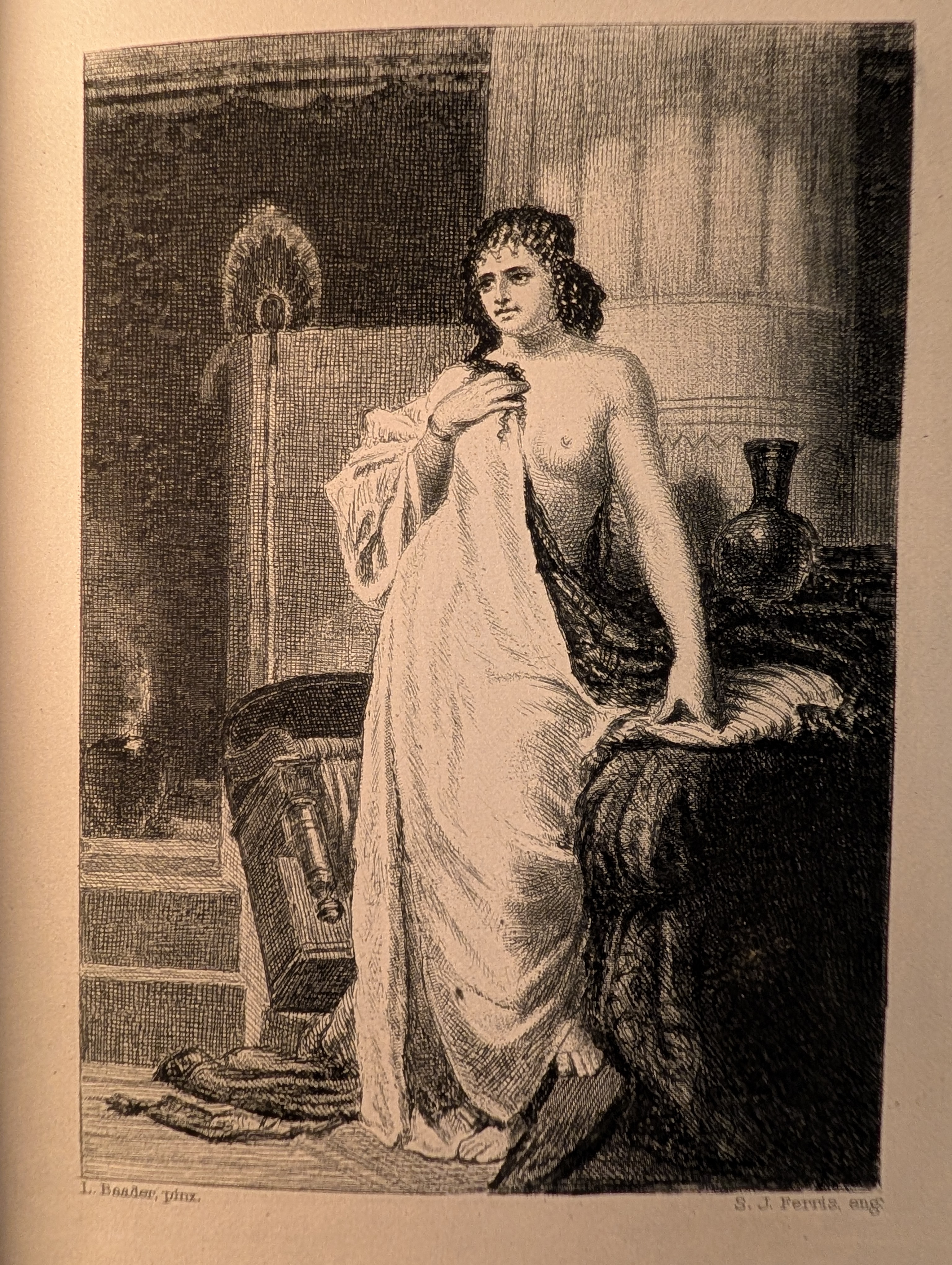
plate · Engraved plate titled Cleopatra's Soliloquy

Transcribed
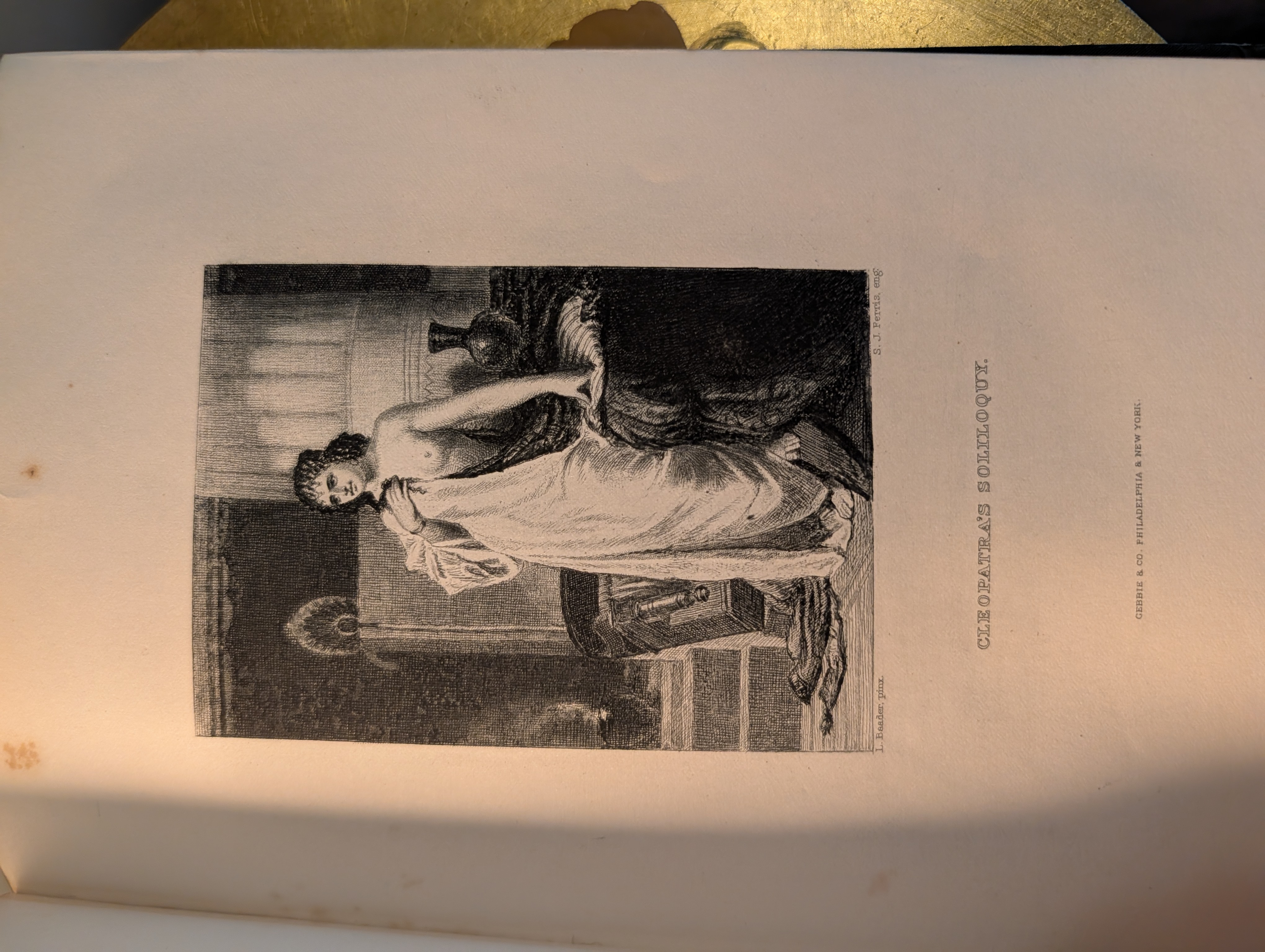
Engraved plate titled Cleopatra's Soliloquy

CLEOPATRA'S SOLILOQUY. L. Beuder, pinx. S. J. Ferris, eng. GEBBIE & CO. PHILADELPHIA & NEW YORK.

p. 48next

plate · Plate caption for Cleopatra's Soliloquy, engraved by S. J. Ferris

Transcribed
Plate caption for Cleopatra's Soliloquy, engraved by S. J. Ferris

L. Beaden, pinx. S. J. Ferris, eng. CLEOPATRA'S SOLILOQUY. GEBBIE & CO. PHILADELPHIA & NEW YORK.

previousnext

plate · Partial engraving plate titled soliloquy, engraved by S. J. Ferris

Partial engraving plate titled soliloquy, engraved by S. J. Ferris

S. J. Ferris, eng. A'S SOLILOQUY.

previousnext

plate · Bottom corner of engraved plate attributed to L. Baader

Bottom corner of engraved plate attributed to L. Baader

L. Baader, pinx.

previousnext

plate · Engraving of a semi-draped woman in classical interior setting

Engraving of a semi-draped woman in classical interior setting

L. Boader, pinx. S. J. Ferris, engr.

previousnext

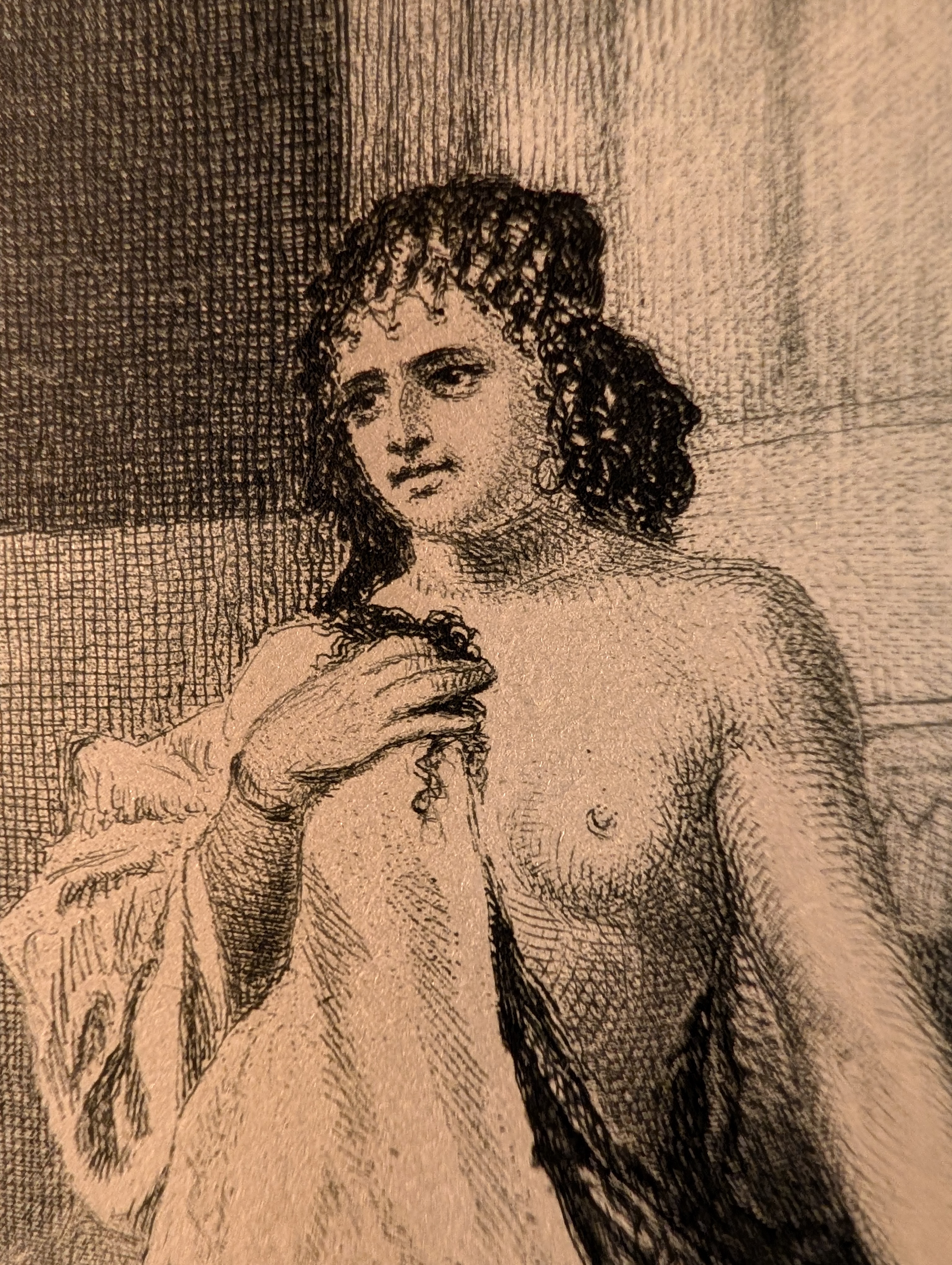
plate · Engraving of a semi-draped woman with curly dark hair

Engraving of a semi-draped woman with curly dark hair

No text on this leaf — Engraving of a semi-draped woman with curly dark hair.

previousp. 49

p. 49 · Claude-tidied (AI summary of a hard-to-OCR leaf)

AI summary
Claude-tidied (AI summary of a hard-to-OCR leaf)

Close of The Storm and Shipwreck (Charles Dickens), then In Memoriam (Tennyson) and the opening of A Week at Batavia (Marquis de Beauvoir). The chapter ends as the drowned man is laid at the narrator's feet and, led along the shore, he finds the body of the friend he had loved since boyhood lying with his head on his arm, as he had often seen him lie at school. A short extract from Tennyson's In Memoriam follows; then Beauvoir's travel letter opens, dated November 1865, describing arrival in Dutch colonial Java — the custom-house, the heat, and Malay women in bright sarongs.

previousp. 50

p. 50 · A Week at Batavia, descriptive travel prose

Transcribed
A Week at Batavia, descriptive travel prose

A WEEK AT BATAVIA. their bare feet decorated with magnificent spurs. There, numbers of itinerant merchants, adorned with "langoutis" of the most vivid colours, traverse the streets at the peculiar trotting pace common to Indians; gesticulating, apostrophising the passer-by, and laughing loudly. It is the most bewildering, the most picturesque, the liveliest crowd I ever saw. It would take me hours to describe its thousand colours, the inconceivable specimens of humanity that compose it, its noisy pantomimic animation. But soon we cross a bridge, and enter the new town. Oh, what a garden of fairyland, what a verdant paradise this is! Batavia; there are no streets in Batavia; there are only splendid avenues, shaded by the most beautiful and luxuriant trees, which form immense long bowers, such as in Europe are only seen in a scene at the opera. The fiery rays of a pitiless sun can only at intervals penetrate this shade, but they deck all that forms it with marvellous hues: the many plumes of the cocoa-nut tree; the slender branches of the tulip tree, which are all flower, and scarlet flower; bananas with their green leaves as large as a man; cotton trees, covered with snow white tufts; the travellers' palm, great fans of the most exquisite grace, from which a stream of a milky fluid springs, if you pierce the trunk; finally, immense banyan trees, from which hundreds of creepers fall straight down, and taking root almost as soon as they touch the ground, climb again to the summit of the tree, twining round it in knotted garlands, only to fall again! One of these trees alone forms a forest surrounded by a curtain, a network of interlaced foliage and flowers, through which children in a state of nature, putting on one side the hundreds of creepers waving in the wind, can look at the boats and the swimmers passing along the canal. The greater part of these bowers of the tropical Babylon are, in fact, only the footpaths to the "arroyos," the greater waterways, which the Dutch would certainly have formed by hundreds, in recollection of their mother-country, if the Malays had not already made them in thousands. Thus the instincts of the white race from the north and the yellow race of the equator coincided. The greatest navigators and the greatest pirates in the world cut up their soil into innumerable islets, and the canals in this town are the veins by which circulates their whole commercial life. Another many-coloured bower therefore, to our left, shades the arroyo on whose opposite shore we are driving. I cannot take my eyes from the innumerable vessels that traverse it; the laughing groups paddling in the water, the tufts of water-lilies blooming there. To the right—through clumps of coffee trees, nutmeg trees, vanilla trees, and tamarinds—we catch glimpses of lawns, fairy-like gardens; and in the distance the white palaces and green verandahs of the European nabobs. I had seen nothing but these avenues and villas, and fancied myself in some delightful suburb of the city, when we found ourselves at the hotel, "der Nederlanden," which, it appears, is in the centre of Batavia; so that this blossoming wood is the town itself! I am in such ecstasies with it, I can hardly believe my eyes. By the beard of all the monkeys with long tails or short that I have yet seen, I swear that it is impossible to describe to you my amazement and admiration. Our new dwelling is situated in the midst of a garden, and sheltered by large trees. The principal building, which is of marble, is supported by an airy colonnade, into which it opens on all sides; on the side of the street and the canal is a circular verandah, where officers, grown thin from the heat, are lounging in cane rocking-chairs. On the opposite side a great oval-shaped kiosk, open to all the winds, but protected by a light roof from the sun, serves as a dining-room. Some sixty Malay servants are swarming like ants to lay the table there. Nothing can be prettier than their long robes, made of red cotton or silk, their blue turbans, and yellow sashes, set off by the whiteness of the balconies and the pavement. Two long wings, of one story only, with verandahs and colonnades, enclose the gardens commanded by the kiosk. Here are our rooms, and on entering them we feel a real sensation of freshness, a delicious temperature compared to that outside; there, in fact, the thermometer is at 114°, and here it is kind enough to go down to 102°. It is five o'clock in the afternoon; good heavens! what will it be tomorrow at noon? We had hardly begun to unpack our boxes when a man presented himself. He was a native, half bailiff, half policeman, with bare feet and a sword at his side, and made us write down, according to police regulations, our names and qualities in a register, which he appeared to hold in great veneration, demanding a legal and minute account for every column. I complied very willingly with the regulations of the colonial "Pietri," but when my august travelling companion was called upon to write down his domicile, he was tempted to put "Batavia itself;" is not every land which is not the beloved country an equally transitory domicile to the exile? If the flowering trees of this terrestrial paradise are the most characteristic beauties

p. 49p. 51

p. 51 · A Week at Batavia, prose travel account, page 51

Transcribed
A Week at Batavia, prose travel account, page 51

A WEEK AT BATAVIA. 51 of the town, the marble basins for bathing are certainly the greatest charm of a Javanese hotel. In less than ten minutes after alighting at the "Nederlanden," I had gone to the end of the colonnade, descended a few steps, and was enjoying in the whitest of basins the voluptuous delights of an abundant shower manufactured by a Malay who pumped the water by a regular movement up to the ceiling, whence it fell again to inundate me. I should have remained in my bath to all eternity if the patience of these placid Malays had not exhausted mine. Two attendants, in fact, had insisted upon following me, and crouching down some four yards off were waiting till I was pleased to condescend to require their soft towels; and beside the man who pumped, a fourth man in a red robe offered me a basket full of mangoes, red mangosteens, whose inside is like pink snow, and the perfumed little-known bananas. In the evening we dined in the kiosk; round us a many-coloured noisy crowd danced under the big trees, from which hung Venetian lanterns. From time to time, amongst the red vests and green robes, a wealthy Dutchman passes languidly along in loose white garments, preceded by the light of an immensely long cigar. We are waited upon by the whole troop of Orientals of whom I spoke just now. I have a Malay to supply me with iced water, which he pours out at arm's length; there are two to change my plate; three to bring round the dishes; one carves; another is awaiting the moment for coffee. I believe if I wished for a dozen dishes, and particularly if I could call for them in the native dialect, I should give employment to the twelve men in red who stand behind my chair! What a charming effect all this variety of colours has on this beautiful evening, with a bright light shining upon them! And when, lazily stretched under the verandah, enjoying the balmy evening breeze, I call "Sapada, cassi api!" immediately one of these Arabian Nights figures, whom one is tempted to call slaves, advances from the column, at the foot of which he has been silently crouching like a statue of Buddha, and brings me to light my cigar a long match of which he has the constant care. It is made of sandal wood saw-dust glued together, and burns night and day with the most delicious perfume. I feel as if I were turning into a pasha! As regards the dinner itself, as a Northman I must make some reservation: eight and forty different kinds of capsicums, a mountain of rice covering a microscopic atom of chicken (the anti-type of the fragment of the Australian Dinornis), which with a Cayenne pepper sauce, constitutes the celebrated curry; an absence of all meat that can be cut with an ordinary knife; an abundance of bamboo salads and chutney; there is a local flavour about this much appreciated by amateurs, but which in palates and digestions unaccustomed to Javanese cooking raises fiery torments, which are only increased by drinking. 11th November, 1866.—As I lay down last night on a bed already possessing the peculiarity of being made with mats instead of sheets, I was greatly surprised to find, besides the innumerable gnats imprisoned behind the mosquito net, a companion quite as remarkable. This was a long roll made of grass matting, about two yards long, and the thickness of an ordinary bolster, which awaited me laid lengthwise on the bed. It was obligingly explained to me that no inhabitant of Java will sleep without this vegetable production, which must be kept between the legs to cool the body. I was very much amused with this specimen of manners and customs; but if it soothes the creoles with a refreshing slumber, it rouses Europeans incontrollably to a bolstering match. Besides the swarms of buzzing mosquitoes, with their impertinent stings, exasperated us by whistling their Javanese airs in our ears; but as the capsicums, the grass bolsters, and the mosquitoes are necessary features of the locality, I intend in a few days to make friends with them all. Very different from Paris customs, fashionable life begins here at half-past four in the morning. As soon as the first mists of a tropical dawn appear, old and young begin to be heard moving over the tiled floors in slippers, and, wrapped in floating cotton garments, hasten to the pools to enjoy the ice-cold waves. As I left them, I met a real odalisque, with jet black eyes, and of the most foreign appearance; she glided between the columns, throwing back masses of black hair which fell to the ground, and classically draped like Stratonice in rose-coloured cashmere. She seemed to us really an apparimere. She, with her sudden changing glances, the tion, with her sudden changing glances, the wild swiftness of her movements, her air as wild swiftness of her movements, her air as of a lioness surprised, and that Indian fire in her veins which always gives so fascinating a charm. We were told that she was the daughter of a Dutch officer and of a native of Borneo. The half-caste beauties bloom wonderfully under the sun of Java, while the unhappy Europeans, enfeebled and worn out by the heat, look pale and ghastly, and inspire one with the most profound pity. Such was my

p. 50p. 52

p. 52 · A Week at Batavia, travel essay text page

Transcribed
A Week at Batavia, travel essay text page

A WEEK AT BATAVIA. 52 first impression, while taking my walk between four and six in the morning, the especially fashionable hour. But what particularly struck me was a military post: twenty Malays were on guard, armed with pikes and pitchforks more than nine feet long. It was explained to us that in this country there are a good many natives suffering from mental disease: over-excited by opium, they wander over the island armed with a sword, and run through the body the first man they fall in with, in honour of the Koran. This is called running a muck. As soon as one of these men appears, the guard gives chase, encloses him between three pitchforks, and the corporal, whose rank may easily be recognized from the fact of his wearing shoes, has the honour of running through with a javelin the terrible madman. First insight into the internal government. A morning at Batavia consists of a walk, five or six baths running, and an appetizing breakfast. In the afternoon every one sleeps. Towards six o'clock in the evening a little stir begins to be felt: hundreds of open carriages drive about. The European population, lounging bare-headed, wends its way to the Waterloo plain, where a military band is playing. We follow the stream, still delighted by the enchanting avenues and brilliant dresses. This "Longchamps" partakes completely of the character of the colony; the garrison, nine thousand men strong, is its principal ornament; more than three hundred carriages stand in the shade of the great trees; the national airs, very well played, echo loudly; and officers gallop about amongst the myriads of Javanese in holiday dress, glittering in the most brilliant Eastern finery. Imagine a tall, fine-looking man, in a blue tunic, loose white trousers, high boots, large spurs, and big sword. Suppose that he will kindly open his legs to admit between them a superbly caparisoned pony, about the size of a Newfoundland dog, and you have a truthful picture of the Javanese representatives of the armed force of all the Netherlands. The small size of the horse detracts in no wise from the greatest military virtues, and Heaven knows that the fame of this army is beyond all praise; but when a troop of Lilliputian horses, mounted by worthy companions of Gulliver, charge the enemy, it is impossible to help laughing with all one's heart. We dined this evening with our friend M. Van Delden, the president of the Chamber of Commerce. Our agreeable companion in the stifling cabin of the 'Hero' had resumed his princely existence in his palace, amidst the peaceful charms of his delightful family circle. Luxurious pools, gardens of Armida, a verandah dining-room amidst the luxuriant foliage of blooming thickets, swarms of Indian servants in their most splendid national dress, nothing is wanting of all that can be imagined as the regal reward of industry, probity, and talent. How is it possible after the well-earned delights of such a paradise to return to a muddy, foggy street in Holland, and live there without twenty horses or four score servants? Holland is but a name to be passionately loved by these patriotic hearts; from time to time they return to see it, and to re-invigorate themselves on their native soil; but space, wealth, sunshine, authority, are wanting there to the happy inhabitants of Java, who monopoly has here made pashas and kings, and who feel little inclined to become subjects, rate-payers, and tenants on lease again, at home! 12th November, 1866.—We follow the fashion and take an airing at five o'clock in the morning on M. Van Delden's skittish ponies. Still the same bowers, the same marvels of verdure and bloom, of perfume and foliage; still the same numbers of villas scattered about in gardens, the same movement on a hundred different canals, the same brilliant colours in this human ant-hill which moves busily about, screaming noisily like a flight of cockatoos. At nine o'clock we have already reached our fifth bath. This torrid temperature of 104° in the shade would really, I believe, burst any thermometer that was put into the sun. I braved it nevertheless with a pyramidal white cotton helmet on my head, which made me look like a white-washed fireman. I was much puzzled with the narrow winding lanes of the old town, where the inhabitants pack themselves into their bamboo huts as we should pile up sacks of wheat in a corn market. The Malay shops are filled with calico goods and sticky eatables; the Chinese shops are of a superior kind. Here, for example, is the stall of a Chinese watchmaker. The proprietor's plaited tail is the sole garment which appears on his immensely fat body. He holds a magnifying glass in his left eye by a contraction of the eyebrow which contorts his features into a horrible grimace, and this semi-nude jeweller is audaciously handling a Breguet watch, and seems very proud of being able to take the Paris workmanship so cleverly to pieces. His neighbour sells monkeys, his opposite neighbour innumerable preparations of capsicum in innumerable saucers piled one upon another. Everywhere a putrid and disgusting smell reigns. The sea breeze brings

p. 51p. 53

p. 53 · Text page from 'A Week at Batavia'

Transcribed
Text page from 'A Week at Batavia'

A WEEK AT BATAVIA. 53 great whiffs of it, exhaled from the mangrove trees and poisonous shrubs which cover the shore. The advancing tide swells their knotted, twisted, porous roots; in a few hours they increase some inches in diameter; then the ebb leaves them exposed on the unhealthy mud; the sun pours down, evaporates and dries them up; a line of yellowish clouds, of pestilential mists, forms itself, and remains for a moment suspended, waiting to be carried off by the wind, and then, woe to the coast where the caprice of the atmosphere may direct it! It is these deadly miasmas which have given to the old town of Batavia that general reputation for unhealthiness which made you fear for us when we left home. And in fact, it is impossible to count the numbers who have fallen victims there since the occupation of the place. I was speaking of this subject with an agreeable acquaintance. "Oh!" said he, "before the period when we retreated from the shores to found the new town, people died like flies in old Batavia, it was actual poisoning for every human being; but now, what does it signify? no one lives there but Chinese or Malays!" This saying, anything but philanthropic, recalled to my mind a certain correspondence in the last Mexican war. Having enumerated the disasters from yellow fever on the coast, and given an account of the movement of the troops into the interior, the letter said: "But families may feel re-assured now, there are none but sailors on the coast!" The families of the French sailors must have been about as much comforted as those of the natives are here. Notwithstanding the pure air of the new town, we have just had a terrible example of the consequence of imprudence. One of our neighbours at table, who had eaten too freely of the juicy pine-apples at dessert yesterday evening, looked a little pale at the mid-day breakfast—at three o'clock, he was dead! It is the only thing which is done quickly in these tropical latitudes! Hardly is the hour of our siesta over before we sit down to write under our verandah. Immediately we are besieged by some fifty Chinese or Malays, wanting to sell us neckties or handkerchiefs, French photographs and military sketches. I drive them away, they return; I threaten them, they spread out a hundred new things, this one crying up his trousers, another his eau de Cologne, a third his monkeys. Determined to await the end of my letter, they are at this moment crouching down in the full sun ten paces from us, evidently hoping that I shall be in a more conciliatory disposition presently. In the evening we were roused by a fire. A hundred and eighty houses—reed huts—in the old town were blazing like a lot of lucifer matches. What quantities of vermin must have been roasted! 18th November, 1866.—We might have expected this! The captain of the 'Hero,' our neighbour in this corridor, turned pale yesterday evening, and passed the night prostrate on the ground very sick, and groaning. We ourselves have paid the necessary tribute of new arrivals, and our interiors are in a pitiable state. If we can preserve our cheerfulness, we are safe from that phantom of cholera—and Javanese cholera—which takes fright if it does not inspire it. Here, too, is something to restore us—the pure air of the mountains inland. A charming letter from the Governor-General for the time being informs us that, "political considerations not permitting him to offer to a prince in exile the honours due to a French prince, he yet begs to be allowed to treat him as the grandson of a king." He sends us a circular passport, a most rare and valuable favour, for the whole island, and even for the so-called imperial territories, where, under Dutch protection, the Sultans of Sourakarta and Djokjokarta reign; notice is given to all the residents and native princes in the island, and the government post horses are put at the Prince's service gratuitously. This is a piece of good fortune which delights us and fills us with the most lively gratitude. Change being recommended for those who feel the enervating effect of this fiery climate, we have not refused the Resident of Batavia, M. Hoogeveen's, kind invitation. At six o'clock in the evening his state carriage came to fetch us. Four outrunners, all dressed in white, carry long white horses' tails with which they flick away the flies from our team; they make good use of their legs, each running by the side of his pony and effectually chasing the flies. We gallop and they run, such is the custom here. In half an hour we arrive at the palace. A regiment of servants arrive at the steps, turbans, sashes, arms, all are on the steps, turbans, sashes, arms, all the splendid figures of Oriental scenery stand out brilliantly on the marble. The Resident receives the Prince most cordially; then come the general in command, the colonels of artillery, the civil engineers, and, finally, the sultan and sultana of one of the principalities of Borneo. The husband is a stunted little old man, wrinkled and rheumatic, furiously chewing a paste made of lime and betel nut, which blackens the teeth and makes the gums bleed, and which, stuck between the teeth and the lower lip, swells the latter, by nature hanging, and so increases a hideous and deformed swelling.

p. 52p. 54

p. 54 · Wedding of Shon Maclean, bagpipe melody from the Gaelic

Transcribed
Wedding of Shon Maclean, bagpipe melody from the Gaelic

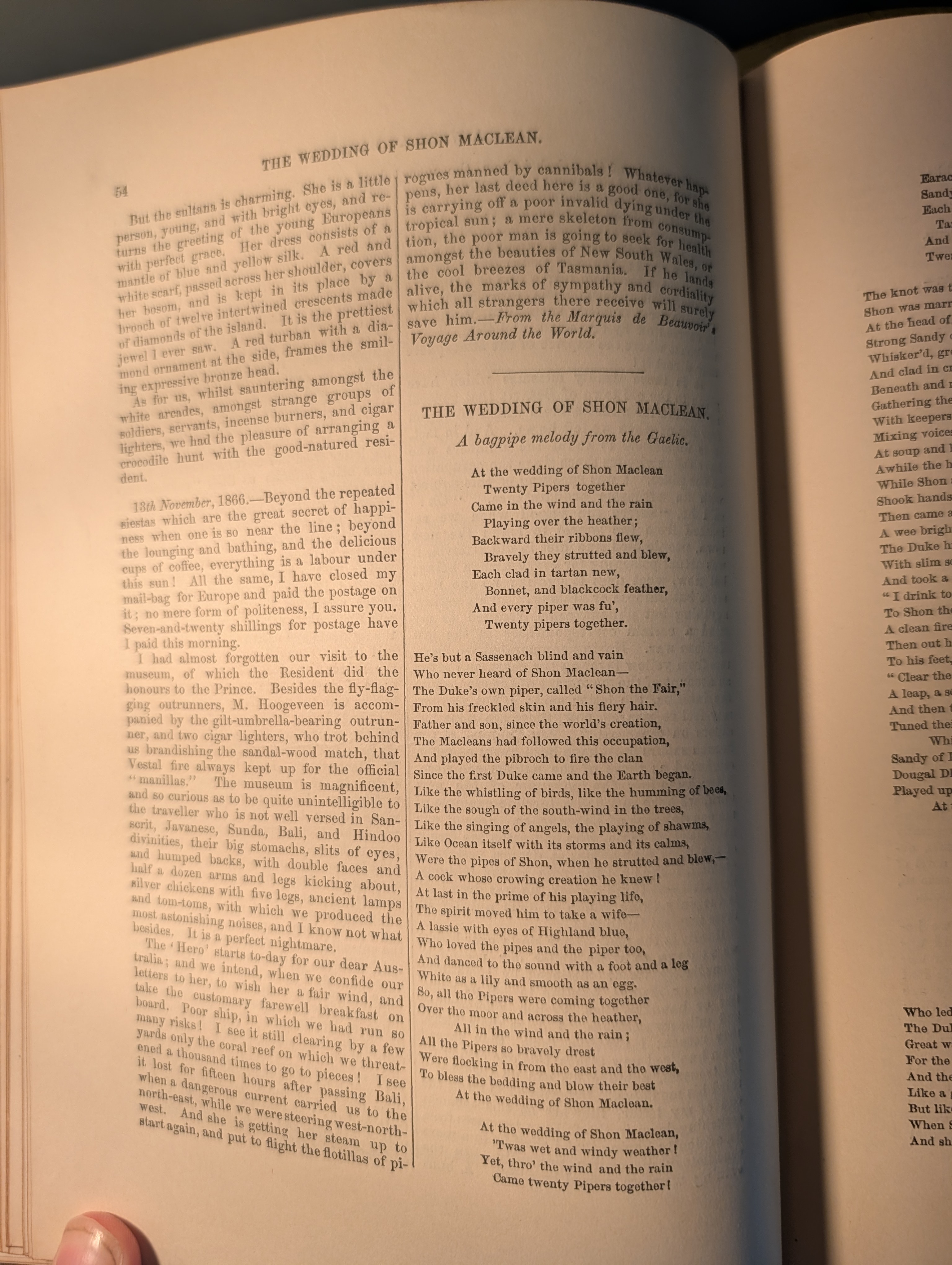
THE WEDDING OF SHON MACLEAN. 54 But the sultana is charming. She is a little person, young, and with bright eyes, and returns the greeting of the young Europeans with perfect grace. Her dress consists of a mantle of blue and yellow silk. A red and white scarf, passed across her shoulder, covers her bosom, and is kept in its place by a brooch of twelve intertwined crescents made of diamonds of the island. It is the prettiest jewel I ever saw. A red turban with a diamond ornament at the side, frames the smiling expressive bronze head. As for us, whilst sauntering amongst the white arcades, amongst strange groups of soldiers, servants, incense burners, and cigar lighters, we had the pleasure of arranging a crocodile hunt with the good-natured resident. 18th November, 1866.—Beyond the repeated siestas which are the great secret of happiness when one is so near the line; beyond the lounging and bathing, and the delicious cups of coffee, everything is a labour under this sun! All the same, I have closed my mail-bag for Europe and paid the postage on it; no mere form of politeness, I assure you. Seven-and-twenty shillings for postage have I paid this morning. I had almost forgotten our visit to the museum, of which the Resident did the honours to the Prince. Besides the fly-flagging outrunners, M. Hoogeveen is accompanied by the gilt-umbrella-bearing outrunner, and two cigar lighters, who trot behind us brandishing the sandal-wood match, that Vestal fire always kept up for the official "manillas." The museum is magnificent, and so curious as to be quite unintelligible to the traveller who is not well versed in Sanscrit, Javanese, Sunda, Bali, and Hindoo divinities, their big stomachs, slits of eyes, and humped backs, with double faces and half a dozen arms and legs kicking about, silver chickens with five legs, ancient lamps and tom-toms, with which we produced the most astonishing noises, and I know not what besides. It is a perfect nightmare. The 'Hero' starts to-day for our dear Australia; and we intend, when we confide our letters to her, to wish her a fair wind, and take the customary farewell breakfast on board. Poor ship, in which we had run so many risks! I see it still clearing by a few yards only the coral reef on which we threatened a thousand times to go to pieces! I see when a dangerous current after passing Bali, north-east, while we were steering west-northwest. And she is getting her steam up to start again, and put to flight the flotillas of pirates rogues manned by cannibals! Whatever happens, her last deed here is a good one, for she is carrying off a poor invalid dying under the tropical sun; a mere skeleton from consumption, the poor man is going to seek for health amongst the beauties of New South Wales, or the cool breezes of Tasmania. If he lands alive, the marks of sympathy and cordiality which all strangers there receive will surely save him.—From the Marquis de Beauvoir's Voyage Around the World. THE WEDDING OF SHON MACLEAN. A bagpipe melody from the Gaelic. At the wedding of Shon Maclean Twenty Pipers together Came in the wind and the rain Playing over the heather; Backward their ribbons flew, Bravely they strutted and blew, Each clad in tartan new, Bonnet, and blackcock feather, And every piper was fu', Twenty pipers together. He's but a Sassenach blind and vain Who never heard of Shon Maclean— The Duke's own piper, called "Shon the Fair," From his freckled skin and his fiery hair. Father and son, since the world's creation, The Macleans had followed this occupation, And played the pibroch to fire the clan Since the first Duke came and the Earth began. Like the whistling of birds, like the humming of bees, Like the sough of the south-wind in the trees, Like the singing of angels, the playing of shawms, Like Ocean itself with its storms and its calms, Were the pipes of Shon, when he strutted and blew,— A cock whose crowing creation he knew! At last in the prime of his playing life, The spirit moved him to take a wife— A lassie with eyes of Highland blue, Who loved the pipes and the piper too, And danced to the sound with a foot and a leg White as a lily and smooth as an egg. So, all the Pipers were coming together Over the moor and across the heather, All in the wind and the rain; All the Pipers so bravely drest Were flocking in from the east and the west, To bless the bedding and blow their best At the wedding of Shon Maclean. At the wedding of Shon Maclean, 'Twas wet and windy weather! Yet, thro' the wind and the rain Came twenty Pipers together!

p. 53p. 55

p. 55 · Poetry: The Wedding of Shon Maclean, page 55

Transcribed
Poetry: The Wedding of Shon Maclean, page 55

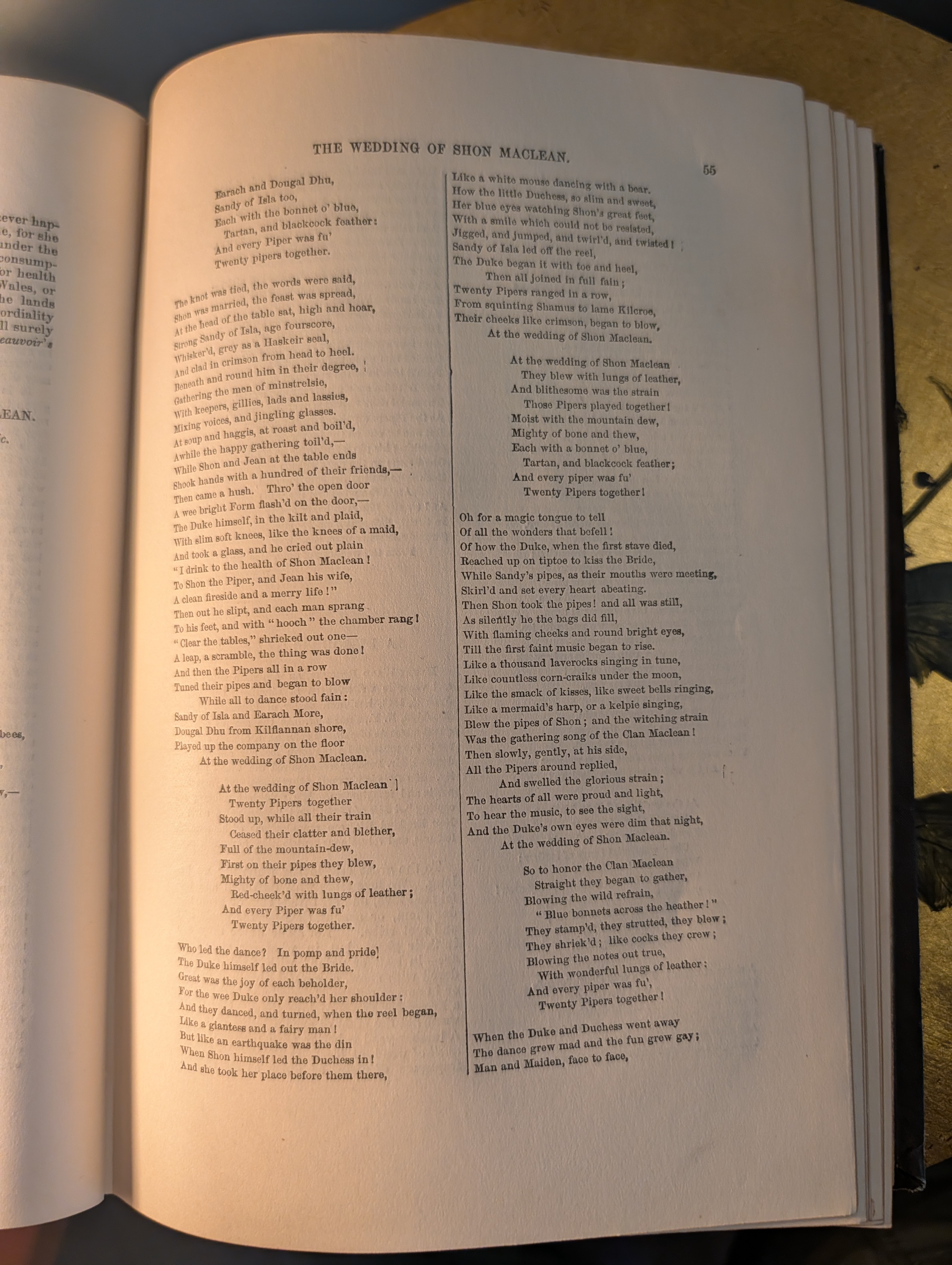
THE WEDDING OF SHON MACLEAN. 55 Earach and Dougal Dhu, Sandy of Isla too, Each with the bonnet o' blue, Tartan, and blackcock feather: And every Piper was fu' Twenty pipers together. The knot was tied, the words were said, Shon was married, the feast was spread, At the head of the table sat, high and hoar, Strong Sandy of Isla, ago fourscore, Whiskerd, grey as a Haskeir seal, And clad in crimson from head to heel, Beneath and round him in their degree, Gathering the men of minstrelrie, With keepers, gillies, lads and lassies, Mixing voices, and jingling glasses. At soup and haggis, at roast and boil'd, Awhile the happy gathering toil'd,— While Shon and Jean at the table ends Shook hands with a hundred of their friends,— Then came a hush. Thro' the open door A wee bright Form flash'd on the door,— The Duke himself, in the kilt and plaid, With slim soft knees, like the knees of a maid, And took a glass, and he cried out plain "I drink to the health of Shon Maclean! To Shon the Piper, and Jean his wife! A clean fireside and a merry life!" Then out he slipt, and each man sprang To his feet, and with "hooch" the chamber rang! "Clear the tables," shrieked out one— A leap, a scramble, the thing was done! And then the Pipers all in a row Tuned their pipes and began to blow While all to dance stood fain: Sandy of Isla and Earach More, Dougal Dhu from Kilfiannan shore, Played up the company on the floor At the wedding of Shon Maclean. At the wedding of Shon Maclean Twenty Pipers together Stood up, while all their train Ceased their clatter and blether, Full of the mountain-dew, First on their pipes they blew, Mighty of bone and thew, Red-cheek'd with lungs of leather; And every Piper was fu' Twenty Pipers together. Who led the dance? In pomp and pride The Duke himself led out the Bride. Great was the joy of each beholder, For the wee Duke only reach'd her shoulder: And they danced, and turned, when the reel began, Like a giantess and a fairy man! But like an earthquake was the din When Shon himself led the Duchess in! And she took her place before them there, Like a white mouse dancing with a bear. How the little Duchess, so slim and sweet, Her blue eyes watching Shon's great feet, With a smile which could not be resisted, Jigged, and jumped, and twirl'd, and twisted! Sandy of Isla led off the reel, The Duke began it with toe and heel, Then all joined in full fain; Twenty Pipers ranged in a row, From squinting Shamus to lame Kilcroe, Their cheeks like crimson, began to blow, At the wedding of Shon Maclean. At the wedding of Shon Maclean They blew with lungs of leather, And blithesome was the strain Those Pipers played together! Moist with the mountain dew, Mighty of bone and thew, Each with a bonnet o' blue, Tartan, and blackcock feather; And every piper was fu' Twenty Pipers together! Oh for a magic tongue to tell Of all the wonders that befell! Of how the Duke, when the first stave died, Reached up on tiptoe to kiss the Bride, While Sandy's pipes, as their mouths were meeting, Skirl'd and set every heart abeating. Then Shon took the pipes! and all was still, As silently he the bags did fill, With flaming cheeks and round bright eyes, Till the first faint music began to rise. Like a thousand laverocks singing in tune, Like countless corn-craiks under the moon, Like the smack of kisses, like sweet bells ringing, Like a mermaid's harp, or a kelpie singing, Blew the pipes of Shon; and the witching strain Was the gathering song of the Clan Maclean! Then slowly, gently, at his side, All the Pipers around replied, And swelled the glorious strain; The hearts of all were proud and light, To hear the music, to see the sight, And the Duke's own eyes were dim that night, At the wedding of Shon Maclean. So to honor the Clan Maclean Straight they began to gather, Blowing the wild refrain, "Blue bonnets across the heather!" They stamp'd, they strutted, they blew; They shriek'd; like cocks they crew; Blowing the notes out true, With wonderful lungs of leather; And every piper was fu', Twenty Pipers together! When the Duke and Duchess went away The dance grew mad and the fun grew gay; Man and Maiden, face to face,
p. 54p. 56

p. 56 · Poetry by Buchanan and prose by Henry Ward Beecher on trees

Transcribed
Poetry by Buchanan and prose by Henry Ward Beecher on trees

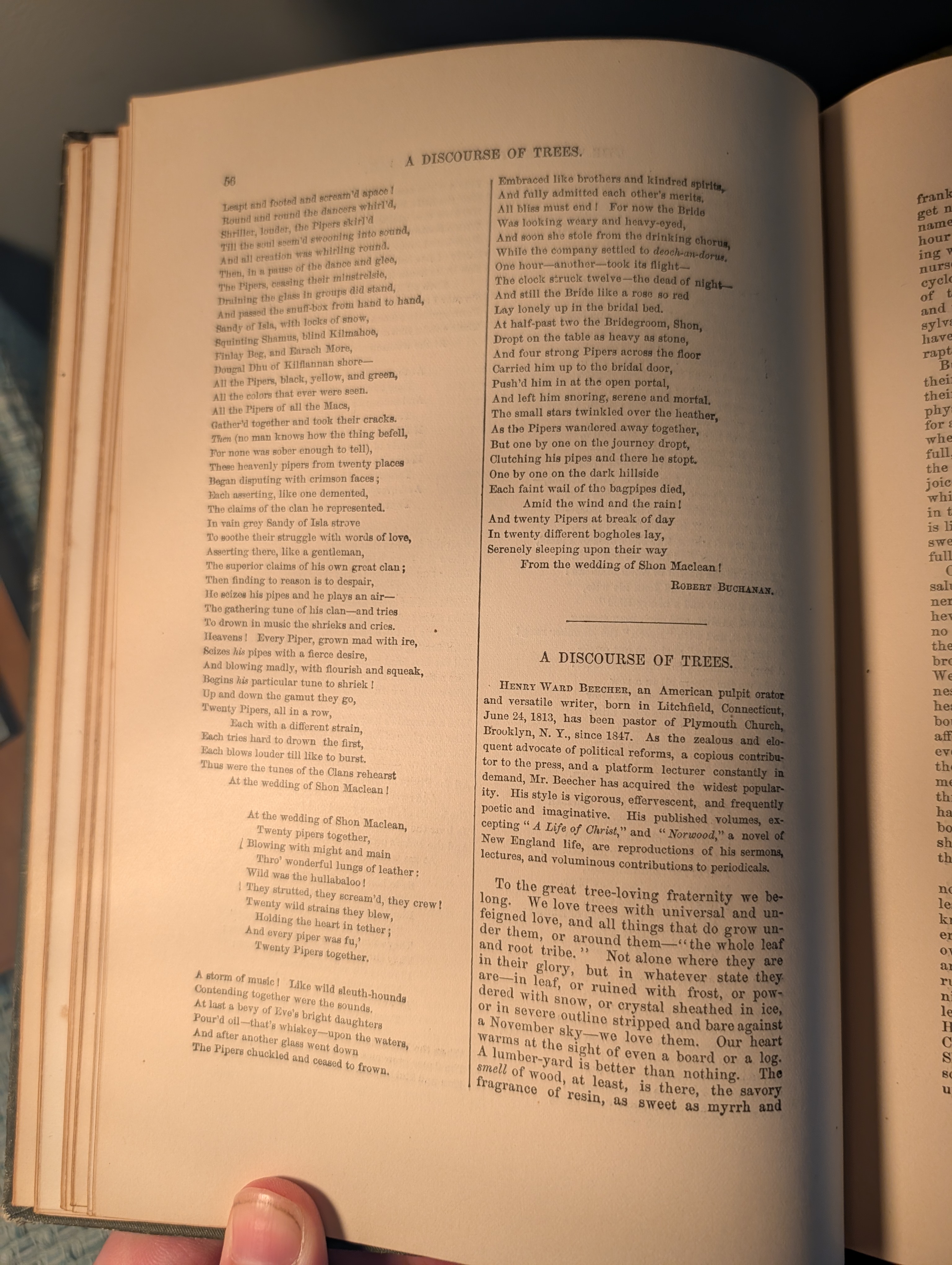
A DISCOURSE OF TREES. 56 Leapt and footed and scream'd apace! Round and round the dancers whirl'd, Shriller, louder, the Pipers skirl'd Till the soul seem'd swooning into sound, And all creation was whirling round. Then, in a pause of the dance and glee, The Pipers, ceasing their minstrelsy, Draining the glass in groups did stand, And passed the snuff-box from hand to hand, Sandy of Isla, with locks of snow, Squinting Shamus, blind Kilmahoe, Finlay Beg, and Earsch More, Dongal Dhu of Kilfiannan shore— All the Pipers, black, yellow, and green, All the colors that ever were seen. All the Pipers of all the Macs, Gather'd together and took their cracks. Then (no man knows how the thing befell, For none was sober enough to tell), These heavenly pipers from twenty places Began disputing with crimson faces; Each asserting, like one demented, The claims of the clan he represented. In vain grey Sandy of Isla strove To soothe their struggle with words of love, Asserting there, like a gentleman, The superior claims of his own great clan; Then finding to reason is to despair, He seizes his pipes and he plays an air— The gathering tune of his clan—and tries To drown in music the shrieks and cries. Heavens! Every Piper, grown mad with ire, Seizes his pipes with a fierce desire, And blowing madly, with flourish and squeak, Begins his particular tune to shriek! Up and down the gamut they go, Twenty Pipers, all in a row, Each with a different strain, Each tries hard to drown the first, Each blows louder till like to burst. Thus were the tunes of the Clans rehearst At the wedding of Shon Maclean! At the wedding of Shon Maclean, Twenty pipers together, Blowing with might and main Thro' wonderful lungs of leather: Wild was the hullabaloo! They strutted, they scream'd, they crew! Twenty wild strains they blew, Holding the heart in tether; And every piper was fu,' Twenty Pipers together. A storm of music! Like wild sleuth-hounds Contending together were the sounds. At last a bevy of Eve's bright daughters Pour'd oil—that's whiskey—upon the waters, And after another glass went down The Pipers chuckled and ceased to frown. Embraced like brothers and kindred spirits, And fully admitted each other's merits, All bliss must end! For now the Bride Was looking weary and heavy-eyed, And soon she stole from the drinking chorus, While the company settled to deoch-an-dorus. One hour—another—took its flight— The clock struck twelve—the dead of night— And still the Bride like a rose so red Lay lonely up in the bridal bed. At half-past two the Bridegroom, Shon, Dropt on the table as heavy as stone, And four strong Pipers across the floor Carried him up to the bridal door, Push'd him in at the open portal, And left him snoring, serene and mortal. The small stars twinkled over the heather, As the Pipers wandered away together, But one by one on the journey dropt, Clutching his pipes and there he stopt. One by one on the dark hillside Each faint wail of the bagpipes died, Amid the wind and the rain! And twenty Pipers at break of day In twenty different bogholes lay, Serenely sleeping upon their way From the wedding of Shon Maclean! Robert Buchanan. A DISCOURSE OF TREES. Henry Ward Beecher, an American pulpit orator and versatile writer, born in Litchfield, Connecticut, June 24, 1813, has been pastor of Plymouth Church, Brooklyn, N. Y., since 1847. As the zealous and eloquent advocate of political reforms, a copious contributor to the press, and a platform lecturer constantly in demand, Mr. Beecher has acquired the widest popularity. His style is vigorous, effervescent, and frequently poetic and imaginative. His published volumes, excepting "A Life of Christ," and "Norwood," a novel of New England life, are reproductions of his sermons, lectures, and voluminous contributions to periodicals. To the great tree-loving fraternity we belong. We love trees with universal and unfeigned love, and all things that do grow under them, or around them—"the whole leaf and root tribe." Not alone where they are in their glory, but in whatever state they are—in leaf, or ruined with frost, or powdered with snow, or crystal sheathed in ice, or in severe outline stripped and bare against a November sky—we love them. Our heart warms at the sight of even a board or a log. A lumber-yard is better than nothing. The smell of wood, at least, is there, the savory fragrance of resin, as sweet as myrrh and

p. 55p. 57

p. 57 · Claude-tidied (AI summary of a hard-to-OCR leaf)

AI summary
Claude-tidied (AI summary of a hard-to-OCR leaf)

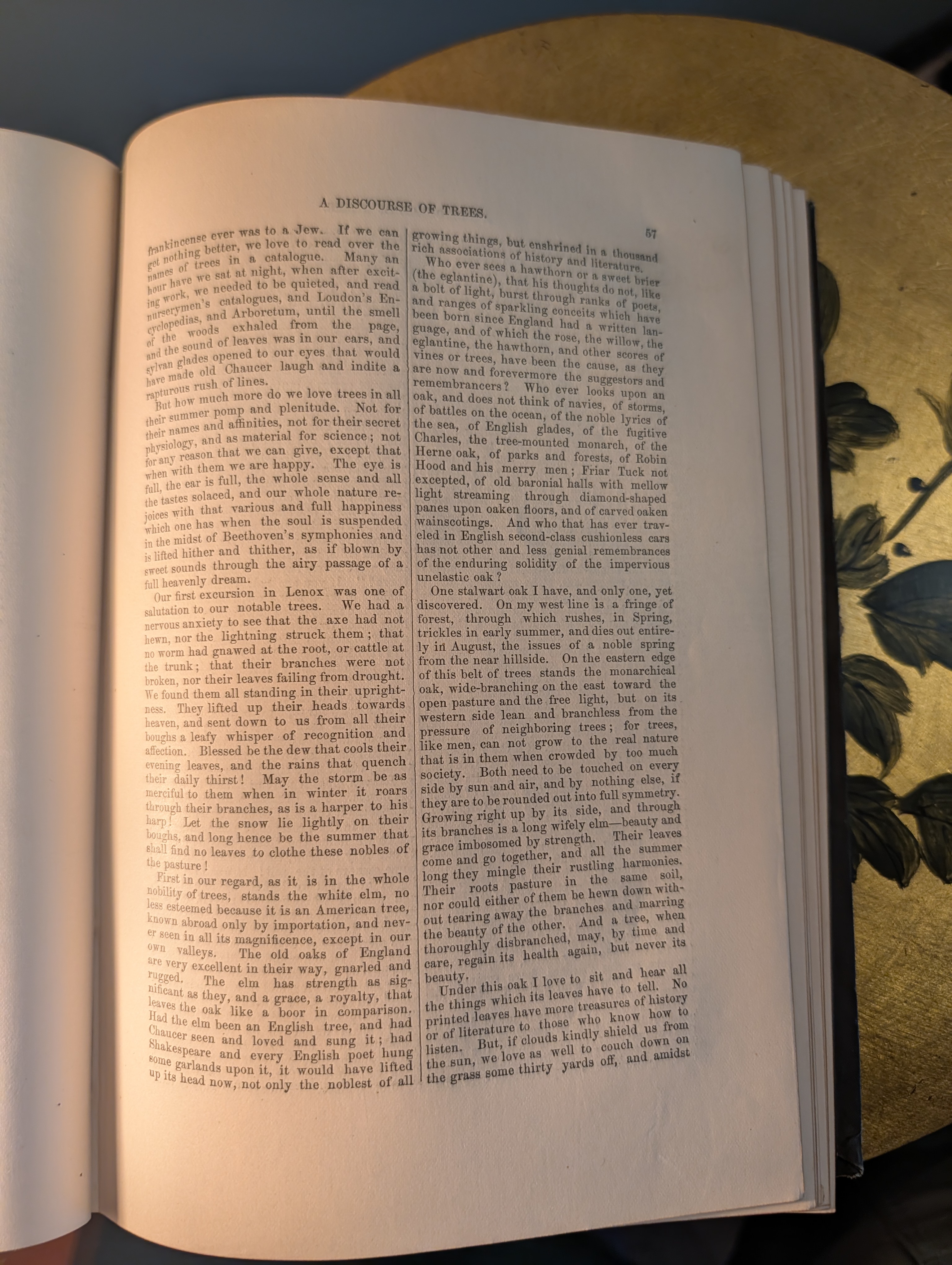
A Discourse of Trees (Henry Ward Beecher). Beecher rhapsodizes on trees and foliage — the play of light through ranks of pines, the contrast between English and American woods, and the shifting beauty of leaves across the seasons — taking the forest as an emblem of nature's endless variety of form.

p. 56p. 58

p. 58 · Claude-tidied (AI summary of a hard-to-OCR leaf)

AI summary
Claude-tidied (AI summary of a hard-to-OCR leaf)

A Discourse of Trees (Henry Ward Beecher), continued. The essay meditates on the moral and spiritual companionship of trees — their silence and harmony, and the open safety of the woods set against human oppression — closing Beecher's reverie on the forest as a refuge for the spirit.

p. 57p. 59

p. 59 · Text of 'The Suicide Banker' and Henry Ward Beecher essay

Transcribed
Text of 'The Suicide Banker' and Henry Ward Beecher essay

THE SUICIDE BANKER. 59 ple where birds praise God. Thou belongest to no man's hand, but to all men's eyes that do love beauty, and that have learned through beauty to behold God! Stand, then, in thine own beauty and grandeur! I shall be a lover and a protector, to keep drought from thy roots, and the axe from thy trunk.' For, remorseless men there are crawling yet upon the face of the earth, smitten blind and inwardly dead, whose only thought of a tree of ages is, that it is food for the axe and the saw! These are the wretches of whom the Scripture speaks: 'A man was famous according as he had lifted up axes upon the thick trees.' Thus famous, or rather infamous was the last owner but one, before me, of this farm. Upon the crown of the hill, just where an artist would have planted them, had he wished to have them exactly in the right place, grew some two hundred stalwart and ancient maples, beeches, ashes, and oaks, a narrow belt-like forest, forming a screen from the northern and western winds in winter, and a harp of endless music for the summer. The wretched owner of this farm tempted of the Devil, cut down the whole blessed band and brotherhood of trees, that he might fill his pocket with two pitiful dollars a cord for the wood! Well, his pocket was the best part of him. The iron furnaces have devoured my grove, and their huge stumps, that stood like gravestones, have been cleared away, that a grove may be planted in the same spot, for the next hundred years to nourish into the stature and glory of that which is gone. In other places, I find the memorials of many noble trees slain; here, a hemlock that carried up its eternal green a hundred feet into the winter air; there, a huge double-trunked chestnut, dear old grandfather of hundreds of children that have for generations clubbed its boughs, or shook its nut-laden top, and laughed and shouted as bushels of chestnuts rattled down. Now, the tree exists only in the form of looped-holed posts and weather-browned rails. I do hope the fellow got a shiver in his fingers every time he touched the hemlock plank, or let down the bars made of those chestnut rails! To most people a grove is a grove, and all groves are alike. But no two groves are alike. There is as marked a difference between different forests as between different communities. A grove of pines without underbrush, carpeted with the fine-fingered russet leaves of the pine, and odorous of resinous gums, has scarcely a trace of likeness to a maple woods, either in the insects, the birds, the shrubs, the light and shade, or the sound of its leaves. If we lived in olden times among young mythologies, we should say that pines held the imprisoned spirit of naiads and water-nymphs, and that their sounds were of the water for whose lucid depths they always sighed. At any rate, the first pines must have grown on the sea-shore, and learned their first accents from the surf and the waves; and all their posterity have inherited the sound, and borne it inland to the mountains. I like best a forest of mingled trees, ash, maple, oak, beech, hickory, and evergreens, with birches growing along the edges of the brook that carries itself through the roots and stones, toward the willows that grow in yonder meadow. It should be deep and sombre in some directions, running off into shadowy recesses and coverts beyond all footsteps. In such a wood there is endless variety. It will breathe as many voices to your fancy as might be brought from any organ beneath the pressure of some Handel's hands. By the way, Handel and Beethoven always remind me of forests. So do some poets, whose numbers are various as the infinity of vegetation, fine as the choicest cut leaves, strong and rugged in places as the unbarked trunk and gnarled roots at the ground's surface. Is there any other place, except the sea-side, where hours are so short and moments so swift as in a forest? Where else except in the rare communion of those friends much loved, do we awake from pleasure, whose calm flow is without a ripple, into surprise that whole hours are gone which we thought but just begun—blossomed and dropped, which we thought but just budding! Henry Ward Beecher. THE SUICIDE BANKER. I have said that in 1854 the tide had turned with John Sadleir. Alas! throughout that year, and all the weary days of 1855, un-year, and all the weary days of 1855, unknown to even his nearest and dearest friends, he was suffering tortures indescribable! Some of his colossal speculations had turned out adversely; and he had misappropriated the last shilling of the Tipperary Bank. Another venture, he thinks, may recoup all: it only leads to deeper ruin! He must go on: he cannot turn back now. But where are the funds to be reached for further wild endeavors? All calmly as ever he had trod the lobby of the House of Commons. No eye could detect on that impassive countenance of his that there was aught but the satisfaction of success within. His political associates joked with him over Gavan Duffy's 'political

p. 58p. 60

p. 60 · Page 60 of 'The Suicide Banker' prose piece

Transcribed
Page 60 of 'The Suicide Banker' prose piece

THE SUICIDE BANKER. 60 funeral." They effusively felicitated him on the signal overthrow and final dispersion of his adversaries. "Ireland is now your own, John," said one of them; "you have conquered all along the line. You must be as happy as a king!" He smiled his cold sad smile, and said, Yes, to be sure he was. At home in Ireland his own journal, and all the Liberal Government organs, were never tired of sounding his praise and proclaiming his triumph over the dead Lucas and the exiled Duffy. Nightly, after leaving the House of Commons, John Sadleir sat up late in the private study of his town house, 11, Glo'ster Terrace, Hyde Park. Morning often dawned and found him at his lonely labors. What were they? In the stillness and secrecy of those midnight hours John Sadleir, the man of success, the millionaire, the Lord of the Treasury that had been, the peer of the realm that was to be, was occupied in forging deeds, conveyances, and bills for hundreds of thousands of pounds! Still, accumulating disaster overpowered even these resources of fraud. In the second week of February, 1856, some one of his numerous desperate financial expedients happened to miscarry for a day, and the drafts of the Tipperary Bank were dishonored at Glyn's. The news came with a stunning shock on most people; but quickly, next day, an announcement was issued that it was all a mistake,—the drafts presented anew had been duly met, and the mischance would not again befall. The alarm, however, had reached Ireland, and at several of the branches something akin to a run took place. If only a panic could be averted, and twenty or thirty thousand pounds obtained, all might be saved. So, at least, declared Mr. James Sadleir, M. P., who was in charge of affairs in Ireland, telegraphing to John on the morning of Saturday, 16th of February.* Twenty or thirty thousand pounds. Once it was a bagatelle in his estimation; but now! He had lain on no bed the night before. All James little knew all when he thus lightly spoke of twenty or thirty thousand pounds, by way of reassuring his hapless brother. The wretched man strove in vain to devise some yet unexhausted means of raising this money. He had already gone so far, so perilously far, that there was no possible quarter in which earnest application might not lead to suspicions that would involve discovery! He drove into the city. Mr. Wilkinson, of Nicholas Lane, telling the sad affair subsequently, says, "He came to me on the morning of Saturday, and suggested that I could raise some money with the view of assisting the Tipperary Bank. He showed me some telegraphic messages he had received from Ireland on the subject of their wants. He had several schemes by which he thought I could assist him in raising money; but after going into them I told him I could not help him, the schemes being such as I could not recommend or adopt. He then became very excited, put his hand to his head, and said, 'Good God! if the Tipperary Bank should fail the fault will be entirely mine, and I shall have been the ruin of hundreds and thousands.' He walked about the office in a very excited state, and urged me to try and help him, because, he said, he could not live to see the pain and ruin inflicted on others by the cessation of the bank. The interview ended in this, that I was unable to assist him in his plans to raise money." In this case, what he feared in so many others exactly occurred. Mr. Wilkinson had previously advanced him large sums, for which, to be sure, Mr. Sadleir, on request, had given security,—one of those numerous title-deeds which he had fabricated during the past year. Mr. Wilkinson that same Saturday night despatched his partner, Mr. Stevens, to Dublin, to look after the matter. On Monday this gentleman found that the deed was a forgery. But by that time a still more dreadful tale was known to all the world. There is reason to think John Sadleir knew of Mr. Stevens's start for Dublin before ten o'clock that evening. His intimate friend, Mr. Norris, solicitor, of Bedford Row, called on him about half-past ten, and remained half an hour. The fact was discussed between them that the Tipperary Bank must stop payment on Monday morning. John Sadleir sat him down, all alone, in that study, and callous must be the heart that can contemplate him in that hour and not compassionate his agony. All was over; he must die. He was yet, indeed, in the prime and vigor of manhood. "Considerably above the middle height," says one who knew him well, "his figure was youthful, but his face, marked, sallow, eyes and hair intensely black, and the lines of the mouth worn into * "Feb. 16, 1856.—Telegram from James Sadleir, 30 Merion Square South, Dublin, to John Sadleir, Esq., M. P., Reform Club, London: All right at all the branches; only a few small things refused there. If from twenty to thirty thousand over here on Monday morning all is safe."
p. 59p. 61

p. 61 · Prose about John Sadleir and poem Carcassonne

Transcribed
Prose about John Sadleir and poem Carcassonne

CARCASSONNE. deep channels. The busy schemes, the lofty ambitions, the daring speculations, were ended now. The poorest cottier on a Tipperary hill-side might look the morrow in the face and cling to life; but for him, the envied man of thousands, the morning sun must rise in vain. He seized a pen, and devoted half an hour to letter-writing. Oh, that woful correspondence of the despairing soul with those whom it loves, and is to lose forever! Then he took a small silver tankard from the sideboard and put it in his breast-pocket, beside a small phial which he had purchased early in that fatal day. As he passed through the hall and took his hat from the stand, he told the butler not to wait up for him. He went out, and closed the door behind him with a firm hand. The clocks were striking twelve: 'twas Sunday morning; God's holy day had come. Ah, far away on the Suir side were an aged father and mother, with whom when a child he often trod the path to early mass, when Sunday bells were music to his ear! And now!—oh, fatal lure of wealth! oh, damned, mocking fiend!—to this, to this it had come at last! He dare not think of God, or friend, or home— Next morning, on a little mound on Hampstead Heath, the passers-by noticed a gentleman stretched as if in sleep. A silver tankard had fallen from his hand and lay upon the ground. It smelt strongly of prussic acid. A crowd soon gathered; the police arrived; they lifted up the body, all stiff and stark. It was the corpse of John Sadleir, the banker. On Monday the news flashed through the kingdom. There was alarm in London; there was wild panic in Ireland. The Tipperary Bank closed its doors; the country people flocked into the towns. They surrounded and attacked the branches: the poor victims imagined their money must be within, and they got crowbars, picks, and spades to force the walls and "dig it out." The scenes of mad despair which the streets of Thurles and Tipperary saw that day would melt a heart of adamant. Old men went about like maniacs, confused and hysterical; widows knelt in the street and, aloud, asked God was it true they were beggared for ever. Even the poor-law unions, which had kept their accounts in the bank, lost all, and had not a shilling to buy the paupers' dinner the day the branch doors closed. The letters which the unhappy suicide penned that Saturday night reveal much of the terrible story so long hidden from the world. Banks, railways, assurance associations, land companies, every undertaking with which he had been connected, were flung into dismay, and for months fresh revelations of fraud, forgery, and robbery came daily and hourly to view. By the month of April the total of such discoveries had reached one million two hundred and fifty thousand pounds. A. M. SULLIVAN, M. P. CARCASSONNE. FROM THE FRENCH OF GUSTAVE NADAUD. I'm growing old, I've sixty years; I've labored all my life in vain: In all that time of hopes and fears I've failed my dearest wish to gain. I see full well that here below Bliss unalloyed there is for none, My prayer will ne'er fulfillment know— I never have seen Carcassonne, I never have seen Carcassonne! You see the city from the hill, It lies beyond the mountains blue, And yet to reach it one must still Five long and weary leagues pursue, And to return as many more! Ah! had the vintage plenteous grown! The grape withheld its yellow store: I shall not look on Carcassonne, I shall not look on Carcassonne! They tell me every day is there Not more nor less than Sunday gay: In shining robes and garments fair The people walk upon their way. One gazes there on castle walls As grand as those of Babylon, A bishop and two generals! I do not know fair Carcassonne, I do not know fair Carcassonne! The vicar's right: he says that we Are ever wayward, weak and blind; He tells us in his homily Ambition ruins all mankind; Yet could I there two days have spent While still the autumn sweetly shone, Ah me! I might have died content When I had looked on Carcassonne, When I had looked on Carcassonne! Thy pardon, Father, I beseech, In this my prayer if I offend: One something goes beyond his reach From childhood to his journey's end. My wife, our little boy Aignan, Have traveled even to Narbonne; My grandchild has seen Perpignan, And I have not seen Carcassonne, And I have not seen Carcassonne!

p. 60p. 62

p. 62 · A Night of Terror by Paul Louis Courier, prose narrative

Transcribed
A Night of Terror by Paul Louis Courier, prose narrative

A NIGHT OF TERROR. PAUL LOUIS COURIER. Paul Louis Courier, one of the most noted of French pamphleteers, born 1772, died 1825, was a Liberal in politics, and had great repute as an eloquent and satirical writer. I was one day traveling in Calabria; a country of people who, I believe, have no great liking to anybody, and are particularly ill-disposed towards the French. To tell you why would be a long affair. It is enough that they hate us to death, and that the unhappy being who should chance to fall into their hands would not pass his time in the most agreeable manner. I had for my companion a worthy young fellow; I do not say this to interest you, but because it is the truth. In these mountains the roads are precipices, and our horses advanced with the greatest difficulty. My comrade going first, a track which appeared to him more practicable and shorter than the regular path, led us astray. It was my fault. Ought I to have trusted to a head of twenty years? We sought our way out of the wood while it was yet light; but the more we looked for the path, the further we were off it. It was a very black night, when we came close upon a very black house. We went in, and not without suspicion. But what was to be done? There we found a whole family of charcoal-burners at table. At the first word they invited us to join them. My young man did not stop for much ceremony. In a minute or two we were eating and drinking in right earnest—he at least; for my own part I could not help glancing about at the place and the people. Our hosts, indeed, looked like charcoal-burners; but the house would have taken it for an arsenal. There was nothing to be seen but muskets, pistols, sabres, knives, cutlasses. Everything displeased me, and I saw that I was in no favor myself. My comrade, on the contrary, was soon one of the family. He laughed, he chatted with them; and with an imprudence which I ought to have prevented, he at once said where we came from, where we were going, and that we were Frenchmen. Think of our situation. Here we were among our mortal enemies—alone, benighted, and far from all human aid. That nothing might be omitted that could tend to our destruction, he must, forsooth, play the rich man, promising these folks to pay them well for their hospitality; and then he must prate about his portmanteau, earnestly beseeching them to take care of it, and put it at the head of his bed, for he wanted no other pillow. Ah, youth, youth! how art thou to be pitied! Cousin, they might have thought that we carried the diamonds of the crown: and yet the treasure in his portmanteau, which gave him so much anxiety, consisted only of some private letters. Supper ended, they left us. Our hosts slept below; we on the story where we had been eating. In a sort of platform raised seven or eight feet, where we were to mount by a ladder, was the bed that awaited us—a nest into which we had to introduce ourselves by jumping over barrels filled with provisions for all the year. My comrade seized upon the bed above, and was soon fast asleep, with his head upon the precious portmanteau. I was determined to keep awake, so I made a good fire, and sat myself down. The night was almost passed over tranquilly enough, and I was beginning to be comfortable, when just at the time it appeared to me that day was about to break, I heard our host and his wife talking and disputing below me; and, putting my ear into the chimney, which communicated with the lower room, I perfectly distinguished these exact words of the husband: "Well, well, let us see—must we kill them both?" To which the wife replied, "Yes!" and I heard no more. How should I tell you the rest? I could scarcely breathe; my whole body was cold as marble; had you seen me you could not have told whether I was dead or alive. Even now the thought of my condition is enough. We were almost without arms; against us, were twelve or fifteen persons who had plenty of weapons. And then my comrade was overwhelmed with sleep. To call him up, to make a noise, was more than I dared; to escape alone was an impossibility. The window was not very high; but under it were two great dogs, howling like wolves. Imagine, if you can, the distress I was in. At the end of a quarter of an hour, which seemed to be an age, I heard some one on the staircase, and through the chink of the door, I saw the

p. 61p. 63

p. 63 · Parallel Between William Penn and John Locke by George Bancroft

Transcribed
Parallel Between William Penn and John Locke by George Bancroft

PARALLEL BETWEEN WILLIAM PENN AND JOHN LOCKE. 63 old man with a lamp in one hand, and one of his great knives in the other. The crisis was now come. He mounted—his wife followed him; I was behind the door. He opened it; but before he entered he put down the lamp, which his wife took up, and coming in, with his feet naked, she being behind him, said in a smothered voice, hiding the light partially with her fingers—"Gently, go gently." On reaching the ladder he mounted, with his knife between his teeth, and going to the head of the bed where that poor young man lay with his throat uncovered, with one hand he took the knife, and with the other—ah, my cousin!—he SEIZED—a ham which hung from the roof,—cut a slice, and retired as he had come in! When the day appeared, all the family, with a great noise, came to arouse us as we had desired. They brought us plenty to eat; they served us up, I assure you, a capital breakfast. Two chickens formed a part of it, the hostess saying, "You must eat one, and carry away the other." When I saw them, I at once comprehended the meaning of those terrible words, "Must we kill them both?" PARALLEL BETWEEN WILLIAM PENN AND JOHN LOCKE. George Bancroft, born at Worcester, Mass., Oct. 3, 1800, liberally educated at Harvard and Göttingen. He early devoted himself to historical writing, publishing the first volume of his "History of the United States" in 1834. This great work is characterized (in the language of the historian Prescott,) "by a brilliant and daring style, picturesque sketches of character and incident, acute reasoning and compass of erudition." Ten volumes have appeared, bringing the work down to the close of the Revolution in 1782, and two concluding volumes, closing with the constitutional period, 1789, are to be issued in 1881. Mr. Bancroft's public services, as Secretary of the Navy in 1845-6, minister to Great Britain 1846-49, and minister to Germany in 1867-74, have conferred additional distinction upon himself and upon his country. Removing to Washington upon his return from Europe in 1874, and surrounded with one of the richest collections of books and manuscripts ever gathered, Mr. Bancroft enjoys a serene old age, addicted to those historical studies for which his wide converse with books and with men, and his native zest for keen philosophical inquiry have eminently fitted him. Penn, despairing of relief in Europe, bent the energy of his mind to the establishment of a free government in the New World. For that "heavenly end" he was prepared by the severe discipline of life, and the love, without dissimulation, which formed the basis of his character. The sentiment of cheerful humanity was irrepressibly strong in his bosom; as with John Eliot and Roger Williams, benevolence gushed prodigally from his ever overflowing heart; and when, in his late old age, his intellect was impaired and his reason prostrated by apoplexy, his sweetness of disposition rose serenely over the clouds of disease. Possessing an extraordinary greatness of mind, vast conceptions, remarkable for their universality and precision, and "surpassing in speculative endowments;" conversant with men, and books, and governments, with various languages, and the forms of political combinations, as they existed in England and France, in Holland and the principalities and free cities of Germany, he yet sought the sources of wisdom in his own soul. Humane by nature and by suffering; familiar with the peace of family; intimate with Sunderland and Sydney; acquainted with Russell, Halifax, Shaftesbury, and Buckingham; as a member of the Royal Society, the peer of Newton and the great scholars of his age,—he valued the promptings of a free mind above the awards of the learned, and reverenced the single-minded sincerity of the Nottingham shepherd more than the authority of colleges and the wisdom of philosophers. And now, being in the meridian of life, but a year older than was Locke when, twelve years before, he had framed the constitution for Carolina, the Quaker legislator was come to the New World to lay the foundations of states. Would he imitate the vaunted system of the great philosopher? Locke, like William Penn, was tolerant; both loved freedom; both cherished truth in sincerity. But Locke kindled the torch of liberty at the fires of tradition; Penn, at the living light in the soul. Locke sought truth through the senses and the outward world; Penn looked inward to the divine revelations in every mind. Locke compared the soul to a sheet of white paper, just as Hobbes had compared it to a slate, on which time and chance scrawled their experience; to Penn, the soul was an organ which of itself instinctively breathes divine harmonies, like those musical instruments which are so curiously and perfectly framed that, when once set in motion, they of themselves give forth all the melodies designed by the artist that made them. To Locke, "Conscience is nothing else than our own opinion of our own actions;" to Penn, it is the image of God, and his oracle in the soul. Locke, who was never a father, esteemed "the duty of parents to preserve their children not to be rents to preserve their children without a thought understood without reward and punishment;" Penn loved his children without a thought for the consequences. Locke, who was

p. 62p. 64

p. 64 · Text page with articles on Penn and Youth of Washington

Transcribed
Text page with articles on Penn and Youth of Washington

THE YOUTH OF WASHINGTON. 64 never married, declares marriage an affair of the senses; Penn reverenced woman as the object of fervent, inward affection, made not for lust, but for love. In studying the understanding, Locke begins with the sources of knowledge; Penn with an inventory of our intellectual treasures. Locke deduces government from Noah and Adam, rests it upon contract, and announces its end to be the security of property; Penn, far from going back to Adam, or even to Noah, declares that "there must be a people before a government," and, deducing the right to institute government from man's moral nature, seeks its fundamental rules in the immutable dictates "of universal reason," its end in freedom and happiness. The system of Locke lends itself to contending factions of the most opposite interests and purposes; the doctrine of Fox and Penn, being but the common creed of humanity, forbids division, and insures the highest moral unity. To Locke, happiness is pleasure; things are good and evil only in reference to pleasure and pain; and to "inquire after the highest good is as absurd as to dispute whether the best relish be in apples, plums, or nuts;" Penn esteemed happiness to lie in the subjection of the baser instincts to the instinct of Deity in the breast, good and evil to be eternally and always as unlike as truth and falsehood, and the inquiry after the highest good to involve the purpose of existence. Locke says plainly that, but for rewards and punishments beyond the grave, "it is certainly right to eat and drink, and enjoy what we delight in;" Penn, like Plato and Fenelon, maintained the doctrine so terrible to despots that God is to be loved for his own sake, and virtue to be practised for its intrinsic loveliness. Locke derives the idea of infinity from the senses, describes it as purely negative, and attributes it to nothing but space, duration, and number; Penn derived the idea from the soul, and ascribed it to truth and virtue and God. Locke declares immortality a matter with which reason has nothing to do, and that revealed truth must be sustained by outward signs and visible acts of power; Penn saw truth by its own light, and summoned the soul to bear witness to its own glory. Locke believed "not so many men in wrong opinions as is commonly supposed, because the greatest part have no opinions at all, and do not know what they contend for;" Penn likewise vindicated the many, but it was because truth is the common inheritance of the race. Locke, in his love of tolerance, inveighed against the methods of persecution as "popish practices;" Penn censured no sect, but condemned bigotry of all sorts as inhuman. Locke, as an American lawgiver, dreaded a too numerous democracy, and reserved all power to wealth and the feudal proprietaries; Penn believed that God is in every conscience, his light in every soul; and therefore he built—such are his own words—"a free colony for all mankind." This is the praise of William Penn, that, in an age which had seen popular revolution shipwreck popular liberty among selfish factions, which had seen Hugh Peter and Henry Vane perish by the hangman's cord and the axe; in an age when Sydney nourished the pride of patriotism rather than the sentiment of philanthropy, when Russell stood for the liberties of his order, and not for new enfranchisements, when Harrington and Shaftesbury and Locke thought government should rest on property,—Penn did not despair of humanity, and though all history and experience denied the sovereignty of the people, dared to cherish the noble idea of man's capacity for self-government. Conscious that there was no room for its exercise in England, the pure enthusiast, like Calvin and Descartes, a voluntary exile, was come to the banks of the Delaware to institute "THE HOLY EXPERIMENT." THE YOUTH OF WASHINGTON. At the very time of the congress of Aix-la-Chapelle, the woods of Virginia sheltered the youthful George Washington, who had been born by the side of the Potomac, beneath the roof of a Westmoreland planter, and whose lot almost from infancy had been that of an orphan. No academy had welcomed him to its shades, no college crowned him with its honors; to read, to write, to cipher, these had been his degrees in knowledge. And now, at sixteen years of age, in quest of an honest maintenance encountering the severest toil; cheered onward by being able to write to a schoolboy friend, "Dear Richard, a doubloon is my constant gain every day, and sometimes six pistoles;" himself his own cook, "having no spit but a forked stick, no plate but a large chip;" roaming over spurs of the Alleghanies, and along the banks of the Shenandoah; alive to nature, and sometimes "spending the best of the day in admiring the trees and richness of the land;" among skin-clad savages with their scalps and rattles, or uncouth emigrants "that would never speak English;" rarely sleeping in a bed; holding a bearskin a splendid couch; glad of a resting-place for the night upon a little hay, straw, or fodder, and often camping in the forests, where the place

p. 63p. 65

p. 65 · Claude-tidied (AI summary of a hard-to-OCR leaf)

AI summary
Claude-tidied (AI summary of a hard-to-OCR leaf)

Close of The Youth of Washington (George Bancroft), then Childe Harold, Canto II (Byron). Bancroft marvels that Providence chose not a European monarch but the young Virginia surveyor — the widow's son — to shape the destinies of millions. Byron's Childe Harold then opens (stanzas I–IX): an invocation to Wisdom amid the ruins of Athens and the Parthenon, brooding on fallen greatness, Socratic doubt that all we know is that nothing can be known, and human mortality.

p. 64p. 66

p. 66 · Claude-tidied (AI summary of a hard-to-OCR leaf)

AI summary
Claude-tidied (AI summary of a hard-to-OCR leaf)

Close of Childe Harold (Byron), then Mark Twain on the Weather (Samuel L. Clemens). Byron's Greek stanzas end, and Twain's New England Society speech begins in answer to a toast on New England weather: he jokes that it must be made by raw apprentices in the weather-clerk's factory, boasts of counting well over a hundred kinds of weather in a single day, and turns toward his famous account of the ice-storm.

p. 65p. 67

p. 67 · Claude-tidied (AI summary of a hard-to-OCR leaf)

AI summary
Claude-tidied (AI summary of a hard-to-OCR leaf)

Close of Mark Twain on the Weather, then The Vision of Mirza (Joseph Addison). Twain's speech crescendos in the dazzling ice-storm — every twig sheathed in jeweled fire — which he forgives New England for, calling it the most enchanting weather in the world. Then Addison's allegory from The Spectator opens: the narrator climbs the hills of Bagdat, reflects that man is but a shadow and life a dream, and is met by the Genius who begins the vision.

p. 66p. 68

p. 68 · Claude-tidied (AI summary of a hard-to-OCR leaf)

AI summary
Claude-tidied (AI summary of a hard-to-OCR leaf)

The Vision of Mirza (Joseph Addison), continued. The Genius reveals that the great bridge spanning the tide of eternity is human life — threescore-and-ten arches, many of them broken — pierced with hidden trap-doors through which the crowds drop into the flood below, death striking at every age, as Mirza watches the multitude press across and vanish.

p. 67p. 69

p. 69 · Claude-tidied (AI summary of a hard-to-OCR leaf)

AI summary
Claude-tidied (AI summary of a hard-to-OCR leaf)

Close of The Vision of Mirza (Joseph Addison), then Will Waterproof's Lyrical Monologue (Tennyson). Mirza glimpses the happy islands — the mansions of good men after death — before the vision dissolves back into the ordinary valley of Bagdat. Then Tennyson's monologue, made at the Cock Tavern, opens: a genial speaker hails the plump head-waiter and toasts the Muse over a pint of port.

p. 68p. 70

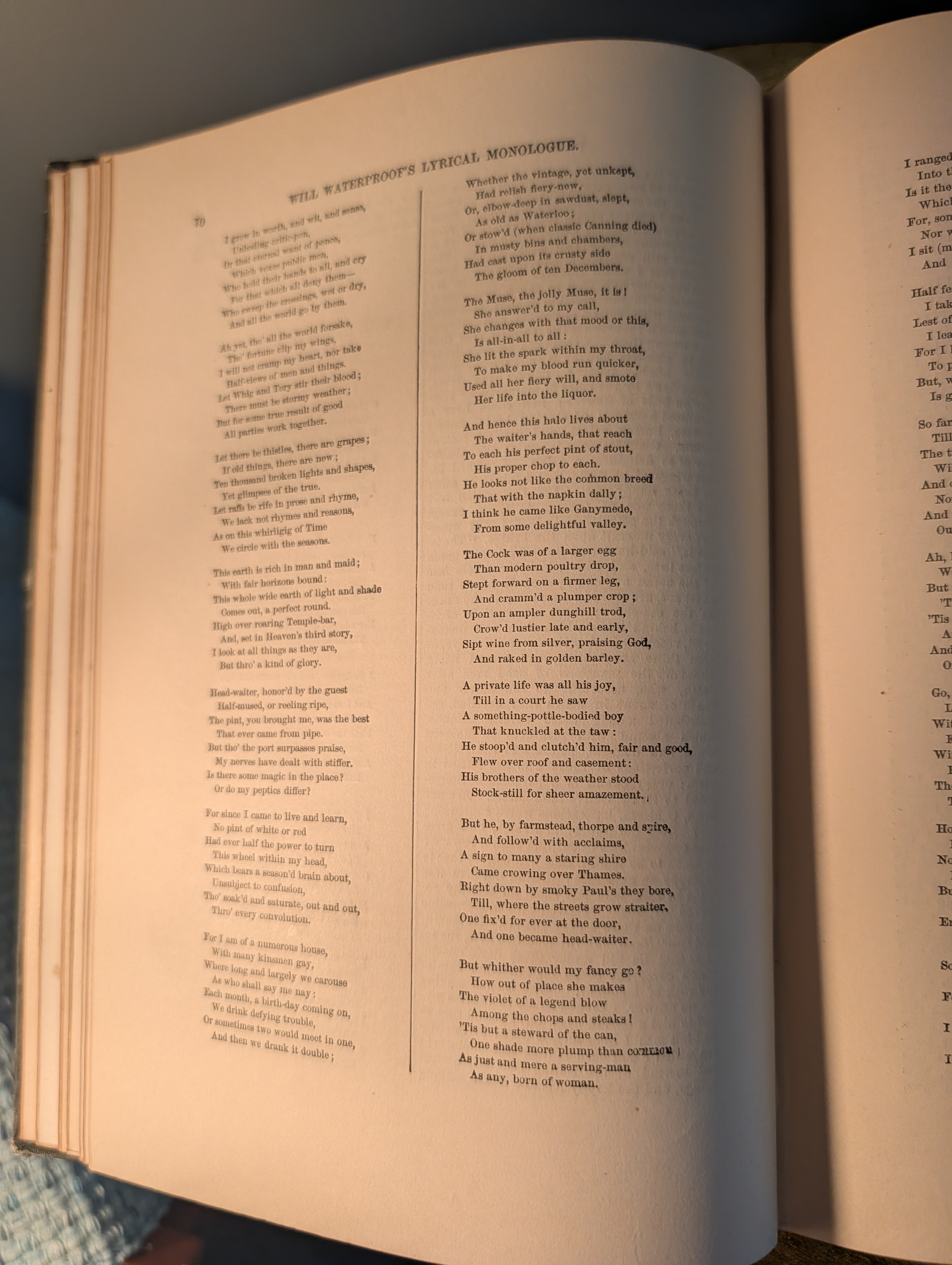
p. 70 · Will Waterproof's Lyrical Monologue, poetry page

Transcribed
Will Waterproof's Lyrical Monologue, poetry page

WILL WATERPROOF'S LYRICAL MONOLOGUE. I gave in worth, and wit, and sense, Unletting critics-pens, By that eternal want of pence, Which vexes public men, Who hold their hands to all, and cry For that which all deny them— Who sweep the crossings, wet or dry, And all the world go by them. Ah yet, tho' all the world forsake, Tho' fortune clip my wings, I will not cramp my heart, nor take Half-alms of men and things. Let Whig and Tory stir their blood; There must be stormy weather; But for some true result of good All parties work together. Let there be thistles, there are grapes; If old things, there are new; Ten thousand broken lights and shapes, Yet glimpses of the true. Let rafe be rife in prose and rhyme, We lack not rhymes and reasons, As on this whirligig of Time We circle with the seasons. This earth is rich in man and maid; With fair horizons bound: This whole wide earth of light and shade Comes out, a perfect round. High over roaring Temple-bar, And, set in Heaven's third story, I look at all things as they are, But thro' a kind of glory. Head-waiter, honor'd by the guest Half-amused, or reeling ripe, The pint, you brought me, was the best That ever came from pipe. But tho' the port surpasses praise, My nerves have dealt with stiffer. Is there some magic in the place? Or do my peptics differ? For since I came to live and learn, No pint of white or red Had ever half the power to turn This wheel within my head, Which bears a season'd brain about, Unsubject to confusion, Tho' soak'd and saturate, out and out, Thro' every convolution. For I am of a numerous house, With many kinsmen gay, Where long and largely we carouse Each month, a birth-day coming on, We drink defying trouble, Or sometimes two would meet in one, And then we drank it double; Whether the vintage, yet unkept, Had relish fiery-new, Or, elbow-deep in sawdust, slept, As old as Waterloo; Or stow'd (when classic Canning died) In musty bins and chambers, Had cast upon its crusty side The gloom of ten Decembers. The Muse, the jolly Muse, it is! She answer'd to my call, She changes with that mood or this, Is all-in-all to all: She lit the spark within my throat, To make my blood run quicker, Used all her fiery will, and smote Her life into the liquor. And hence this halo lives about The waiter's hands, that reach To each his perfect pint of stout, His proper chop to each. He looks not like the common breed That with the napkin dally; I think he came like Ganymede, From some delightful valley. The Cock was of a larger egg Than modern poultry drop, Stept forward on a firmer leg, And cramm'd a plumper crop; Upon an ampler dunghill trod, Crow'd lustier late and early, Sipt wine from silver, praising God, And raked in golden barley. A private life was all his joy, Till in a court he saw A something-pottle-bodied boy That knuckled at the taw: He stoop'd and clutch'd him, fair and good, Flew over roof and casement: His brothers of the weather stood Stock-still for sheer amazement. But he, by farmstead, thorpe and spire, And follow'd with acclaims, A sign to many a staring shire Came crowing over Thames. Right down by smoky Paul's they bore, Till, where the streets grow straiter, One fix'd for ever at the door, And one became head-waiter. But whither would my fancy go? How out of place she makes The violet of a legend blow Among the chops and steaks! 'Tis but a steward of the can, One shade more plump than common, As just and mere a serving-man As any, born of woman.

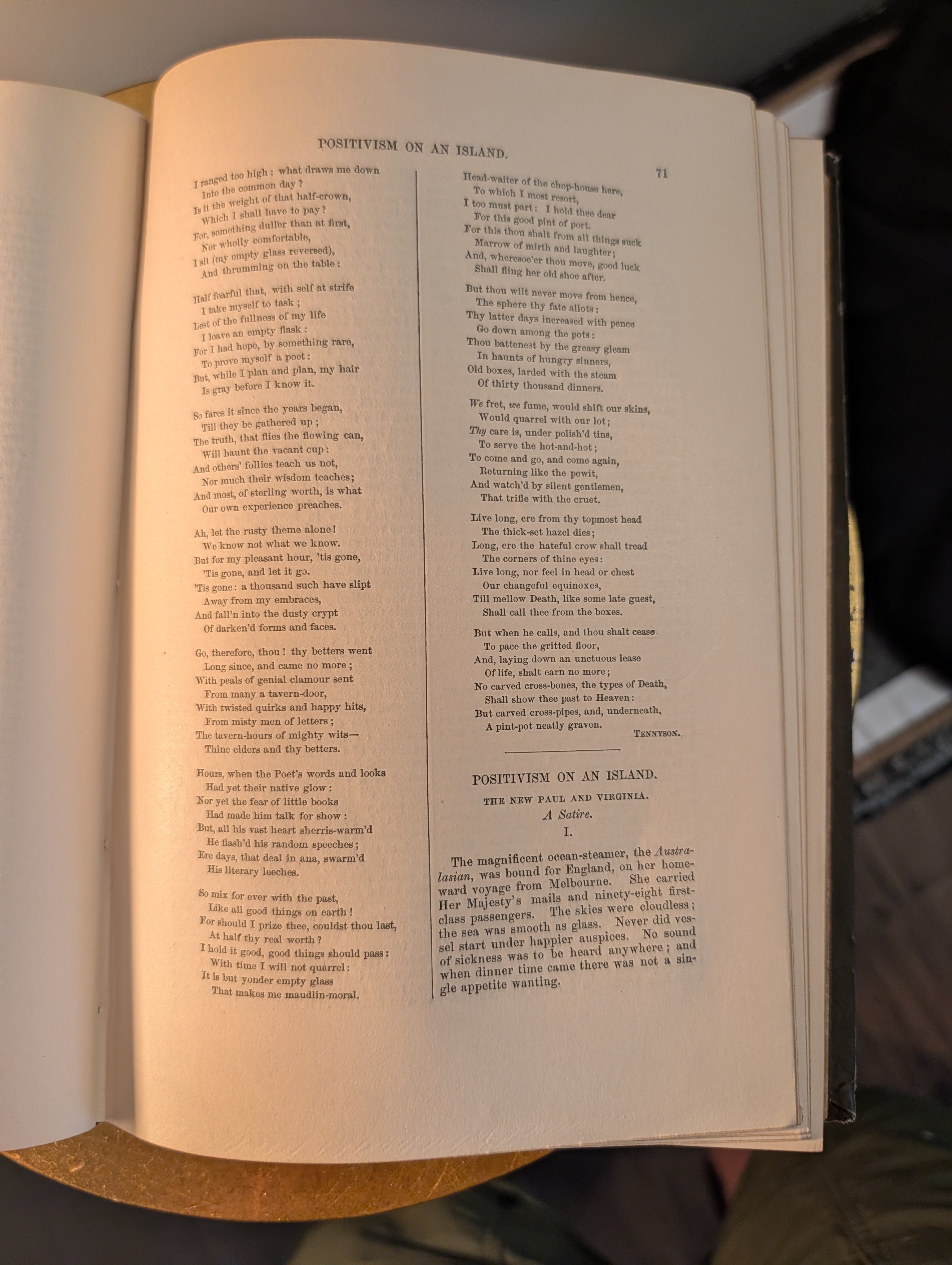
p. 69p. 71

p. 71 · Poetry by Tennyson and start of Positivism on an Island

Transcribed
Poetry by Tennyson and start of Positivism on an Island

POSITIVISM ON AN ISLAND. 71 I ranged too high : what draws me down Into the common day ? Is it the weight of that half-crown, Which I shall have to pay ? For, something duller than at first, Nor wholly comfortable, I sit (my empty glass reversed), And thrumming on the table : Half fearful that, with self at strife I take myself to task ; Lest of the fullness of my life I leave an empty flask : For I had hope, by something rare, To prove myself a poet : But, while I plan and plan, my hair Is gray before I know it. So fares it since the years began, Till they be gathered up ; The truth, that flies the flowing can, Will haunt the vacant cup : And others' follies teach us not, Nor much their wisdom teaches; And most, of sterling worth, is what Our own experience preaches. Ah, let the rusty theme alone ! We know not what we know. But for my pleasant hour, 'tis gone, 'Tis gone, and let it go. 'Tis gone : a thousand such have slipt Away from my embraces, And fall'n into the dusty crypt Of darken'd forms and faces. Go, therefore, thou ! thy betters went Long since, and came no more ; With peals of genial clamour sent From many a tavern-door, With twisted quirks and happy hits, From misty men of letters ; The tavern-hours of mighty wits— Thine elders and thy betters. Hours, when the Poet's words and looks Had yet their native glow : Nor yet the fear of little books Had made him talk for show : But, all his vast heart sherris-warm'd He flash'd his random speeches ; Ere days, that deal in ana, swarm'd His literary leeches. So mix for ever with the past, Like all good things on earth ! For should I prize thee, couldst thou last, At half thy real worth ? I hold it good, good things should pass ; With time I will not quarrel : It is but yonder empty glass That makes me maudlin-moral. Head-waiter of the chop-house here, To which I most resort, I too must part : I hold thee dear For this good pint of port. For this thou shalt from all things suck Marrow of mirth and laughter ; And, wheresoever thou move, good luck Shall fling her old shoe after. But thou wilt never move from hence, The sphere thy fate allots : Thy latter days increased with pence Go down among the pots : Thou battenest by the greasy gleam In haunts of hungry sinners, Old boxes, larded with the steam Of thirty thousand dinners. We fret, we fume, would shift our skins, Would quarrel with our lot ; Thy care is, under polish'd tins, To serve the hot-and-hot ; To come and go, and come again, Returning like the pewit, And watch'd by silent gentlemen, That trifle with the cruet. Live long, ere from thy topmost head The thick-set hazel dies ; Long, ere the hateful crow shall tread The corners of thine eyes : Live long, nor feel in head or chest Our changeful equinoxes, Till mellow Death, like some late guest, Shall call thee from the boxes. But when he calls, and thou shalt cease To pace the gritted floor, And, laying down an unctuous lease Of life, shalt earn no more ; No carved cross-bones, the types of Death, Shall show thee past to Heaven : But carved cross-pipes, and, underneath, A pint-pot neatly graven. TENNYSON. POSITIVISM ON AN ISLAND. THE NEW PAUL AND VIRGINIA. A Satire. I. The magnificent ocean-steamer, the Australasian, was bound for England, on her homeward voyage from Melbourne. She carried Her Majesty's mails and ninety-eight first-class passengers. The skies were cloudless ; the sea was smooth as glass. Never did vessel start under happier auspices. No sound of sickness was to be heard anywhere ; and when dinner time came there was not a single appetite wanting.

p. 70p. 72

p. 72 · Positivism on an Island, prose fiction content page

Transcribed
Positivism on an Island, prose fiction content page

POSITIVISM ON AN ISLAND. But the passengers soon discovered they were lucky in more than weather. Dinner was hardly half over before two of those present had begun to attract general attention ; and every one was wondering, in whispers, who they could possibly be. One of the objects of this delightful curiosity was a large-boned, middle-aged man, with gleaming spectacles, and lank, untidy hair; whose coat fitted him so ill, and who seemed to be so plain at a glance he was some great celebrity. The other was a beautiful lady of about thirty years of age. No one present had seen her like before. She had the fairest hair and the darkest eyebrows, the largest eyes and the smallest waist conceivable;—in fact, art and nature had been struggling as to which should do the most for her;—whilst her bearing was so haughty and distinguished, her glance so tender, and her dress so expensive and so fascinating, that she seemed at the same time to defy and to court attention. Evening fell on the ship with a soft, warm witchery. The air grew purple, and the stars began to glitter in the moonlight. The passengers gathered in knots upon the deck. The distinguished strangers were still the subject of conjecture. At last the secret was discovered by the wife of an old colonial judge; and the news spread like wildfire. In a few minutes all knew that there were on board the Australasian no less personages than Professor Paul Darnley and the superb Virginia St. John. II. Miss St. John had, for at least six years, been the most renowned woman in Europe. In Paris and St. Petersburg, no less than in London, her name was equally familiar both to princes and to pot-boys; the eyes of all the world were upon her. Yet in spite of this exposed situation, scandal had proved powerless to wrong her; she defied detraction. Her enemies could but echo her friends' praise of her beauty; her friends could but confirm her enemies' description of her character. Though of birth that might be called almost humble, she had been connected with the heads of many distinguished families; and so general was the affection she inspired, and so winning the ways in which she contrived to retain it, that she found herself at the age of thirty mistress of nothing except a large fortune. She was now converted with surprising rapidity by a ritualistic priest, and she became in a few months a model of piety and devotion. She made lace trimmings for the curate's vestments; she bowed at church as often and profoundly as possible; she enjoyed nothing so much as going to confession; she learnt to despise the world. Indeed, such utter dross did her riches now seem to her, that despite all the arguments of her ghostly counselor, she remained convinced that they were too worthless to offer to the Church, and she saw nothing for it but to still keep them for herself. The mingled humility and discretion of this resolve so won the heart of a gifted colonial bishop, then on a visit to England, that having first assured himself that Miss St. John was sincere in making it, he besought her to share with him his humble mitre, and make him the happiest prelate in the whole Catholic Church. Miss St. John consented. The nuptials were celebrated with the most elaborate ritual, and after a short honeymoon the bishop departed for his South Pacific diocese of the Chasuble Islands, to prepare a home for his bride, who was to follow him by the next steamer. Professor Paul Darnley, in his own walk of life was even more renowned than Virginia had been in hers. He had written three volumes on the origin of life, which he had spent seven years in looking for in infusions of hay and cheese; he had written five volumes on the entozoa of the pig, and two volumes of lectures, as a corollary to these, on the sublimity of human heroism and the whole duty of man. He was renowned all over Europe and America as a complete embodiment of enlightened modern thought. His mind was like a sea, into which the other great minds of the age discharged themselves, and in which all the slight discrepancies of the philosophy of the present century mingled together and formed one harmonious whole. He criticized everything; he took nothing on trust, except the unspeakable sublimity of the human race and its august terrestrial destinies. And in his double capacity of a seer and a savant, he had destroyed all that the world had believed in the past, and revealed to it all that it is going to feel in the future. Nor was he less successful in his own private life. He married, at the age of forty, an excellent evangelical lady, ten years his senior, who wore a green gown, grey cork-screw curls, and who had a fortune of two hundred thousand pounds. Orthodox though she was, Mrs. Darnley was yet proud beyond measure of her husband's world-wide fame, for she did but imperfectly understand the grounds of it. Indeed, the only thing that marred her happiness was the single tenet of his that she had really mastered. This, unluckily, was that he disbelieved in hell. And so, as Mrs.

p. 71p. 73

p. 73 · Story text: Positivism on an Island, section III

Transcribed
Story text: Positivism on an Island, section III

POSITIVISM ON AN ISLAND. 73 parnley conceived that that place was designed mainly to hold those who doubted its existence, she daily talked her utmost, and left no text unturned to convince her darling of his very dangerous error. These assiduous arguments soon began to tell. The Professor grew moody and brooding, and he at last suggested to his medical man that a voyage round the world unaccompanied by his wife, was the prescription most needed by his failing patience. Mrs. Darnley at length consented with a fairly good grace. She made her husband pledge himself that he would not be absent for above a twelve-month, or else, she said, she should immediately come after him. She bade him the tenderest of adieus, and promised to pray till his return for his recovery of a faith in hell. The Professor, who had but exceeded his time by six months, was now on board the Australasian, homeward bound to his wife. Virginia was outward bound to her husband. III. The sensation created by the presence of these two celebrities was profound beyond description; and the passengers were never weary of watching the gleaming spectacles and the square-toed boots of the one, and the liquid eyes and the ravishing toilettes of the other. There were three curates, who, having been very quick in making Virginia's acquaintance, soon sang at nightfall with her a beautiful vesper hymn. And so lovely did the strains sound, and so devotional did Virginia look, that most of the passengers the night after joined in a repetition of this touching evening office. The Professor, as was natural, held quite aloof; and pondered over a new species of bug, which he had found very plentiful in his berth. But it soon occurred to him that he often heard the name of God being uttered otherwise than in swearing. He listened more attentively to the sounds which he had at first set down as negro melodies: and he soon became convinced that they were something whose very existence he despised himself for remembering—namely, Christian hymns. He then thought of the three curates, whose existence he despised himself for remembering also. And the conviction rapidly dawned on him, that though the passengers seemed fully alive to his fame as a man of science, they could yet know very little of all that science had done for them; and of the death-blow it had given to the foul superstitions of the past. He therefore resolved that next day he would preach them a lay-sermon. At the appointed time the passengers gathered eagerly round him—all but Virginia, who retired to her cabin when she saw that the preacher wore no surplice; as she thought it would be a mortal sin to listen to a sermon without one. The Professor began amidst a profound silence. He first proclaimed to his hearers the great primary axiom in which all modern thought roots itself. He told them that there was but one order of things, it was so much neater than two; and if we would be certain of anything we must never doubt it. Thus, since countless things exist that the senses can take account of, it is evident that nothing exists that the senses cannot take account of. The senses can take no account of God; therefore God does not exist. Men of science can only see theology in a ridiculous light; therefore theology has no side that is not ridiculous. He then told them a few of the new names that enlightened thinkers had applied to the Christian Deity—how Professor Tyndall had called him an "atom-manufacturer," and Professor Huxley, a "pedantic drill-sergeant." The passengers at once saw how demonstrably at variance with fact was all religion, and they laughed with a sense of humor that was quite new to them. The professor's tones then became more solemn; and, having extinguished error, he proceeded to unveil the brilliant light of truth. He showed them how, viewed by modern science, all existence is a chain, with a gas at one end, and no one knows what at the other; and how Humanity is a link somewhere; but, holy and awful thought!—we can none of us tell where. "However," he proceeded, "of one thing we can be quite certain: all that is, is matter; the laws of matter are eternal, and we cannot act or think without conforming to them: and if," he said, "we would be solemn, and high, and happy, and heroic, and saintly, we have but to strive and struggle to do what we cannot for an instant avoid doing. Yes," he exclaimed, "as the sublime Tyndall tells us, let us struggle to attain to a deeper knowledge of matter, and a more faithful conformity to its laws!" The Professor would have proceeded; but the weather had been rapidly growing rough and he here became violently sea-sick. "Let us," he exclaimed hurriedly, "conform to the laws of matter and go below." Nor was the advice premature. A storm arose, exceptional in its suddenness and its fury. It raged for two days without ceasing. The Australasian sprang a leak; her steering gear was disabled; and it was feared she would go ashore on an island that was seen

p. 72p. 74

p. 74 · Text page from 'Positivism on an Island', sections IV and V

Transcribed
Text page from 'Positivism on an Island', sections IV and V

POSITIVISM ON AN ISLAND. 74 dimly through the fog to the leeward. The boats were got in readiness. A quantity of provisions and of the passengers' baggage was already stowed in the cutter; when the clouds parted, the sun came out again, and the storm subsided almost as quickly as it arose. IV. No sooner were the ship's damages in a fair way to be repaired than the Professor resumed his sermon. He climbed into the cutter, which was still full of the passengers' baggage, and sat down on the largest of Virginia's boxes. This so alarmed Virginia that she followed the Professor into the cutter to keep an eye on her property; but she did not forget to stop her ears with her fingers, that she might not be guilty of listening to an un-surpliced minister. The Professor took up the thread of his discourse just where he had broken it off. Every circumstance favoured him. The calm sea was sparkling under the gentlest breeze; all Nature seemed suffused with gladness; and at two miles' distance was an enchanting island, green with every kind of foliage, and glowing with the hues of a thousand flowers. The Professor, having reminded his hearers of what nonsense they now thought all the Christian teachings, went on to show them the blessed results of this. Since the God that we once called all-holy is a fable, that Humanity is all-holy must be a fact. Since we shall never be sublime, and solemn, and unspeakably happy hereafter, it is evident that we can be sublime, and solemn, and unspeakably happy here. "This," said the Professor, "is the new Gospel. It is founded on exact thought. It is the gospel of the kingdom of man; and had I only here a microscope and a few chemicals, I could demonstrate its eternal truth to you. There is no heaven to seek for; there is no hell to shun. We have nothing to strive and live for except to be unspeakably happy." This eloquence was received with enthusiasm. The captain in particular, who had a wife in every port he touched at, was overjoyed at hearing that there was no hell; and he sent for all his crew, that they might learn the good news likewise. But soon the general gladness was marred by a sound of weeping. Three-fourths of the passengers, having had time to reflect a little, began claiming that as a matter of fact they were really completely miserable, and that for various reasons they could never be anything else. "My friends," said the Professor, quite undaunted, "that is doubtless completely true. You are not happy now; you probably never will be. But that is of little moment. Only conform faithfully to the laws of matter, and your children's children will be happy in the course of a few centuries; and you will like that far better than being happy yourselves. Only consider the matter in this light, and you yourselves will become happy also; and whatever you say, and whatever you do, think only of the effect it will have five hundred years afterwards." At these solemn words, the anxious faces grew calm. An awful sense of the responsibility of each one of us, and the infinite consequences of every human act, was filling the hearts of all; when by a faithful conformity to the laws of matter, the boiler blew up, and the Australasian went down. In an instant the air was rent with yells and cries; and all the Humanity that was on board the vessel was busy, as the Professor expressed it, uniting itself with the infinite azure of the past. Paul and Virginia, however, floated quietly away in the cutter, together with the baggage and provisions. Virginia was made almost senseless by the suddenness of the catastrophe; and on seeing five sailors sink within three yards of her, she fainted dead away. The Professor begged her not to take it so much to heart, as these were the very men who had got the cutter in readiness; "and they are therefore," he said, "still really alive in the fact of our happy escape." Virginia, however, being quite insensible, the Professor turned to the last human being still to be seen above the waters, and shouted to him not to be afraid of death, as there was certainly no hell, and that his life, no matter how degraded and miserable, had been a glorious mystery, full of infinite significance. The next moment the struggler was snapped up by a shark. The cutter, meanwhile, borne by a current, had been drifting rapidly towards the island. And the Professor, spreading to the breeze Virginia's beautiful lace parasol, soon brought it to the shore on a beach of the softest sand. V. The scene that met Paul's eyes as he landed was one of extreme loveliness. He had run the boat ashore in a little fairy bay, full of translucent waters, and fringed with silvery sands. On either side it was protected by fantastic rocks, and in the middle it opened inland to an enchanting valley, where tall tropical trees made a grateful shade, and where the ground was carpeted with the softest moss and turf. Paul's first care was for his fair companion.

p. 73p. 75

p. 75 · Prose content page from 'Positivism on an Island'

Transcribed
Prose content page from 'Positivism on an Island'

POSITIVISM ON AN ISLAND. 75 He spread a costly cashmere shawl on the beach, and placed her, still fainting, on this. In a few moments she opened her eyes; but was on the point of fainting again as the horrors of the last half-hour came back to her, when she caught sight in the cutter of the largest of her own boxes, and she began to recover herself. Paul begged her to remain quiet while he went to reconnoitre. He had hardly proceeded twenty yards into the valley, when to his infinite astonishment he came on a charming cottage, built under the shadow of a broad tree, with a broad verandah, plate-glass windows, and red window-blinds. His first thought was that this could be no desert island at all, but some happy European settlement. But on approaching the cottage, it proved to be quite untenanted, and from the cobwebs woven across the doorway it seemed to have been long abandoned. Inside there was abundance of luxurious furniture; the floors were covered with gorgeous Indian carpets; and there was a pantry well stocked with plate and glass and table-linen. The Professor could not tell what to make of it, till, examining the structure more closely, he found it composed mainly of a ship's timbers. This seemed to tell its own tale; and he at once concluded that he and Virginia were not the first castaways who had been forced to make the island for some time their dwelling-place. Overjoyed at this discovery, the Professor hastened back to Virginia. She was by this time quite recovered, and was kneeling on the cashmere shawl, with a rosary in her hands designed especially for the use of Anglo-Catholics, and was alternately lifting up her eyes in gratitude to Heaven, and casting them down in anguish at her torn and crumpled dress. The poor Professor was horrified at the sight of a human being in this degrading attitude of superstition. But as Virginia quitted it with alacrity as soon as ever he told his news to her, he hoped he might soon convert her into a sublime and holy Utilitarian. The first thing she besought him to do was to carry her biggest box to this charming cottage, that she might change her clothes, and appear in something fit to be seen in. The Professor most obligingly at once did as she asked him; and whilst she was busy at her toilette, he got from the cutter what provisions he could, and proceeded to lay the table. When all was ready, he rang a gong which he found suspended in the lobby; Virginia appeared shortly in a beautiful pink dressing-gown, embroidered with silver flowers; and just before sunset, the two sat down to a really excellent meal. The bread-tree at the door of the cottage contributed some beautiful French rolls; close at hand also they discovered a butter-tree; and the Professor had produced from the cutter a variety of salt and potted meats, pâté-de-foie-gras, cakes, preserved fruit, and some bottles of fine champagne. This last helped much to raise their spirits. Virginia found it very dry, and exactly suited to her palate. She had but drunk five glasses of it, when her natural smile returned to her, though she was much disappointed because Paul took no notice of her dressing-gown; and when she had drunk three glasses more, she quietly went to sleep on the sofa. The moon had by this time risen in dazzling splendour; and the Professor went out and lighted a cigar. All during dinner there had been a feeling of dull despair in his heart, which even the champagne did not dissipate. But now, as he surveyed in the moonlight the wondrous Paradise in which his strange fate had cast him, his mood changed. The air was full of the scents of a thousand night-smelling flowers; the sea murmured on the beach in soft, voluptuous cadences. The Professor's cigar was excellent. He now saw his situation in a truer light. Here was a bountiful island, where earth unbidden brought forth all her choicest fruits; and most of the luxuries of civilization had already been wafted thither. Existence here seemed to be purified from all its evils. Was not this the very condition of things which all the sublimest and exactest thinkers of modern times had been dreaming and lecturing, and writing books about for a good half-century? Here was a place where Humanity could do justice to itself, and realize those glorious destinies which all exact thinkers take for granted must be in store for it. True, from the mass of Humanity he was completely cut away; but Virginia was his companion. Holiness, and solemnity, and unspeakably significant happiness, did not, he argued, depend on the multiplication table. He and Virginia represented Humanity as well as a million couples. They were a complete Humanity in themselves, and Humanity in a perfectible shape; and the very next day they would make preparations for fulfilling their holy destiny, and being as solemnly and unspeakably happy as it was their stern duty to be. The Professor turned his eyes upwards to the starry heavens; and a sense came over him of the eternity and the immensity of Nature, and the demonstrable absence of any intelligence that guided it. These reflections naturally brought home to him with more vividness the stupendous and boundless importance of Man. His bosom swelled violently; and he cried aloud, his

p. 74p. 76

p. 76 · Positivism on an Island, section VI, prose narrative

Transcribed
Positivism on an Island, section VI, prose narrative

POSITIVISM ON AN ISLAND. eyes still fixed on the firmament, "Oh, important All! oh, important Me!" When he came back to the cottage, he found Virginia just getting off the sofa, and preparing to go off to bed. She was too sleepy even to say good-night to him, and with evident want of temper was tugging at the buttons of her dressing-gown. "Ah," she murmured as she left the room, "if God, in his infinite mercy, had only spared my maid!" Virginia's evident discontent gave profound pain to Paul. "How solemn," he exclaimed, "for half Humanity to be discontented!" But he was still more disturbed at the appeal to a chimerical manufacturer of atoms; and he exclaimed, in yet more sorrowful tones, "How solemn for half Humanity to be sunk lower than the beasts by superstition!" However, he hoped that these stupendous evils might, under the present favourable conditions, vanish in the course of a few days' progress; and he went to bed, full of august auguries. VI. Next morning he was up betimes; and the prospects of Humanity looked more glorious than ever. He gathered some of the finest pats from the butter-tree, and some fresh French rolls from the bread-tree. He discovered a cow close at hand, that allowed him at once to milk it; and a little roast pig ran up to him out of the underwood, and fawning on him with its trotters, said, "Come, eat me." The Professor vivisected it before Virginia's door, that its automatic noise, which the vulgar call cries of pain, might awaken her; and he then set it in a hot dish on the table. "It has come! it has come!" he shouted, rapturously, as Virginia entered the room, this time in a blue silk dressing-gown, embroidered with flowers of gold. "What has come?" said Virginia, pettishly, for she was suffering from a terrible headache, and the Professor's loud voice annoyed her. "You don't mean to say that we are rescued, are we?" "Yes," answered Paul, solemnly; "we are rescued from all the pains and imperfections of a world that has not learnt how to conform to the laws of matter, and is but imperfectly acquainted with the science of sociology. It is therefore inevitable that, the evils of existence being thus removed, we shall both be solemnly, stupendously, and unspeakably happy." "Nonsense!" said Virginia, snappishly, who thought the Professor was joking. "It is not nonsense," said the Professor. "It is deducible from the teachings of John Stuart Mill, of Auguste Comte, of Mr. Frederic Harrison, and of all the exact thinkers who have cast off superstition, and who adore Humanity." Virginia meanwhile ate pâté-de-foie-gras, of which she was passionately fond; and, growing a little less sullen, she at last admitted that they were lucky in having at least the necessaries of life left to them. "But as for happiness—there is nothing to do here, there is no church to go to, and you don't seem to care a bit for my dressing-gown. What have we got to make us happy?" "Humanity," replied the Professor eagerly, —"Humanity, that divine entity, which is of course capable of everything that is fine and invaluable, and is the object of indescribable emotion to all exact thinkers. And what is Humanity?" he went on more earnestly, "You and I are Humanity—you and I are that august existence. You already are all the world to me; and I very soon shall be all the world to you. Adored being, it will be my mission and my glory to compel you to live for me. And then, as modern philosophy can demonstrate, we shall both of us be significantly and unspeakably happy." For a few moments Virginia merely stared at Paul. Suddenly she turned quite pale, her lips quivered, and exclaiming, "How dare you!—and I, too, the wife of a bishop!" she left the room in hysterics. The Professor could make nothing of this. Though he had dissected many dead women, he knew very little of the hearts of live ones. A sense of shyness overpowered him. He felt embarrassed, he could not tell why, at being thus left alone with Virginia. He lit a cigar, and went out. Here was a to-do indeed, he thought. How would progress be possible if one half of Humanity misunderstood the other? He was thus musing, when suddenly a voice startled him; and in another moment a man came rushing up to him, with every demonstration of joy. "Oh, my dear master! oh, emancipator of the human intellect! and is it indeed you? Thank God!——I beg pardon for my unspeakable blasphemy—I mean, thank circumstances over which I have no control." It was one of the three curates, whom Paul had supposed drowned, but who now related how he had managed to swim ashore, despite the extreme length of his black clerical coat. "These rags of superstition," he said, "did their best to drown me. But I survive in spite of them, to covet truth and to reject error. Thanks to your glorious

p. 75p. 77

p. 77 · Claude-tidied (AI summary of a hard-to-OCR leaf)

AI summary
Claude-tidied (AI summary of a hard-to-OCR leaf)

Positivism on an Island (W. H. Mallock). In this satire the Professor, Paul, and Virginia rhapsodize in mock-solemn terms over the religion of Humanity (Comtean positivism), groaning with reverence at the very word. They then set up house on the island — unpacking the Professor's busts of philosophers, boxes of essays, music, wine, and provisions — as he proclaims that material progress has ended and moral progress just begun.

p. 76p. 78

p. 78 · Prose fiction content, 'Positivism on an Island', section IX

Transcribed
Prose fiction content, 'Positivism on an Island', section IX

POSITIVISM ON AN ISLAND. woman, dripping with sea-water, and with an expression on her face of the utmost misery. They soon recognized her as one of the passengers of the ship. She told them how she had been floated ashore on a spar, and how she had been sustained by a little roast pig, that kindly begged her to eat it, having first lain in her bosom to restore her to warmth. She was now looking for her son. "And if I cannot find him," said the old woman, "I shall never smile again. He has half broken my heart," she went on, "by his wicked ways. But if I thought he was dead —dead in the midst of his sins, it would be broken altogether; for in that case he must certainly be in hell." "Old woman," said the Professor, very slowly and solemnly, "be comforted. I announce to you that your son is alive." "Oh, bless you, sir, for that word!" cried the old woman. "But where is he? Have you seen him? Are you sure that he is living?" "I am sure of it," said the Professor, "because enlightened thought shows me that he cannot be anything else. It is true that I saw him sink for a third time in the sea, and that he was then snapped up by a shark. But he is as much alive as ever in his posthumous activities. He has made you wretched mous activities. He has made you wretched after him; and that is his future life. Become an exact thinker, and you will see that this is so. Old woman," added the Professor, solemnly, "you are your son in hell." At this the old woman flew into a terrible rage. "In hell, sir!" she exclaimed; "me in hell!—a poor lone woman like me! How dare you!" And she sank back in a chair and fainted. "Alas!" said the Professor, "thus is misery again introduced into the world. A fourth part of Humanity is now miserable." The curate answered promptly that if no restoratives were given her, she would probably die in a few minutes. "And to let her die," he said, "is clearly our solemn duty. It will be for the greatest happiness of the greatest number." "No," said the Professor; "for our sense of pity would then be wounded, and the happiness of all of us would be marred by that." "Excuse me," said the curate; "but exact thought shows me that pity for others is but the imagining of their misfortune falling on ourselves. Now, we can none of us imagine ourselves exactly in the old woman's case; therefore it is quite impossible that we can pity her." "But," said the Professor, "such an act would violate our ideas of justice." "You are wrong again," said the curate; "for exact thought shows me that the love of justice is nothing but the fear of suffering injustice. If we were to kill strong men, we might naturally fear that strong men would kill us. But whatever we do to fainting old women, we cannot expect that fainting old women will do anything to us in return." "Your reasoning cannot be sound," said the Professor, "for it would lead to the most horrible conclusions. I will solve the difficulty better. I will make the old woman happy, and therefore fit to live. Old woman," he exclaimed, "you are yourself by your own unhappiness expiating your son's sins. Do but think of that, and you will become unspeakably happy." Meanwhile, however, the old woman had died. When the Professor discovered this he was somewhat shocked; but at length with a sudden change of countenance, "We neither of us did it," he exclaimed, "her death is no act of ours. It is part of the eternal not-ourselves that makes for righteousness—righteousness, which is, as we all know, but another name for happiness. Let us adore the event with reverence." "Yes," said the curate, "we are well rid of her. She was an immoral old woman; for happiness is the test of morality, and she was very unhappy." "On the contrary," said the Professor, "she was a moral old woman; for she made us happy by dying so very opportunely. Let us speak well of the dead. Her death has been a holy and a blessed one. She has conformed to the laws of matter. Thus is unhappiness destined to fade out of the world. Quick! let us tie a bag of shot to all the sorrow and evil of Humanity, which, after all, is only a fourth part of it; and let us sink her in the bay close at hand, that she may catch lobsters for us." IX. "At last," said the Professor, as they began dinner that evening, "the fulness of time has come. All the evils of humanity are removed, and progress has come to an end because it can go no further. We have nothing now to do but to be unspeakably and significantly happy." The champagne flowed freely. Our friends ate and drank of the best, their spirits rose; and Virginia admitted that this was really "jolly." The sense of the word pleased the Professor, but its sound seemed below the gravity of the occasion; so he begged her to say "sublime" instead. "We can make it mean," he said, "just the same, but we prefer it for the sake of its associations."

p. 77p. 79

p. 79 · Positivism on an Island, section X, prose fiction

Transcribed
Positivism on an Island, section X, prose fiction

POSITIVISM ON AN ISLAND. It soon, however, occurred to him that eating and drinking were hardly delights sufficient to justify the highest state of human emotion; and he began to fear he had been feeling sublime prematurely; but in another moment he recollected he was an altruist, and that the secret of their happiness was not that any one of them was happy, but that they each knew the others were. "Yes, my dear curate," said the Professor, "what I am enjoying is the champagne that you drink, and what you are enjoying is the champagne that I drink. This is altruism; this is benevolence; this is the sublime outcome of enlightened modern thought. The pleasures of the table, in themselves, are low and beastly ones; but if we each of us are only glad because the others are enjoying them, they become holy and glorious beyond description." "They do," cried the curate rapturously, "indeed they do! I will drink another bottle for your sake. It is sublime!" he said as he tossed off three glasses. "It is significant!" he said as he finished three more. "Tell me, my dear, do I look significant?" he added, as he turned to Virginia, and suddenly tried to crown the general bliss by kissing her. Virginia started back, looking fire and fury at him. The Professor was completely astounded by an occurrence so unnatural, and exclaimed in a voice of thunder, "Morality, sir,—remember morality! How dare you upset that which Professor Huxley tells us must be for ever strong enough to hold its own?" But the last glass of champagne had put the curate beyond the reach of exact thought. He tumbled under the table, and the Professor carried him off to bed. X. The Professor, like most serious thinkers, knew but little of that trifle commonly called "the world." He had never kissed any one except his wife; even that he did as seldom as possible; and the curate lying dead drunk was the first glimpse he had of what, par excellence, is called "life." But though the scene just described was thus a terrible shock to him, in one way it gave him an unlooked-for comfort. He felt that even yet things were not quite as sublime as they should be. He now saw the reason. "Of course," he said, "existence cannot be perfect, so long as one third of Humanity makes a beast of itself. A little more progress is still necessary." He hastened to explain this next morning to Virginia, and begged her not to be alarmed at the curate's scandalous conduct. "Immorality," he said, "is but a want of success in attaining our own happiness. It is evidently most immoral for the curate to be kissing you; and therefore kissing you won't really conduce to his happiness. I will convince him of this solemn truth in a very few moments. Then the essential dignity of human nature will become at once apparent, and we shall all of us at last begin to be unspeakably happy." The curate, however, altogether declined to be convinced. He maintained stoutly that to kiss Virginia would be the greatest pleasure that Humanity could offer him. "And if it is immoral as well as pleasant," he added, "I should like it all the better." At this the Professor gave a terrible groan; he dropped almost fainting into a chair; he hid his face in his hands; and murmured half-articulately, "Then I can't tell what to do!" In another instant, however, he recovered himself; he fixed a dreadful look on the curate, and said, "That last statement of yours cannot be true; for if it were, it would upset all my theories. It is a fact that can be proved and verified, that if you kissed Virginia it would make you miserable." "Pardon me," said the curate, rapidly moving towards her, "your notion is a remnant of superstition; I will explode it by a practical experiment." The Professor caught hold of the curate's coat-tails, and forcibly pulled him back into his seat. "If you dare attempt it," he said, "I will kick you soundly, and, shocking, immoral man! you will feel miserable enough then." The curate was a terrible coward, and very weak as well. "You are a great hulking fellow," he said, eyeing the Professor; "and I am of a singularly delicate build. I must, therefore, conform to the laws of matter, and give in." He said this in a very sulky voice; and, going out of the room, slammed the door after him. A radiant expression suffused the face of the Professor. "See," he said to Virginia, "the curate's conversion is already half accomplished. In a few hours more he will be rational, he will be moral, he will be solemnly and significantly happy." The Professor talked like this to Virginia the whole morning; but in spite of all his arguments she declined to be comforted. "It is all very well," she said, "whilst you are in the way. But as soon as your back is turned, I know he will be at me again." "Will you never," said Paul, by this time a little irritated, "will you never listen to

p. 78p. 80

p. 80 · Content page from 'Positivism on an Island' story

Transcribed
Content page from 'Positivism on an Island' story

POSITIVISM ON AN ISLAND. 80 "Idiot!" said the Professor. "Virginia is another man's wife. Nobody really kissing another man's wife; nor do likes kissing anyone except their wives ever like kissing—really like is what Professor Huxley calls the undefined but bright ideal of the highest good,' which, as he says, exact thought shows us the end of existence. But, pooh! what is the use of all this talking? You know which way your higher nature calls you; and, of course, unless men believe in God, they cannot help obeying their higher nature." "I," said the curate, "think the belief in God a degrading superstition; I think every one an imbecile who believes a miracle possible." "And yet I do not care two straws about the highest good. What you call my lower nature is best of my ability; and I prefer culture to be far the strongest; I mean to follow it to the best, my higher, for the sake of associating it, my higher, for the sake of the associations." This plunged the Professor in deeper grief than ever. He knew not what to do. He paced up and down the verandah, or about the rooms, and moaned and groaned as if he had a violent toothache. Virginia and the curate asked what was amiss with him. "I am agonizing," he said, "for the sake of holy, solemn, unspeakably dignified Humanity." The curate, seeing the Professor thus dejected, by degrees took heart again; and as Virginia still continued her fascinating behaviour to him, he resolved to try and prove to her that, the test of morality being happiness, the most moral thing she could do would be to allow him to kiss her. No sooner had he begun to propound these views, than the Professor gave over his groaning, seized the curate by the collar, and dragged him out of the room with a roughness that nearly throttled him. "I was but propounding a theory—an opinion," gasped the curate. "Surely thought is free. You will not persecute me for my opinions?" "It is not for your opinions," said the Professor, "but for the horrible effect they might have. Virginia doesn't want to hear morality is. Virginia doesn't, want You can only tolerate opinions that have no possible consequence. You may promulgate any of those as much as you like; because to do that would be a self-regarding action." XI. At dinner, however, things wore a more promising aspect. The curate had been so terrified by the Professor's look at Virginia; hardly dared so much he drank an unusual and to make up for it, which soon set him quantity of champagne, at a rate that was laughing and clattering quite extraordinary. Virginia began to fear that, as Paul said, he really did so much care to kiss her after all. She therefore put on all her most enticing ways; she talked, flirted, and smiled her best, and made her most effective eyes, that the curate might see what a prize was for ever beyond his reach. Paul thought the state of affairs full of glorious promise. Virginia's tears were dried, she had never looked so radiant and exquisite before. The curate had foregone every attempt to kiss Virginia, and yet he seemed happiness itself. The Professor took the latter aside, as soon as the meal was over, to congratulate him on the natural growth the curate thought had conducted him. "You see," he said, "a natural growth the to best morality is. Virginia doesn't want to be kissed by you. I should be shocked at your doing so shocking a thing as kissing her. If you kissed her, you would make both of yourselves; and, as a necessary consequence of us tion would be in an agony likewise; in addition, which I should inevitably kick you." "Virginia," said the curate, "I suppose I kissed lay on the sly—I merely put this as an while, remember,—and that in a little would that liked it, what the, She and I would both be happy; and then happy too, because we were." XII. "Well," said the curate, "if I may not kiss Virginia, I will drink brandy instead. That will make me happy enough; and then we shall all be happy. He soon put his resolve into practice. He got a bottle of brandy, he sat himself down

p. 79p. 81

p. 81 · Page 81, 'Positivism on an Island,' section XIII

Transcribed
Page 81, 'Positivism on an Island,' section XIII

POSITIVISM ON AN ISLAND. under a palm-tree, and told the Professor he was going to make an afternoon of it. "Foolish man!" said the Professor; "I was never drunk myself, it is true; but I know that to get drunk makes one's head ache horribly. To get drunk is, therefore, horribly immoral; and therefore I cannot permit it." "Excuse me," said the curate; "it is a self-regarding action. Nobody's head will ache but mine; so that is my own lookout. I have been expelled from school, college, and from my first curacy for drinking. So I know well enough the balance of pains and pleasures." Here he pulled out his brandy bottle, and applied his lips to it. "Oh, Humanity!" he exclaimed, "how solemn this brandy tastes!" Matters went on like this for several days. The curate was too much frightened to again approach Virginia. Virginia at last became convinced that he did not care about kissing her. Her vanity was wounded, and she became sullen; and this made the Professor sullen also. In fact, two-thirds of Humanity were overcast with gloom. The only happy section of it was the curate, who alternately smoked and drank all day long. "The nasty little beast!" said Virginia to the Professor; "he is nearly always drunk. I am beginning quite to like you, Paul, by comparison with him. Let us turn him out, and not let him live in the cottage." "No," said the Professor; "for he is one third of Humanity. You do not properly appreciate the solidarity of mankind. His existence, however, I admit is a great difficulty." One day at dinner, however, Paul came in radiant. "Oh holy, oh happy event!" he exclaimed; "all will go right at last." Virginia inquired anxiously what had happened, and Paul informed her that the curate, who had got more drunk than usual that afternoon, had fallen over a cliff, and been dashed to pieces. "What event," he asked, "could be more charming—more unspeakably holy? It bears about it every mark of sanctity. It is for the greatest happiness of the greatest number." "Come," he continued, "let us begin our love-feast. Let us each seek the happiness of the other. Let us instantly be sublime and happy." XIII. "Let us prepare ourselves," said Paul solemnly, as Lucy sat down to dinner, "for Vol. I. realizing to the full the essential dignity of Humanity—that grand etre, which has come, and me. Every condition of happiness that modern thinkers have dreamed of is now fulfilled. We have but to seek each the happiness of the other, and we shall both be in a solemn, a significant, and unspeakable state of rapture. See, here is an exquisite leg of mutton. I," said Paul, who liked the fat best, "will give up all the fat to you." "And I," said Virginia resignedly, "will give up all the lean to you. So I A few mouthfuls made Virginia feel sick. "I confess," she said, "I can't get on with this fat." "I confess," the Professor answered, "I don't exactly like this lean." "Then let us," said Virginia, "be like Jack Sprut and his wife." "No," said the Professor, meditatively, "that is quite inadmissible. For in that case we should be egoistic hedonists. However, for to-day it shall be as you say. I will think of something better to-morrow." Next day he and Virginia had a chicken apiece; only Virginia's was put before Paul, and Paul's before Virginia; and they each walked round the table to supply each other with the slightest necessaries. "Ah!" cried Paul, "this is altruism indeed. I think already I can feel the sublimity beginning." Virginia liked this rather better. But soon she committed the sin of taking for herself the liver of Paul's chicken. As soon as she had eaten the whole of it her conscience began to smite her. She confessed her sin to Paul, and inquired, with some anxiety, if he thought she would go to hell for it. "Meanphorically," said Paul, "you have already done so. You are punished by the loss of the pleasure you would have had in giving that liver to me, and also by your knowledge that my knowledge of your folly in foregoing the pleasure." Virginia was much relieved by this answer; she at once took several more happy in the sor's choicest bits, and was exalted in the thought that her sins were atoned. by the latent very act of their contrition they were attended pain she felt persuaded sufficient, she took Feeling that this disapproval to her care not to add Paul told him again. punishment, she ne this practice of altruism For a short time seemed to Virginia Professor was always exclaiming, "How significant is human life by But though the very nature of its constitution!" she the very soon found it a trifle dull. Luckily,

p. 80next

content · Two-page spread of 'Positivism on an Island' fiction text

Transcribed
Two-page spread of 'Positivism on an Island' fiction text

POSITIVISM ON AN ISLAND. however, she lit upon a new method of exercising her originality, and, a yet more solemn sign of grace, she got more solemn sig- nificant of of giving a yet more solemn sig- nificance. The Professor having by some acre to grow face higheagerness had begun them once, to hit up with an expression of trium- phant eagerness. "The missing link!" he exclaimed, "the missing link at last! Thank God—heaven—I mean, thank circumstances profusely; I beg pardon for my unspeakable blasphemy, I have no control. I must this over which assured him it the consented. "Oh, Paul at first giggled, blushed, and at last, as Virginia the consoled him it some pack till I know that I will not instant decision will make you come back till I know that I will not it." "This Pack" she exclaimed when the fell at Paul's feet weeping, and besought him come was a fearful blow to Virginia. She in piteous accents that he would not thus abandon her. "I must," said the Professor, solemnly; "for I am going in pursuit of truth. To arrive at Truth is man's perfect and most rapturous happiness. You must surely know that, even if I have forgotten to tell it to you. To pursue truth—holy truth for holy truth's sake—is a more solemn pleasure than even frizzling your hair." "Oh," cried Virginia, hysterically, "I don't care two straws for truth. What on earth is the good of it?" "It is its own end," said the Professor. "It is its own exceeding great reward. I must be off in search of it. Good-bye for the present. Seek truth on your own ac- count, and be unspeakably happy also, be- cause you know that I am seeking it." The Professor remained away for three days. For the first two of them Virginia was inconsolable. She wandered about mournfully with her head dejected. She very often sighed; at last she very often uttered the name of Paul. At last she surprised herself by exclaiming aloud to the irresponsible soli- tude, "Oh, Paul, until you were gone, I never knew how passionately I loved you!" No sooner were those words out of her mouth than she stood still, horror-stricken. "Alas!" she cried, "and have I really come to this! I am in a state of deadly sin, and there is no priest here to confess to! I must conquer my forbidden love as best I may. But, ah me, what am I? But, al- As she uttered these words, her eyes fell on a tin box of the Professor's marked "Pri- vate," which he always kept carefully locked and which had before now excited her curi- osity. Suddenly she became conscious of a new impulse. "I will pursue truth," she exclaimed. "I will break that box open, and I will see what is inside it. Ah!" she added, as with the aid of the poker she at XIV. Matters now went on charmingly. All ex- istence seemed to take a richer colouring, and there was something, Paul said, which and Professor Tyndall's words said, which, and tone to it, but which gave fulness analyze nor comprehend. But at last a twinge came. One morning, whilst Virginia was arranging Paul's mustachios, she was frightened almost into a fit by a sudden ap- parition at the window. It was a hideous baby in a momer, perfectly naked but for a band of figure, perfectly naked but for a band a momer which it wore round its neck. For a moment it did nothing round its neck. For Suddenly it woke Paul by grin and stared; then it flung into Virginia's lap a filthy piece

p. 81p. 83

p. 83 · Positivism on an Island, chapter XV prose text

Transcribed
Positivism on an Island, chapter XV prose text

POSITIVISM ON AN ISLAND. last wrenched off the padlock, "Paul may be right after all. There is more interest in the pursuit of truth than I thought there was." The box was full of papers, letters, and diaries, the greater part of which were marked "Strictly private." Seeing this, Virginia's appetite for truth became keener than ever. She instantly began her researches. The more she read, the more eager she became; and the more private appeared the nature of the documents, the more insatiable did her thirst for truth grow. To her extreme surprise, she gathered that the Professor had begun life as a clergyman. There were several photographs of him in his surplice; and a number of devout prayers apparently composed by himself for his own personal use. This discovery was the result of her labours. "Certainly," she said, "it is one of extreme significance. If Paul was a priest now. Orders are indelible—at least in the Church of England I know they are." XV. Paul came back, to Virginia's extreme relief without the missing link. But he was still radiant in spite of his failure; for he had discovered, he said, a place where the creature had apparently slept, and he had collected in a card-paper box a large number of its parasites. "I am glad," said Virginia, "that you have not found the missing link: though as to thinking that we really came from monkeys, of course that is too absurd. Now if you could have brought me a nice monkey, I should really have liked that. The Bishop has promised that I shall have a darling one, if I ever reach him—a me!—if—Paul." continued Virginia, in a very solemn voice, after a long pause, "do you know that whilst you have been away I have been pursuing truth? I rather liked it; and I found it very, very significant." "Oh, joy!" exclaimed the Professor. "Oh, unspeakable radiance! Oh holy, oh essentially dignified Humanity! it will very soon be perfect. Tell me, Virginia, what truths have you been discovering?" "One truth about you," said Paul," said Virginia, very gravely, "and a truth about me. I burn—oh I burn to tell them to you; but one half of it was entrusted to me that one half of Humanity had been studying human nature, and began asking Virginia if her discoveries belonged to the domain of historical or biological science. Meanwhile Virginia had flung herself on her knees before him, and was exclaiming in piteous accents— "By my fault, by my own fault, by my very grievous fault, holy father, I confess to you—" "Is the woman mad?" cried the Professor, starting up from his seat. "You are a priest, Paul," said Virginia; "that is one of the things I have discovered; I am in a state of deadly sin; that is the other; and I must and will confess to you. Once a priest, always a priest. You cannot get rid of your orders, and you must and shall hear me." "I was once in orders, it is true," said Paul, reluctantly; "but how did you find out my miserable secret?" "In my zeal for truth," said Virginia, "I broke open your tin box; I read all your letters; I looked at your early photographs; I saw all your beautiful prayers." "You broke open my box!" cried the Professor. "You read my letters and my private papers! Oh, horrible! oh, immoral! What shall we do if half Humanity has no feeling of honour?" "Oh," said Virginia, "it was all for the love of truth—of solemn and holy truth. I sacrificed every other feeling for that. But I have not told you my truth yet; and I am determined you shall hear it, or I must still remain in my sins. Paul, I am a married woman; and I discover, in spite of that, that I have fallen in love with you. My husband, it is true, is far away; and, whatever we do, he could never possibly be the wiser. But I am in a state of mortal sin, nevertheless; and I would give anything in the world if you would only kiss me." "Woman!" exclaimed Paul, aghast with fright and horror, "do you dare to abuse truth, by turning it to such base purposes? "Oh, you are so clever," Virginia went on, "and when the ends of your moustaches are waxed, you look positively handsome; and I love you so deeply and so tenderly, that I shall certainly go to hell if you do not give me absolution." At this the Professor jumped up, and staring very hard at Virginia, asked her if, after all that he had said on the ship, she really believed in such exploded fallacies as hell. She reminded him that he had preached there without a surplice, and that she had therefore not thought it right to listen to a word he said. The Professor, with a sigh of intense relief, "I see it all, how can Humanity ever be unspeakably holy so long as one half of it grovels in dreams of an un-

previousp. 94

p. 94 · Positivism on an Island, prose fiction content page

Transcribed
Positivism on an Island, prose fiction content page

POSITIVISM ON AN ISLAND. speakably holy God? As Mr. Frederic Harrison truly says, a want of the surest marks of the dignity of Humanity, is one of the essential dignity of the influence of our accordingly tial dignity the Professor substance of the mentoring. The Professor fully im- celestial glory. delivered to Virginia the entire ship. He felt of the of his lectures in all the intellect and that impressed on her that of Humanity; and a proof was on the side of disproved with a world existence could be agreeably sur- box of chemicals. He was not at all unwilling to hated finding her not at all unexacting in priued and extremely few days, she be convinced and for proof. In a few days, she had not a remnant of superstition left. her demeanour assumed the Professor; 'it has has!' exclaimed Unspeakable happiness will come at last! surely begin now. XVI. No one could possibly be more eman- cipated than Virginia. She tittered all day long, and whenever the Professor asked her way, she always told him she was think- ing of an intelligent First Cause, a con- ception which she said was really quite killing. But when her first burst of intel- lectual excitement was over, she became more serious. 'All thought, Paul,' she said, 'is valuable mainly because it leads to action. Come, my love, my beauty, and let us kiss each other all day long. Let us enjoy the charming license which exact thought shows us we shall never be punished for.' This was a result of freedom that the Pro- fessor had never bargained for. He could not understand it; 'because,' he argued, 'if people were to reason in that way, mo- rality would at once cease to be possible.' But he had seen so much of the world lately, that he soon recovered himself; and, recol- lecting that immorality was only ignorance, he began to show Virginia where her error lay — her one remaining error. 'I perceive,' he said, 'that you are ignorant of one of the greatest triumphs of exact thought — the dis- tinction between the lower and higher pleas- ures. Philosophers, who have thought the whole thing over in their studies, have be- come sure that as soon as the latter are pre- sented to men they will at once leave all and follow them.' 'Virginia must be very nice pleasures,' said Virginia, 'if they would — ' 'They are the pleasures of the imagination,' said the Professor; 'They kissing me told them,' and the of the imagination, is so truth. Compare glorious apprehension, the in- function between exact thought — unspeakably solemn.' moment, whilst I go to fetch something; and you shall then begin to taste them.' In a few moments Paul came back again, and found Virginia in a state of intense ex- pectancy. 'Now ——' he exclaimed, triumphantly. 'Now ——' exclaimed Virginia, with a beating heart. The Professor put his hand in his pocket, and drew slowly forth from it an object which Virginia knew well. It reminded her of the most innocent period of her life; but she hated the very sight of it none the less. It was a Colenso, said the Professor, 'no truths are so pure and necessary as those of mathe- matics; you shall at once begin the glorious apprehension of them.' 'Oh, Paul,' cried Virginia, in an agony, 'but I really don't care for truth at all; and you know that when I broke your tin box open and read your private letters in my search for it, you were very angry with me.' 'Ah,' said Paul, holding up his finger, 'but those were not necessary truths. Truths about human action and character are not necessary truths; therefore men of science care nothing about them, and they have no place in scientific systems of ethics. Pure truths are of a very different character; and however much you may misunderstand your own inclinations, you can really care for nothing so much as doing a few sums. I will set you some very easy ones to begin with; and you shall do them by yourself, whilst I magnify in the next room the parasites of the missing link.' Virginia saw that there was no help for it. She did her sums by herself the whole morn- ing, which, as at school she had been very good at arithmetic, was not a hard task for her; and Paul magnified parasites in the next room, and prepared slides for his microscope. When they met again, Paul began skipping and dancing, as if he had gone quite out of his senses; and every now and then Vir- ginia asked him, in astonishment, what on earth was the matter with him. 'Matter!' he exclaimed. 'Why, Hu- manity is at last perfect! All the evils of ex- istence are removed; we neither of us believe in a God or a celestial future; and we are both in full enjoyment of the higher pleas- ures, and the apprehension of scientific truth. And therefore I skip because Humanity is so unspeakably happy; and I groan because it is so unspeakably solemn.' 'Alas, alas!' cried Virginia, 'and would not you like to kiss me?' 'No,' said the Professor, sternly; 'and you would not — you would not prefer the pleasure of the pars- able that, pleasure of fin- enjoy both?' 'No,' said to kiss you, I about the par- 'Well,' sa- to say that; b Virginia was to resume here ures, when a open drain, w the window. 'Oh, raptu handkerchief, And in anothe fort. Whilst from the hig cried, as she 'he is so nic- ened thinkers loved, or else again.' Paul return unsuccessful i 'Ah,' crie have not caug 'Glad,' ec you know tha link the cau- grievously? the solemn fac matter. I di him. He ha his neck. H was rolling th through him th the holy, the know so little 'Bother th- couldn't bear- come between thinking of y- whole time yo 'What!' c 'What!' o been able to f- tellect?' 'I have des- 'for the pleas- I gathered fro- And I found th imagining that- reality less en-

p. 83p. 85

p. 85 · Prose fiction page titled Positivism on an Island

Transcribed
Prose fiction page titled Positivism on an Island

POSITIVISM ON AN ISLAND. you would not like me to kiss you. It is im- possible that one half of Humanity should prefer the pleasure of unlawful love to the pleasure of finding out scientific truths." "But," pleaded Virginia, "cannot we enjoy both?" "No," said the Professor; "for if I began to kiss you, I should soon not care two straws about the parasites of the missing link." "Well," said Virginia, "it is nice of you to say that; but still—— Ah me!" XVII. Virginia was preparing, with a rueful face, to resume her enjoyment with the higher pleas- ures, when a horrible smell, like that of an open drain, was suddenly blown in through the window. "Oh, rapture!" cried the Professor, as Virginia was stopping her nose with her handkerchief, "I smell the missing link." And in another instant he was gone. "Well," said Virginia, "here is one com- fort. Whilst Paul is away I shall be relieved from the higher pleasures. Alas!" she cried, as she flung herself down on the sofa, "he is so nice-looking and such an enlight- ened thinker. But it is plain he has never loved, or else very certainly he would love again." Paul returned in a couple of hours, again unsuccessful in his search. "Ah," cried Virginia, "I am so glad you have not caught the creature!" "Glad," echoed the Professor, "glad! Do you know that till I have caught the missing link the cause of glorious truth will suffer grievously? The missing link is the token of the solemn fact of our origin from inorganic matter. I did catch one blessed glimpse of him. He had certainly a silver band about his neck. He was about three feet high. He was rolling in a lump of carrion. It is through him that we are related to the stars— the holy, the glorious stars, about which we know so little." "Bother the stars!" said Virginia; "I couldn't bear, Paul, that anything should come between you and me. I have been thinking of you and longing for you the whole time you have been away." "What!" cried Paul, "and how have you been able to forego the pleasures of the in- tellect?" "I have deserted them," cried Virginia, "for the pleasures of the imagination, which I gathered from you were also very ennobling. And I found they were so; for I have been imagining that you loved me. Why is the reality less ennobling than the imagination? Paul, you shall love me; I will force you to love me. It will make us both so happy; we shall never go to hell for it; and it cannot possibly cause the slightest scandal." The Professor was more bewildered than ever by these appeals. He wondered how Humanity would ever get on if one half of it cared nothing for pure truth, and persisted in following the vulgar impulses that had been the most distinguishing feature of its benighted past—that is to say, those ages of its existence of which any record has been preserved for us. Luckily, however, Virgi- nia came to his assistance. "I think I know, Paul," she said, "why I do not care as I should do for the intellec- tual pleasures. We have been both seeking them by ourselves; and we have been there- fore egoistic hedonists. It is quite true, as you say, that selfishness is a despicable thing. Let me," she went on, sitting down beside him, "look through your microscope along with you. I think perhaps, if we shared the pleasure, the missing link's parasites might have some interest for me." The Professor was overjoyed at this pro- posal. The two sat down side by side, and tried their best to look simultaneously through the eye-piece of the microscope. Virginia in a moment expressed herself much satisfied. It is true they saw nothing; but their cheeks touched. The Professor too seemed contented; and said they should both be in a state of rapture when they had got the right focus. At last Virginia whispered, with a soft smile— "Suppose we put that nasty microscope aside; it is only in the way. And then, oh, Paul! dear love of a Paul! we can kiss each other to our hearts' content." Paul thought Virginia quite incorrigible, and rushed headlong out of the room. XVIII. "Alas!" cried Paul, "what can be done to convince one half of Humanity that it is really devoted to the higher pleasures and does not care for the lower—at least nothing to speak of?" The poor man was in a state of dreadful perplexity, and felt well nigh dis- tracted. At last a light of his most re- membered that as one Tyndall had admit- vered masters, Professor Tyndall, had always ted, a great part of Humanity now had need a religion, and that Virginia now had none. He at once rushed back to her. "Ah!" he exclaimed, "all is explained now. You cannot, if you be in love with me, for that would be unlawful passion. Unlawful passion is un- reasonable, and unreasonable passion would
p. 94next

content · Content page from 'Positivism on an Island' story

Transcribed
Content page from 'Positivism on an Island' story

POSITIVISM ON AN ISLAND. quite upon a system of pure reason, which is a creation of pure reason, going to analyze and comprehend that; but true religious feeling, as Professor Tyndall tells us, can neither analyze nor comprehend. We know how big nature is, and how little—ah, See how little!—we know about it. Is it all, we how solemn, and sublime, and awful? Come, let solemn, again.' The Professor's devotional fervour grew every moment. At last he put his hand to his mouth, and began hooting like an owl, till it seemed that all the island echoed to the louder Paul hooted and howled, him. The more near did he draw to Virginia. 'Ah,' he said, as he put his arm about her waist, 'it is in solemn moments like this that the solidarity of mankind becomes most apparent.' Virginia, during the last few moments, had stuck her fingers in her ears. She now took them out, and, throwing her arms round Paul's neck, tried, with her cheek on his shoulder, to make another little hoot; but the sound her lips formed was much more like a kiss. The power of religion was at last too much for Paul. 'Religion,' replied Paul; 'that cannot be the religion of half Humanity; else high, holy, solemn, awful morality would never be able to stand on its own basis. See, the glorious moon has arisen, the stupendous stars are sparkling in the firmament. Come down with me to the seashore, where we may be face to face with nature, and I will show you then what true religion—what true worship is.' The two went out together. They stood on the smooth sands, which glittered white and silvery in the dazzling moonlight. All was hushed. The gentle murmur of the trees, and the soft splash of the sea, seemed only to make the silence audible. The Professor paused close beside Virginia, and took her hand. Virginia liked that, and thought that religion without theology was not perhaps so bad after all. Meanwhile Paul had fixed his eye on the moon. Then in a voice almost broken with emotion, he whispered a prayer of the man of science. 'The must be for the most part of the silent said. He who said that it was wrong. It must be silent; it need have discovered an audible and a reasonable liturgy which and will give utterance to the bill to the religion of exact thought. Let us both join our voices, and let us croon at the moon.' The Professor at once began a long low howling. Virginia joined him, until she was out of rational, from the Lord's Prayer. 'Oh, Paul!' she said at last, 'is this more 'Yes,' said the Professor, 'for we can 'It is nothing,' cried Paul; 'it cannot possibly be anything. I protest, in the name of science, that it is an optical delusion.' 'Thank God,' the female figure exclaimed, 'Thank God, it is he!' In another moment the mule figure exclaimed, 'Thank God, it is she!' 'My husband?' gasped Virginia. 'My wife!' replied the bishop (for it was

p. 85p. 87

p. 87 · Claude-tidied (AI summary of a hard-to-OCR leaf)

AI summary
Claude-tidied (AI summary of a hard-to-OCR leaf)

Close of Positivism on an Island (Mallock), then The Wants of Man (John Quincy Adams). Mallock's positivist satire ends, and Adams's catalogue-poem begins, with a biographical headnote on the sixth President. Riffing on Goldsmith's line that man wants but little here below, the speaker confesses his wants are many a score — fine food and wine, elegant attire, and ever more — admitting that a mint of gold for each wish would still leave him longing.

previousp. 88

p. 88 · Claude-tidied (AI summary of a hard-to-OCR leaf)

AI summary
Claude-tidied (AI summary of a hard-to-OCR leaf)

The Wants of Man (John Quincy Adams), continued. The catalogue rises from material wants — plate, porcelain, a fine house — to higher ones: a faithful friend, a tender heart, a keen eye and a listening ear, sound health, and at last genius, inventive power, and a persevering soul to mould the will of human hearts. The leaf also carries the toast-header opening the next piece, The Babies.

p. 87p. 89

p. 89 · Claude-tidied (AI summary of a hard-to-OCR leaf)

AI summary
Claude-tidied (AI summary of a hard-to-OCR leaf)

Close of The Wants of Man (J. Q. Adams), then The Babies (Mark Twain). Adams's poem ends by turning from worldly wants to the soul's last want — God's mercy at the Judgment Day. Then Mark Twain's celebrated toast, given at the 1879 Army of the Tennessee banquet for General Grant, opens: all of us were once babies and stand on common ground there, and the baby is the one commander before whom even soldiers must hand in their resignation and march double-quick to his orders.

p. 88p. 90

p. 90 · Page 90 with Paraphrase from Seneca and Budge's Version of the Flood

Transcribed
Page 90 with Paraphrase from Seneca and Budge's Version of the Flood

BUDGE'S VERSION OF THE FLOOD. And if the child is but the prophecy of the man, there are mighty few will doubt that he succeeded. S. L. Clemens. PARAPHRASE FROM SENECA. Let him that will, ascend the tottering seat Of courtly grandeur, and become as great As are his mounting wishes; as for me, Let sweet repose and rest my portion be; Let sweet me mean obscure recess, a sphere Of falling lower; where I sweetly may Out of the road of business, or the fear Myself and dear retirement still enjoy; Let not my life or name be known unto The grandees of the time, tost to and fro By censures or applause; but let my age Slide gently by; not overthwart the stage Of public action; unheard, unseen, And unconcerned, as if I ne'er had been. And thus, while I shall pass my silent days In shady privacy, free from the noise And bustle of the mad world, then shall I A good old innocent plebeian die. Death is a mere surprise, a very snare To him, that makes it his life's greatest care To be a public pageant; known to all, But unacquainted with himself doth fall. Sir Matthew Hall. "BUDGE'S VERSION OF THE FLOOD." A CHAPTER FROM "HELEN'S BABIES." That afternoon I devoted to making a bouquet for Miss Mayton, and a most delightful occupation I found it. It was no florist's bouquet, composed of only a few kinds of flowers, wired upon sticks, and arranged according to geometric pattern. I used many a rare flower, too shy of bloom to recommend itself to florists; I combined tints almost as numerous as the flowers were, and perfumes to which city bouquets are utter strangers. At length it was finished, but my delight suddenly became clouded by the dreadful thought, "What will people say?" Ah! I had it. I had seen in one of the library-drawers a small pasteboard box, shaped like a band-box; doubtless that would hold it. I found the box; it was of just the size I needed, dropped my card into the bottom—no danger of a lady not finding the card accompanying a gift of flowers—neatly fitted the bouquet in the center of the box, and went in search of

p. 89p. 91

p. 91 · Budge's Version of the Flood, humorous prose piece

Transcribed
Budge's Version of the Flood, humorous prose piece

BUDGE'S VERSION OF THE FLOOD. Mike. He winked cheeringly as I explained the nature of his errand, and he whispered; "I'll do it as clane as a whistle, yer honor. Mistress Clarkson's cook an' mesilf understhand each other, an' I'm used to goin' in the back way. Niver a man can see but the angels, an' they won't tell." "Very well, Mike; here's a dollar for you; you'll find the box on the hat-rack, in the hall." Toddie disappeared somewhere, after supper, and came back very disconsolate. "Can't find my dolly's k'adle," he whined, "an' came back very disconsolate. "Never mind, old pet," said I soothingly. "Uncle will ride you on his foot." "But I want my dolly's k'adle," said he, piteously rolling out his lower lip. "Don't you want me to tell you a story?" For a moment Toddie's face indicated a terrible internal conflict between old Adam and mother Eve; but curiosity finally overpowered natural depravity, and Toddie murmured: "Yesh." "What shall I tell you about?" "'Bout Nawndeark." "About what?" "He means Noah an' the ark," exclaimed Budge. "Dash what I shay—Nawndeark," declared Toddie. "Well," said I, hastily refreshing my memory by picking up the Bible—for Helen, like most people, is pretty sure to forget to pack her Bible when she runs away from home for a few days—"well, once it rained forty days and nights, and everybody was drowned from the face of the earth excepting Noah, a righteous man, who was saved with all his family, in an ark which the Lord commanded him to build." "Uncle Harry," said Budge, after contemplating me with open eyes and mouth for at least two minutes after I had finished, "do you think that's Noah?" "Certainly, Budge; here's the whole story in the Bible." "Well, I don't think it's Noah one single bit," said he, with increasing emphasis. "I'm here, with increasing emphasis. "Bibles Beginning to think we read different Bibles; but let's hear your version." "Huh, Budge; if you want me to. Once the Lord will, if you want me to. Once the Lord felt so uncomfortable cos folks was bad and he was sorry he ever made anybody, or any world or anything. But Noah wasn't told; the Lord liked him first-rate, so he told Noah to build a big ark, and then the Lord would make it rain so everybody should be drownded but Noah an' his little boys' gal girls, an' doggies an' pussies an' mamma-cows an' little-girl-cows an' hosses an' boy-cows an' little-girl-cows an' everything; they'd go in the ark an' wouldn't get wet, an' didn't rained. An' Noah took lots of things to eat in the ark—cookies an' milk an' oatmeal an' strawberries an' pumpkin-pies. But Noah didn't want everybody to get drownded so he talked to the folks and said, 'It's goin' to rain awful pretty soon; you'd better be good, an' then the Lord'll let you come into my ark.' An' they jus' said, 'Oh! if it rains we'll go in the house till it stops,' an' other folks said, 'We ain't afraid of rain; we've got an umbrella.' An' some more said they wasn't goin' to be afraid of just a rain. But it did rain though, an' folks went in their houses, an' the water came in an' they went upstairs, an' the water came up there, an' they got on the tops of the houses, an' up in big trees, an' up in mountains, an' the water went after 'em everywhere an' drownded everybody, only just except Noah an' the people in the ark. An' it rained forty days and nights, an' then it stopped, an' Noah got out of the ark, an' he an' his little boys and girls went wherever they wanted to, an' everything in the world was all theirs, there wasn't anybody to tell 'em to go home, nor no kindergarten schools to go to, nor no bad boys to fight 'em, nor nothin'. Now tell us 'nother story." "An' I want my dolly's k'adle. Ocken Hawwy, I wants my dolly's k'adle, tause my dolly's in it, an' I want to shee her," interrupted Toddie. Just then came a knock at the door. "Come in!" I shouted. In stepped Mike, with an air of the greatest secrecy, handed me a letter from Miss Burton in which I had sent the flowers to Miss Mayon. What could it mean? I hastily opened the envelope, and at the same time Toddie shrieked: "Oh, dash opened the box, and displayed not snatched and opened the box, and did not his doll!! My heart sickened, and did not regain its strength during the perusal of the following note: Miss Mayon herewith returns to Mr. Burton the package which just arrived with his earnest property unloaces the contents isn't nephews, but is there— of one of Mr. Burton's had been sent to her. "Toddie," I roared, as my younger nephew caressed his loathsome doll, and murmured endearing words to it, "where did you get that box?"

p. 90p. 92

p. 92 · Poetry and prose: Treachery of Mettius, Laocoon pieces

Transcribed
Poetry and prose: Treachery of Mettius, Laocoon pieces

THE TREACHERY OF METTIUS. That they had found the topmost fact of life, Above the reach of all philosophies And all religions—every scheme of man To placate or dethrone. That fact they found, And moulded into form. The silly priest Whose desecrations of the altar stirred The vengeance of his God, and summoned forth The wreathed gorgons of the slimy deep To crush him and his children, was the word By which they spoke to their own age and race, That listened and applauded, knowing not That high above the small significance They apprehended, rose the grand intent That mourned their doom and breathed a world's despair! Be sure it was no fable that inspired So grand an utterance. Perchance some leaf From an old Hebrew record had conveyed A knowledge of the genesis of man. Perchance some fine conception rose in them Of unity of nature and of race, Springing from one beginning. Nay, perchance Some vision flashed before their thoughtful eyes Inspired by God, which showed the mighty man, Who, unbegotten, had begot a race That to his lot was linked through countless time By living chains, from which in vain it strove To wrest its tortured limbs and leap amain To freedom and to rest! It matters not: The double word—the fable and the fact, The childish figment and the mighty truth, Are blent in one. The first was for a day And dying Rome; the last for later time And all mankind. J. G. HOLLAND. THE TREACHERY OF METTIUS AND ITS PUNISHMENT. The peace after the combat between the Horatii and the Curiatii which resulted in a treaty of peace between the Romans and the Albans, was not of long continuance. The dissatisfaction of the multitude, on account of the power and fortune of the state having been hazarded on three champions, perverted the unsteady mind of the dictator; and as his designs, though honourable, had not been crowned with success, he endeavoured, by others of a different kind, to recover the esteem of his countrymen. With this view, therefore, his countrymen—men who had so, as formerly, in time of war, he had sought peace, so now, when peace was established, he as ardently wished for war: but, perceiving that his own state possessed more courage than strength, he persuaded other nations to make war, openly, by his own of their governments, reserving to his own people the part of effecting their purposes, THE LAOÖON, Laoöon! thou great embodiment Of human life and human history! Thou record of the past, thou prophecy Of the sad future, thou majestic voice, Pealing along the ages from old time! There wail of agonized humanity! There lives no thought in marble like to thee! Thou hast no kindred in the Vatican, But standest separate among the dreams Of old mythologies—alone—alone! The beautiful Apollo at thy side Is but a marble dream, and dreams are all The gods and goddesses and turns and fates That populate those wondrous halls; but thou, Standing among them, liftest up thyself In majesty of meaning, till they sink Far from the sight, no more significant Than the poor boys of children. For thou art A voice from out the world's experience, Speaking of all the generations past To all the generations yet to come Of the long struggle, the sublime despair, The wild and weary agony of man! Ay Adam and his offspring, in the toils Of the twin serpents Sin and Suffering, Thou dost impersonate; and as I gaze Upon the twining monsters that enfold In marvelous, intertwisting coils, The awful serpentining coils, Deep in the quivering flesh, while still thy might In fierce and quivering flesh; while still thy might That wild convulsion fails the fateful wound With vain and destroy thee, I am overwhelmed And a strange sympathy of kindred pain, The ice through gathering tears the tragedy, The care and conflict of a ruined race! These Rhodian sculptors were gigantic men, Whose inspirations came from other source Than their religion. Run from other source Through its familia, though they chose to speak And seizing quils of language—men who saw To critre the world's divinity, felt how weak Whose reign the great war were all the powers The immortal their age acknowledged. So they sat— What one great work should stand long and well What one great work should speak the truth for them, What one great work should stand true and testify J. HABBERTON.
p. 91p. 93

p. 93 · Text page: The Treachery of Mettius

Transcribed
Text page: The Treachery of Mettius

THE TREACHERY OF METTIUS. by treachery, under the mask of allies. The Fidenarians, a Roman colony, being assured of the concurrence of the Veientians, and receiving desert to their side, were prevailed on to take arms and declare war. Fidenne having thus openly revolted, Tullus, after summoning Mettius and his army from Alba, marched against the enemy, and passing the river, pitched his camp at the conflux of the Anio. Between that place, and Fidenne, in the line of battle, they composed the right wing near the river, the Fidenarians being posted on the left towards the mountains. Tullus drew up the Albans opposite to the troops of the Fidenarians. The Alban had not more resolution than fidelity, so that, not daring either to keep his ground, or openly to desert, he filed off slowly towards the mountains. When he thought he had proceeded to a sufficient distance, he ordered the whole line to halt, and being still irresolute, in order to waste time, he employed himself in forming the ranks: his scheme was to join his forces to whichever of the parties fortune should favour with victory. At first, the Romans who stood nearest were astonished at finding their flank left uncovered, by the departure of their allies, and, in a short time, a horseman at full speed brought an account to Tullus, that the Albans were retreating. Tullus, in this perilous juncture, vowed to institute twelve new Salian priests, and also to build temples to Paleness and Terror; then, rebuking the horseman with a loud voice, that the enemy might hear, he ordered him to return to the fight, telling him, that there was no occasion for any uneasiness: it was by his order the Alban army was wheeling round, in order to fall upon the unprotected rear of the Fidenarians. He commanded him, also, to order the cavalry to raise their spears aloft; and, this being performed, intercepted, from a great part of the infantry, the view of the Alban army retreating. While those who did see them, believing that the King had said, fought with the greater spirit. The fright was now transferred to the enemy, for they had heard what the King had spoken aloud, and many of the Fidenarians understood the Latine tongue, as having been intermixed with Romans in the colony. Wherefore, dreading lest the Albans lead the army should if occupied, Mettius not run down suddenly from the hills, and cut off their retreat to the town, they betook themselves to flight. Tullus pressed them close, and after routing this wing completely, flew against the Veientians, turned back with double fury it was who broke the league between the

p. 92p. 94

p. 94 · Page 94 with prose and poetry titled 'The Closing Scene'

Transcribed
Page 94 with prose and poetry titled 'The Closing Scene'

94 Romans and Albans. May others dare to commit like crimes, if I do not now make him a conspicuous example to all mankind." On this the centurions in arms gathered round Mettius, and the King gave measure prosperity. "Mettius, and happy to Albany, be the the Roman peo- course." ple, to me, and fortunate to you; it is my intention to remove the entire people of Alba to Rome, to give to the commons the privileges of citizens, and to enroll the principal inhabitants among the fathers, to form the state of Alba, from the republic. As the state divided into one people, was heretofore united." On being one of these be now re-united. "On hearing this, the Alban youth who were un- two, so let armed, and surrounded by armed troops, however different their sentiments were, yet, being all restrained by the same apprehension, kept a profound silence. Tullus then said, "Mettius Fuffetiust, if you were capa- ble of learning to preserve faith, and a regard to treaties, I should have suffered you to live, and supply you with instructions; but your dis- position is incurable: let your punishment, then, teach mankind to consider those things as sacred, which you have dared to violate. As therefore, you lately kept your mind divided between the interest of the Fidena- tians and of the Romans, so shall you now have your body divided and torn in pieces. Then two chariots being brought, each drawn by four horses, he tied Mettius extended at full length, to the carriages of them, and the horses being driven violently in different di- rections, bore away on each carriage part of his mangled body, with the limbs which were fastened by the cords. The eyes of all were turned with horror from this shocking spec- tacle. This was the first, and the last, in- stance among the Romans, of any punish- ment inflicted without regard to the laws of humanity. In every other case, we may justly boast, that no nation in the world has shewn greater mildness. LIVY. THE CLOSING SCENE. THOMAS BUCHANAN READ. Thomas Buchanan Read, an American painter and poet, born in Pennsylvania, 1822, died in New York, 1872. Many volumes of his poems have appeared from 1847 to 1867, and he edited in 1848 a collection of the "Female Poets of America." The russet year inhaled the dreamy air; Within the sober realm of leafless trees, Like some tanned reaper, in his noisy air; When all the fields are lying brown and bare, THE CLOSING SCENE. The gray barns looking from their hazy hills, O'er the dim waters widening in the vales, Sent down the air a greeting to the mills On the dull thunder of alternate flails. All sights were mellowed and all sounds subdued, The hills seemed further and the stream sang low, As in a dream the distant woodman hewed His winter log with many a muffled blow. The embattled forests, erewhile armed with gold, Their banners bright with every martial hue, Now stood like some sad, beaten host of old, Withdrawn afar in Time's remotest blue. On somber wings the vulture tried his flight; The dove scarce heard his sighing mate's complaint; And, like a star slow drowning in the light, The village church vane seemed to pale and faint. The sentinel cock upon the hillside crew,— Crew thrice,—and all was stiller than before; Silent, till some replying warden blew His alien horn, and then was heard no more, Where erst the jay, within the elm's tall crest, Made garrulous trouble round her unfledged young; And where the oriole hung her swaying nest, By every light wind like a censer swung, Where sang the noisy martins of the eves, The busy swallows circling ever near,— Foreboding, as the rustic mind believes, An early harvest and a plenteous year; Where every bird that waked the vernal feast Shook the sweet slumber from its wings at morn, To warn the reaper of the rosy east:— All now was sunless, empty, and forlorn. Alone, from out the stubble, piped the quail; And croaked the crow through all the dreary gloom; Alone, the pheasant, drumming in the vale, Made echo in the distance to the cottage-loom. There was no bud, no bloom upon the bowers; The spiders moved their thin shrouds night by night; The thistle-down, the only ghost of flowers, Sailed slowly by,—passed noiseless out of sight. Amid all this—in this most dreary air, And where the woodbine shed upon the porch Its crimson leaves, as if the year stood there, Firing the floor with its inverted torch,— Amid all this, the center of the scene, The white-haired matron, with monotonous tread, Plied the swift wheel, and with her joyless mien Sat like a fate, and watched the flying thread. She had known Sorrow. He had walked with her, Oft supped, and broke with her the ashen crust, And in the dead leaves still she heard the stir Of his thick mantle trailing in the dust.

p. 93p. 95

p. 95 · Page 95, 'The Last Days of the Emperor Otho'

Transcribed
Page 95, 'The Last Days of the Emperor Otho'

THE LAST DAYS OF THE EMPEROR OTHO. While yet her cheek was bright with summer bloom, Her country summoned and she gave her all; And twice War bowed to her his sable plume,— And gave the sword to rust upon the wall. Re-gave the sword, but not the hand that drew And struck for liberty the dying blow; Nor him who, to his sire and country true, Fell mid the ranks of the invading foe. Long, but not loud, the droning wheel went on, Long, but not loud, the memory of the gone Breathed through her lips a sad and tremulous tune. At last the thread was snapped,—her head was bowed; Life dropped the distaff through her hands serene; And loving neighbors smoothed her careful shroud, While death and winter closed the autumn scene. THE LAST DAYS OF THE EMPEROR OTHO. C. Cornelius Tacitus, the great Roman historian, whose birth is of uncertain date, wrote in the first century of the Christian era. He acquired great reputation, both as an orator and as an author. His 'Agricola,' is a charming biography of his father-in-law. His 'Manners of the Germans,' 'History,' and 'Annals' constitute his other works, all of which evince a powerful mind, and a skill in condensation sufficiently rare among historians ancient or modern. Otho, in the mean time having taken his resolution, waited, without trepidation, for an account of the event. First, rumors of a melancholy character reached his ears; soon after, fugitives, who escaped from the field, brought sure intelligence that all was lost. The fervor of the soldiers bade him sum mon up his best resolution; there were forces still in reserve, and in their prince's cause they were ready to suffer and dare the ut most. Nor was this the language of flattery: impelled by a kind of frenzy and like men possessed, they were all on fire to go to the field and restore the state of their party. The men who stood at a distance stretched forth their hands in token of their assent, clasped as gathered round the prince while such, praetorian guards. He implored his master est; to abandon an army devoted to his inter not aggravate the resentment of the by his entreaties, to depart without loss of time, age, or dignity, and endeavoured to induce all, most zealous. Plotius Firmus being the talked with his friends, according to his rank, his courteous terms, addressed each in Having thus declared his sentiments, he fain would live. pose, that to complain of no man, is the part of one who eminent proof of the fixedness of my pur the act of a dastard spirit. Hold it as an descant largely upon our last moments is do you retard the proof of my constancy. To me in my departure; but live on yourselves. Neither let me long obstruct your safety, nor to die for the commonwealth; but live on yourselves, attend armies, to be laid low, and cut off from the many of the Roman youth, so many gallant with equal fortitude. Shall I again suffer so creign power longer; Others have held the sov nor consolations. er, his wife, and children. I want no revenge, Otho. Vitellius shall be blest with his broth er; his wife, and children. I want no revenge, lish a precedent by preventing a second the praedom. It shall be mine to estab civil war; and he originated our contest for joy with moderation. Vitellius began the not promise to last, it is more difficult to en is not material; but the felicity which does trial of each other; for what length of time will be my death. I and Fortune have made me, were I disposed to live, the more glorious brilliant the prospects which you hold out to ing too costly a price for my life. The more as you now display, would, I deem, be pay to further perils such spirit and such virtue prosecuting the war, and said: 'To expose Otho himself was averse to any plans of still carried on. victors or the vanquished, might have been which could not have been foreseen by the that a fierce and bloody war, the issue of had entered Aquileia. Whence it is evident vaded the coming army, and that the legions legions brought word that the same zeal per the detachment sent forward by the Moesian praetorians, the peculiar soldiers of Otho; groaned. Nor was this spirit confined to the ened the muscles of his face, they shouted or words, accordingly as Otho relaxed or stig them into despair.' While uttering these abject only allowed their, the timorous against the current of fortune, hope, even uous sustained themselves upon, the brave and stren than to shrink from it; the brave and stren deavoring to repress the tears of his friends countenance serene, his voice firm, and en and rumors by remaining with him. His not aggravate the resentment of the by his entreaties, to depart without loss of time, most zealous. Plotius Firmus being the in his cause. 'It was more magnanimous,' est; a soldiery who had undergone so much to abandon an army devoted to his inter they said, 'to bear up against adversity,'

p. 94p. 96

p. 96 · The Little Man All in Grey poem and prose content

Transcribed
The Little Man All in Grey poem and prose content

THE LITTLE MAN ALL IN GREY. as uncalled-for, he ordered boats or carriages for those who were willing to depart. Papering those who were willing to depart, Pap-er-ing for those who were containing strong expressions of duty toward Vitellius, or himself. He distri-buted money in presents, but the world. Then, lius, he cozy in presents, but not with the buted money a man quitting the world. Then, was structure, but likely to endure, profusion his brother's son, and distressed observing, in the bloom of youth, him, com-anus, in the duty, but rebuking him, fears: and weeping. "Could it be," he supposed that Vitellius, inhuman-mending his supposed that Vitellius, inhuman-ian. "Could it be safe, would refuse, inhumans. it would ot be safe, he should escape to his own family, the generosity shown to hims-'he should establish a claim upon his clem-ly, to return threatening his death," he said, ency; since, not the army was clamor-but at a time when he had made his death for another battle. For himself, he an offering to his country. He and left to his had gained ample renown. After the Julian family enough of lustre. A Servian, he was race, the Claudian, and the sovereignty into a the first who carried the sovereignty into a new family. Wherefore he should cling to life with lofty aspirations, and neither forget at any time that Otho was his uncle, nor re-member it overmuch." After this, his friends having all with-drawn, he reposed awhile. When lo! while his mind was occupied with the last act of his life, he was diverted from his purpose by a sudden uproar. The soldiers, he was told, were in a state of frenzy and riot, threatening destruction to all who offered to depart, and directing their fury particularly against Verginius, whom they kept besieged in his house, which he had barricaded. Having reproved the authors of the disturbance, he returned, and devoted himself to bidding adieu to those who were going away, until the close of day he quenched his thirst with a draught of cold water, and then ordered two points of both, and laid one under his head. Having ascertained that his friends were safe on their way, he passed the night At the dawn of day he passed the night, quiet, and, as we are assured, even slept. to his breast, and fell upon it. On hearing and with groans, his freedmen and slaves, his dying groans, his freedmen and slaves, ian praetor Plotius Firmus, the praetor-had dispatched himself. In one wound he had been his earnest request, lest his head should be cut off and he made a public spec-tacle. He was borne on the shoulders of the praetorian soldiers, who kissed his hands and his wounds, amidst tears and praises. Some THE LITTLE MAN ALL IN GREY. JEAN PIERRE DE BERANGER, a French lyric poet, born 1790, died 1857, was one of the most widely popular of French writers. An ardent Republican, his political verses brought him fine and imprisonment, but his independence resisted alike persecution and blandishments. The light spirit, gayety and bonhommie of his poems produce the happiest effects by the most simple and inimitable touches. In Paris a queer little man you may see, A little man all in grey; Rosy and round as an apple is he, Content with the present, whate'er it may be, While from care and from cash he is equally free, And merry both night and day! "Ma foi! I laugh at the world," says he,— "I laugh at the world, and the world laughs at me!" What a gay little man in grey! He runs after the girls, like a great many more, This little man all in grey; He sings, falls in love and in debt o'er and o'er, And drinks without wasting a thought on the score; And then in the face of a dun shuts his door, Or keeps out of the bailiff's way. "Ma foi! I laugh at the world," says he,— "I laugh at the world, and the world laughs at me!" What a gay little man in grey! When the rain comes in through the broken panes, This little man all in grey Goes to bed content, and never complains, And, though winter be chilling the blood in his veins A PICTURE. FRANCOIS AND guished French w the United States the primeval fore tion of some of th (1831), "Genius a (1839), and "Jou are the most valu style is highly po scenery are emine France forms rica a vast emp to the Florida Atlantic to th Canada. Four great from the sam which is lost baine; the W on to seas the which runs fr Bay; and the from north to The last-nam than a thousa country call United States Vol. I.

p. 95p. 97

p. 97 · Wild Nature on the Mississippi, prose and poem content

Transcribed
Wild Nature on the Mississippi, prose and poem content

WILD NATURE ON THE MISSISSIPPI. French left the pretty appellation of Louisiana. A thousand other rivers tributaries of the Mississippi, the Missouri, the Illinois, the Arkansas, the Wabache, the Tennessee—enriched with their mud and fertilize it with their waters. When all these rivers have been swollen by the deluges of winter, uprooted trees, forming large portions of forests torn down by tempests, crowd about their sources. In a short time the mud cements the torn tree together, and they become inchained by creepers which, taking root in every direction, bind and consolidate the debris. Carried away by the foaming waves, the rafts descend to the Mississippi; which, taking possession of them, hurries them down towards the Gulf of Mexico, throws them upon sand-banks, and so increases the number of its mouths. At intervals the swollen river raises its voice whilst passing over the resisting heaps, and spreads its overflowing waters around the colonnades of the forests, and the pyramids of the Indian tombs; and so the Mississippi is the Nile of these deserts. But grace is always united to splendour in scenes of nature; while the midstream bears away towards the sea the dead trunks of pine-trees and oaks, the lateral currents on either side convey along the shores floating islands of pistias and nenuphars, whose yellow roses stand out like little pavilions. Green serpents, blue herons, pink flamingoes, and baby crocodiles embark as passengers on these rafts of flowers; and the brilliant colony unfolding to the wind its golden sails, glides along slumberingly till it arrives at some retired creek in the river. The two shores of the Mississippi present the most extraordinary picture. On the western border vast savannahs spread away farther than the eye can reach, and their waves of verdure, as they recede, appear to rise gradually into the azure sky, where they fade away. In these limitless meadows herds of three or four thousand wild buffaloes wander at random. Sometimes cleaving the waters as it swims, a bison, laden with years, comes to repose among the high grass on an island of the Mississippi, its forehead ornamented with two crescents, and its ancient and slimy beard giving it the appearance of a god of the river, throwing an eye of satisfaction upon the grandeur of its waters, and the wild abundance of its shores. Such is the scene upon the western border; but it changes on the opposite side, which forms an admirable contrast with the other shore. Suspended along the course of more than a thousand leagues, waters a delicious country called by the inhabitants of the United States the New Eden, to which the trees of every form, of every colour, and of Blows his frost-bitten fingers, and merrily feigns Not to care for a fire to-day! "Ma foi! I laugh at the world," says he,— "I laugh at the world, and the world laughs at me!" What a gay little man in grey! The prettiest wife one need wish to possess Has this little man all in grey; But the world will talk and I must confess That her exquisite taste and her elegant dress Leads others to wonder—perhaps to guess That her lovers perchance may pay. Still her husband looks on. "Ma foi!" says he,— "I laugh at the world, and the world laughs at me!" What a gay little man in grey! Now racked by the gout on his comfortless bed Lies this little man all in grey; And the priest, with his book and his shaven head, Comes and talks of the devil, the grave and the dead, Till the sick man's patience is wholly fled, And he frightens the priest away! "Ma foi! I laugh at the world," says he,— "I laugh at the world, and the world laughs at me!" What a gay little man in grey! TRANSLATED BY AMELIA B. EDWARDS. A PICTURE OF WILD NATURE ON THE MISSISSIPPI. FRANCOIS AUGUSTE DE CHATEAUBRIAND, a distinguished French writer, born 1769, died 1848. He visited the United States at the age of twenty-two, and from the primeval forests of the south was drawn the inspiration of some of his most romantic works. His "Atala," (1801), "Genius of Christianity," (1802), "The Martyrs," (1809), and "Journey from Paris to Jerusalem," (1811), are the most valuable of his voluminous works. His style is highly poetical, and his descriptions of natural scenery are eminently fine. France formerly possessed in North America a vast empire, extending from Labrador to the Floridas, and from the shores of the Atlantic to the most distant lakes of Upper Canada. Four great rivers, deriving their sources from the same mountains, divided these immense regions: the River St. Lawrence, which is lost to the east in the gulf of that name; the Western River, whose waters flow on to seas then unknown; the river Bourbon, which runs from south to north into Hudson Bay; and the Mississippi, whose waters fall from north to south into the Gulf of Mexico. The last-named river, in its course of more than a thousand leagues, waters a delicious country called by the inhabitants of the United States the New Eden, to which the Vol. I. 7

p. 96p. 98

p. 98 · Page 98 with prose and poetry on Old Age

Transcribed
Page 98 with prose and poetry on Old Age

ON OLD AGE. every perfume, throng and grow together, stretching up into the air to heights big- enough to follow. Wild vines, weary the colonies, intertwine each other trunks, and at the extremity of their-branches, stretching from the tulip to the full-grown, and thus forming. Often, in holly-hock, elms, and porticoes these creepers grottoes, arching from trees, in which they their wanderings cross the arm of flowers. Out of the midst throw a bridge the magnolia, raising its white of these masses, surmounted by large, it has motionless cone, all the forest, where which buds, commands than the palm-tree which no other rival by, its fans of verdure. gently waves, close animals, placed in these re- A multitude of the Creator, spread treats by the hand of enchantment. From the ex- about life and avenues may be seen bears, tremities of the intoxicated with the grape, staggering upon the branches of the elm-trees; cats among the in the lake; black squirrels play along the thick foliage; mocking-birds, and Virginian pigeons not bigger than sparrows fly down upon the turf reddened with strawberries; green parrots, cardinals red as fire, clamber woodpeckers, at the very tops of the cypress-trees; up to humming-birds sparkle upon the jessamine of the Floridas; and bird-catching serpents hiss while suspended to the domes of the woods, where they swing about like the creepers themselves. If all is silence and repose in the savannahs on the other side of the river, all here, on the contrary, is sound and motion, peckings against the trunks of the oaks, frictions of animals walking along as they nibble or crush between their teeth the stones of fruits, the roaring of the waves, plaintive cries, dull bellowings and mild cooings, fill these deserts with tender, yet wild harmony. But when a breeze happens to animate these solitudes, to swing these floating bodies, to confound these masses of white, blue, green, and pink, to mix all the colours and to combine all the murmurs, there issue such sounds from the depths of the forests, and such things pass before the eyes, that I should in vain en- deavour to describe them to those who have never visited these primitive fields of nature. What though no grants of royal donors With pompous titles grace our blood? We'll shine in more substantial honors, And to be noble we'll be good. Our name, while virtue thus we tender, Will sweetly sound where'er 'tis spoke, And all the great ones, they shall wonder How they respect such little folk. What though from fortune's lavish bounty No mighty treasures we possess, We'll find within our pittance plenty, And be content without excess. Still shall each kind returning season Sufficient for our wishes give; For we will live a life of reason, And that's the only life to live. Through youth and age in love excelling, We'll hand in hand together tread; Sweet smiling peace shall crown our dwelling, And babes, sweet smiling babes, our bed. How should I love the pretty creatures, While round my knees they fondly clung; To see them look their mother's features; To hear them lisp their mother's tongue. And when with envy time transported, Shall think to rob us of our joys, You'll in your girls again be courted, And I'll go wooing in my boys. ANONYMOUS. ON OLD AGE. What, therefore, should I fear, if after death I am sure either not to be miserable or to be happy? Although who is so foolish, though he be young, as to be assured that will live even till the evening? Nay, that period of life has many more probabilities of death than ours has: young men more read- ily fall into disease, suffer more severely are cured with more difficulty, and therefore few arrive at old age. Did not this happen so, we should live better and more wisely, for in- telligence, and reflection, and judgment, none of them, no states could exist at all. But I return to the imminence of death. What charge is that against old age, since you see it to be common to youth also? I experi- enced not only in the case of my own excel- lent son, but also in that of your brothers, Scipio, men plainly marked out for the high- WINTERFREDA. Away, let naught to love displeasing, My Winfreda, move your care, Let naught delay the heavenly blessing, Nor squeamish pride nor gloomy fear.

p. 97p. 99

p. 99 · Essay on Old Age, prose text, page 99

Transcribed
Essay on Old Age, prose text, page 99

ON OLD AGE. est distinction, that death was common to every period of life. Yet a young man hopes that he will live a long time, which expectation an old man cannot entertain. His hope is but a foolish one; for what man can be more foolish than to regard uncertainties as certainties, delusions as truths? An old man indeed has nothing to hope for; yet he is in so much the happier state than a young one; since he has already attained what the other is only hoping for. The one is wishing to live long, the other has lived long. And yet, good gods! what is there in man's life that can be called long? For allow the latest period; let us anticipate the age of the kings of the Tartessii. For there dwelt as I find it recorded, a man named Arganthonius at Gades, who reigned for eighty years, and lived a hundred and twenty. But to my mind, nothing whatever seems of long duration, in which there is any end. For when that arrives, then the time which has passed has flowed away; that only remains which you have secured by virtue and right conduct. Hours indeed depart from us, and days and years; nor does past time ever return, nor can it be discovered what is to follow. Whatever time is assigned to each to live, with that he ought to be content: for neither need the drama be performed by the actor, in order to give satisfaction, provided he be approved in whatever act he may be; nor need the wise man live fill the plaudite. For the short period of life is long enough for living well and honorably; and if you should advance further, you need no more grieve than farmers do when the loveliness of spring-time hath past, that summer and autumn have come. For spring represents the time of youth, and gives promise of the future fruits; the remaining seasons are intended for plucking and gathering in those fruits. Now the harvest of old age, as I have often said, is the recollection and abundance of blessings previously secured. In truth everything that happens agreeably to nature is to be reckoned among blessings. What, however, is so agreeable to nature as for an old man to die? which even is the lot of the young, though nature opposes and resists. And thus it is that young men seem to me to die, just as when the violence of flame is extinguished by a flood of water; whereas old men die, as the exhausted fire goes out, spontaneously, without the exertion of any force; and as fruits when they are green are plucked by force from the trees, but when ripe and mellow drop off, so violence takes away their lives from youths, maturity from old men; a state which to me indeed is so delightful, that the nearer I approach to death, I seem as it were to be getting sight of land, and at length, after a long voyage, to be just coming into harbor. Of all the periods of life there is a definite limit, but of old age there is no limit fixed; and life goes on very well in it, so long as you are able to follow up and attend to the duty of your situation, and, at the same time, to care nothing about death; whence it happens that old age is even of higher spirit and bolder than youth. Agreeable to this was the answer given to Pisistratus, the tyrant, by Solon; when on the former inquiring "in reliance on what hope he so boldly withstood him," the latter is said to have answered, "old age." The happiest end of life is this — when the mind and the other senses being unimpaired, the same nature, which put it together, takes asunder her own work. As in the case of a ship or a house, he who built them takes them down most easily: so the same nature which has compacted man, most easily breaks him up. Besides, every fastening of glue, when fresh, is with difficulty torn asunder, but easily when tried by time. Hence it is that short remnant of life should be neither greedily coveted, nor without reason given up: and Pythagoras forbids us to abandon the station or post of life without the orders of our commander, that is of God. There is, indeed, a saying of the wise Solon, in which he declares that he does not wish his own death to be unattended by the grief and lamentation of friends. He wishes, I suppose, that he should be dear to his friends. But I know not whether Ennius does not say with more propriety: "Let no one pay me honor with tears nor celebrate my funeral with mourning." He conceives that a death ought not to be lamented which an immortality follows. Besides, a dying man may have some degree of consciousness, but that for a short time, especially in the case of an old man, after death, indeed, consciousness either does not exist, or it is a thing to be desired. But this ought to be a subject of study from our youth to be indifferent about death; without which study no one can be of tranquil mind. For die we certainly must, and it is uncertain whether or not on this very day. He, therefore, who at all hours dreads impending death, how can he be at peace in his mind? Concerning which there seems to be no need of such long discussion, when I call to mind not only Lucius Brutus, who was slain in liberating his country; nor the two Decii, who spurred on their steeds to a voluntary death; nor Marcus Attilius, who set out to execution, that he might keep a promise he pledged to the enemy; nor the two Scipios,

p. 98p. 99

p. 99 · Essay on Old Age, prose text two columns

Transcribed
Essay on Old Age, prose text two columns

ON OLD AGE. est distinction, that death was common to every period of life. Yet a young man hopes that he will live a long time, which expectation an old man cannot entertain. His hope is but a foolish one; for what man can be more foolish than to regard uncertainties as certainties, delusions as truths? An old man indeed has nothing to hope for; yet he is in so much the happier state: he has what the other is only hoping for. The one is wishing to live long, the other has lived long. And yet, good gods! what is there in man's life that can be called long? For allow the latest period; let us anticipate the age of the kings of the Tartessii. For there dwelt, as I find it recorded, a man named Arganthonius at Gades, who reigned for eighty years, and lived a hundred and twenty. But to my mind, nothing whatever seems of long duration, in which there is any end. For when that arrives, then the time which has passed has flowed away; that only remains which you have secured by virtue and right conduct. Hours indeed depart from us, and days and years; nor does past time ever return, nor can it be discovered what is to follow. Whatever time is assigned to each to live, with that he ought to be content; for neither need the drama be performed by the actor, in order to give satisfaction, provided he be approved in whatever act he may be; nor need the wise man live till the plaudite. For the short period of life is long enough for living well and honorably; and if you should advance further, you need no more grieve than farmers do when the loveliness of spring-time hath past, that summer and autumn have come. For spring represents the time of youth, and gives promise of the future fruits; the remaining seasons are intended for plucking and gathering in those fruits. Now the harvest of old age as I have often said, is the recollection and abundance of blessings previously secured. In truth every thing that happens agreeably to nature is to be reckoned among blessings. What, however, is so agreeable to nature as for an old man to die? which even is the lot of the young, though nature opposes and resists. And thus it is that young men seem to me to die, just as when the violence of flame is extinguished by a flood of water; whereas old men die, as the exhausted fire goes out, spontaneously, without the exertion of any force; and as fruits when they are green are plucked by force from the trees, but when ripe and mellow drop off, so violence takes away their lives from youths, maturity from old men; a state which to me indeed is so delightful, that, the nearer I approach to death, I seem as it were to be getting sight of land, and at length, after a long voyage, to be just coming into harbor. Of all the periods of life there is a definite limit, but of old age there is no limit fixed; and life goes on very well in it, so long as you are able to follow up and attend to the duty of your situation, and, at the same time, to care nothing about death; whence it happens that old age is even of higher spirit and bolder than youth. Agreeable to this was the answer given to Pisistratus, the tyrant, by Solon; when on the former inquiring "in reliance on what hope he so boldly withstood him," the latter is said to have answered, "old age." The happiest end of life is this—when the mind and the other senses being unimpaired, the same nature, which put it together, takes asunder her own work. As in the case of a ship or a house, he who built them takes them down most easily; so the same nature which has compacted man, most easily breaks him up. Besides, every fastening of glue, when fresh, is with difficulty torn asunder, but easily when tried by time. Hence it is that that short remnant of life should be neither greedily coveted, nor without reason given up; and Pythagoras forbids us to abandon the station or post of life without the orders of our commander, that is of God. There is, indeed, a saying of the wise Solon, in which he declares that he does not wish his own death to be unattended by the grief and lamentation of friends. He wishes, I suppose, that he should be dear to his friends. But I know not whether Ennius does not say with more propriety: "Let no one pay me honor with tears nor celebrate my funeral with mourning." He conceives that a death ought not to be lamented which an immortality follows. Besides, a dying man may have some degree of consciousness, but that for a short time, especially in the case of an old man, after death, indeed, consciousness either does not exist, or it is a thing to be desired. But this ought to be a subject of study from our youth to be indifferent about death; without which study no one can be of tranquil mind. For die we certainly must, and it is uncertain whether or not on this very day. He, therefore, who at all hours dreads impending death, how can he be at peace in his mind? Concerning which there seems to be no need of such long discussion, when I call to mind not only Lucius Brutus, who was slain in liberating his country; nor the two Decii, who spurred on their steeds to a voluntary death; nor Marcus Atilius, who set out to execution, that he might keep a promise pledged to the enemy; nor the two Scipios,

p. 99p. 100

p. 100 · Two columns: prose and poem on mortality

Transcribed
Two columns: prose and poem on mortality

THE BILL OF MORTALITY. bodies sought to nor oracle of Apollo he who was pronounced by the oracle to be the wisest of all men. But why say more? I have thus persuaded my- self, such as is my belief: that since such is the activity of our souls, so tenacious their mem- ory of things past, and their sagacity regard- ing things future—so many arts, so many discoveries, that the na- ture which comprises these qualities cannot be mortal; and since the mind is ever in ac- tion and has no source of motion, because it moves itself, I believe that it never will find any end of motion, and since the nature of the soul is uncompounded, and has not in itself any admixture heterogeneous and dissimilar to itself, I maintain that it cannot undergo dis- solution; and if this be not possible, it can- not perish: and it is a strong argument, that men know very many things before they are born, since when mere boys, while they are learning difficult subjects, they so quickly catch up numberless ideas, that they seem not to be learning them then for the first time, but to remember them, and to be calling them to recollection. Thus did our Plato argue. CICERO. THE BILL OF MORTALITY. Pallida Mors aequo pulsat pede pauperum tabernas, Regumque turres. Horace Pale Death with equal foot strikes wide the door Of royal halls and hovels of the poor. While thirteen moons saw smoothly run The Neva's barge-laden wave, All these, life's rambling journey done, Have found their home, the grave. Was man (frail always) made more frail Than in foregoing years? Did famine or did plague prevail, That so much death appears? No; these were vigorous as their sires, Nor plague nor famine came; This annual tribute Death requires, And never waives his claim. Like crowded forest-trees we stand, And some are mark'd to fall; The axe will smite at God's command, And soon shall smite us all. Green as the bay tree, ever green, With its new foliage on, The gay, the thoughtless, have I seen, I pass'd—and they were gone.

p. 99next

content · Poetry excerpt attributed to Wm. Cowper

Transcribed
Poetry excerpt attributed to Wm. Cowper

THE Read, ye that run, the awful truth With which I charge my page! A worm is in the bud of youth, And at the root of age. No present health can health insure For yet an hour to come; No medicine, though it oft can cure, Can always balk the tomb. And oh! that humble as my lot, And scorn'd as is my strain, These truths, though known, too much forgot, I may not teach in vain. WM. COWPER.

p. 100