Stress on 12,000 Ukrainian words was a lookup, except for 246 arguments
Ukrainian never marks which syllable is stressed in print, so a learner's word list has to. I added the stress to all 12,000 words on my open Ukrainian frequency list: most came from an open dictionary in one pass, 246 needed a judgment call, and a native speaker will check a random sample before I call any of it correct. What stress is, why it matters, and what comes next.
My partner goes to the Ukrainian Catholic University in Lviv every year, to teach English and to learn Ukrainian. Much of the research on this site is about Ukraine too, so I keep a free, open list of the 12,000 most-used Ukrainian words, built so that learners, teachers and app makers can use it without asking anyone. This post is about one column I just added to that list: where the stress falls in each word. It explains what stress is, why a learner can't do without it, how most of the 12,000 answers came easily and 246 did not, and what happens next.
What stress is, and why a word list has to say
Stress is the syllable you say a little louder. English has it too: you REcord a song, but you reCORD it. In Ukrainian the stress can fall on almost any syllable, and moving it can change the word. за́мок, stressed on the first syllable, is a castle. замо́к, stressed on the second, is a lock. Watch the mark move below.
Ordinary Ukrainian text never marks where the stress goes. Native speakers just know. Learners have to be told, which is why dictionaries and textbooks for learners print an accent mark over the stressed vowel. A word list without stress marks leaves a learner guessing on every word, and a wrong guess sticks.
The list this column belongs to
The list ranks the 12,000 most common Ukrainian words by how often they appear in a very large collection of real text. Each entry is the word's dictionary form, which is why the list counts lemmas: "книга", "книги" and "книгою" all count as one word, the way a learner thinks of them. The coverage curve shows how much of everyday reading the top words account for, and the CEFR levels say which words belong at which stage of learning, from beginner (A1) up.
Other columns already sit beside each word. Derussification flags words that good Ukrainian style replaces with a native alternative. Audio and paradigms attach a pronunciation and the word's full set of endings, where open sources have them. Stress is the newest of these columns.
Several tools are built on top of the list. The vocabulary test estimates how many Ukrainian words you know in a few minutes. The text profiler tells you how much of a pasted text a learner at a given level can read. And the free Learn Ukrainian course teaches the list itself, from the alphabet up.
Most of it was a lookup
lang-uk, an open-source project that builds tools for the Ukrainian language, publishes an open stress dictionary. A friend who works on Ukrainian language tools pointed me to it, and I checked every word on the list against it and against both the English and the Ukrainian Wiktionary.
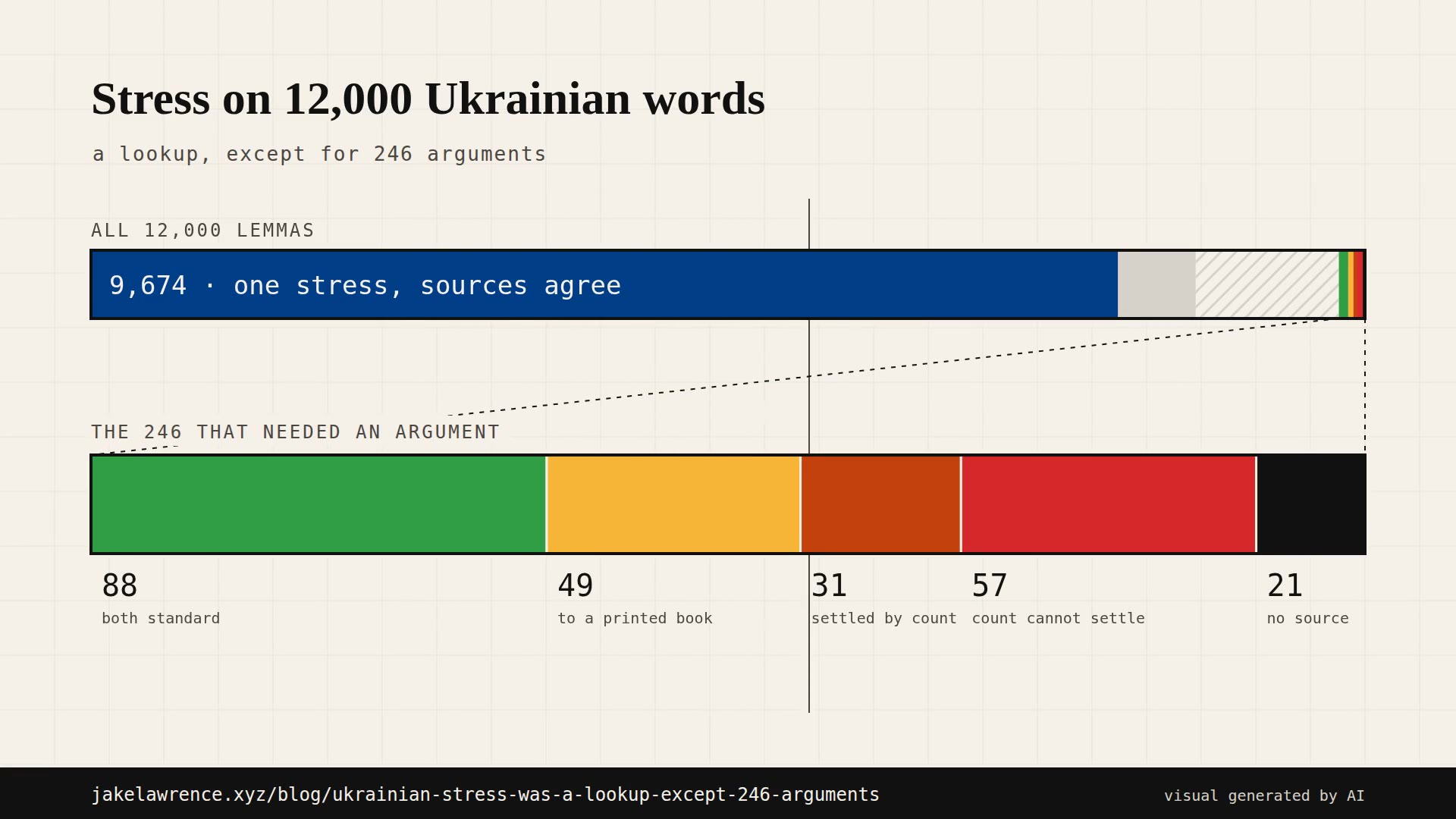
Leaving out one-syllable words, which have nowhere else for the stress to go, and names, there are 9,920 words. For 9,674 of them every source that has the word agreed on one answer. That is 97.5 percent. The diagram below shows where each word's answer came from; press a source to see what it added.
The 1,348 names (cities, rivers, surnames) stay on the list but are not counted. A surname is stressed the way its own family says it, and no dictionary can promise that.
Read by the list’s own part of speech, so a bare headword never has to be guessed at.
The 246 that needed a judgment call
The remaining words fall into a few kinds, and each needed a different answer. The bar below is the whole list at one scale, with those few kinds zoomed in underneath, because at the list's scale they are a sliver you can barely press.
All 12,000 words on the list
The 247 that needed an argument, zoomed in
Two words share a spelling and differ by stress. Their inflected forms that are spelled differently were counted across 2.3 billion words of UberText, and the commoner reading became the primary.
пора → пора́
Four kinds of hard case
Both are correct (88 words). Some words have two accepted stresses. та́кож and тако́ж both mean "also", and both are standard. These rows carry both.
Two stresses, nothing to break the tie (49 words). The dictionary lists two stresses and no other open source covers the word. The right tiebreaker is a printed pronunciation dictionary (Погрібний's), so these rows are labeled as unsettled rather than guessed.
Same spelling, different word (88 words). These are homographs: о́рган is an organ of the body, орга́н is the instrument in a church. On a list there is no sentence around the word to tell you which one is meant. But when a word changes its ending, the two meanings are sometimes no longer spelled alike, and a form spelled one way can belong to only one of them. So I counted those forms in UberText, about 2.3 billion words of real Ukrainian news, fiction, Wikipedia, court rulings and social media, and the more common meaning became the one the list shows first. That settled 31. In four cases the count disagreed with the order an online dictionary gives, for example сходи́ти over схо́дити, 653 uses against 225.
One trap: a form can belong to a third word entirely. заходи is a command ("come in") and also the plural of захід ("event"). So every form went through the site's own lemmatizer first, a tool that works out which dictionary word a form belongs to, and 79 forms that belonged to some other word were thrown out.
For the other 57 homographs every form is spelled the same in both meanings, so there is nothing to count. Those rows keep both stresses and say so.
No source has it yet (21 words). These stay empty rather than guessed.
That is the whole method. The chart below is every question the pipeline asks, in order; pick a word and watch it travel to its answer.
книга ends in confident. The dictionary and both Wiktionaries say кни́га.
Checking my own work
The stress data first arrived as a finished file, so the next step was to rebuild it from the original sources and see if the same answers came out. They did, for every word but one compound, and the rebuild turned up five bugs in my extraction code, now fixed.
That still only proves the sources agree with each other. It does not prove a native speaker would agree with them. So before anyone has looked at a single answer, I wrote down the test and drew the sample: 348 rows chosen at random, including every one of the 88 homographs, for a paid native speaker to check one by one.
The pass mark is fixed in advance. At least 150 confident rows have to be checked, and even the cautious low end of the estimate has to show at least 95 percent correct. The result goes on the hub whichever way it comes out.
Try it yourself
Reading about stress is one thing. Here are two small games built on the column.
Guess the stress. A real word from the list appears with its meaning and its level. Tap the syllable you think is stressed. Every answer is a confident row, where the open dictionary and both Wiktionaries agree, and most come with a native speaker's recording from Wikimedia Commons, which loads only when you press Listen.
The homograph duel. Once you have five right, the harder round opens: one spelling, two words. Which stress means the meaning shown? When you answer, the game shows the corpus count that decided the list's order, or tells you that every form is spelled alike and nothing could be counted.
Your score and best streak stay in your browser on this device, and nothing you do here is sent anywhere.
Loading a word from the list.
What comes next
The native-speaker check. A reviewer works through the 348 rows. Any row marked wrong is flagged for a decision by hand, never changed automatically, and the score is published against the pass mark above.
Stress marks in the course. The Learn Ukrainian course teaches these words today without stress marks. Next, its lessons and flashcards will show the mark on every word that has one, and so will the text profiler.
Fixes sent back to the dictionary. The check turned up two errors in lang-uk's dictionary (його is stored as йо́го instead of його́, and підозрюватися as підозрюва́тися instead of підо́зрюватися), and hyphenated words whose two stresses it lists as alternatives. Those go back to its maintainers, along with the counted homographs, so the fix helps everyone who uses the dictionary and not only this list.
Look it up from your wrist. The email that started this thread also described a reading trick: an open Ukrainian-English dictionary behind a tiny API, dictated to from a watch, so an unknown word costs a second instead of a tab. The same idea now runs on this site's own tiers. Look up any word, in any of its forms, and get the stress, the level, the rank, a recording and the definitions in one answer; the page shows the five-step Shortcut. Reading that dictionary against the column was a free check: it agrees on 99.8 percent of the words it marks, and the sixteen it does not are published as a list.
Further out
The column marks each word's dictionary form only. In Ukrainian the stress also moves as a word changes: рука́ is "hand", but ру́ки is "hands". Marking every form of every word is a much larger problem, and this column does not try to solve it yet. The list of threads on the hub is where the next pieces of the project appear, and the whole site has a Ukrainian-language edition for readers who would rather read it in Ukrainian.
Who this is for, and who can skip it
If you are learning Ukrainian, a good learner's dictionary or course already shows stress, and you don't need any of this. The column matters for people who build things: a teacher making flashcards, a developer writing a learning app, a researcher counting words. For them it is free to reuse under CC-BY-SA, with every answer labeled by how it was settled. It is in the hub's downloads, archived with a permanent citation (10.5281/zenodo.23092388), and installable for Python as ukvocab.
Other work on this site about Ukraine includes how the country's recovery gets recorded and why the site has a Ukrainian edition at all. The previous post in this series, about a number that had to come down, covers the list's other recent work.
Get the next one
An occasional note when something genuinely new ships here — essays, free tools, projects. No schedule, no filler, easy out.
Need something like this built?
I build the AI tools and automations a team adopts, and the full-stack apps and data pipelines under them, and ship them to production. Tell me the problem in a sentence and I'll give you an honest read on fit within a day.
Work with me →