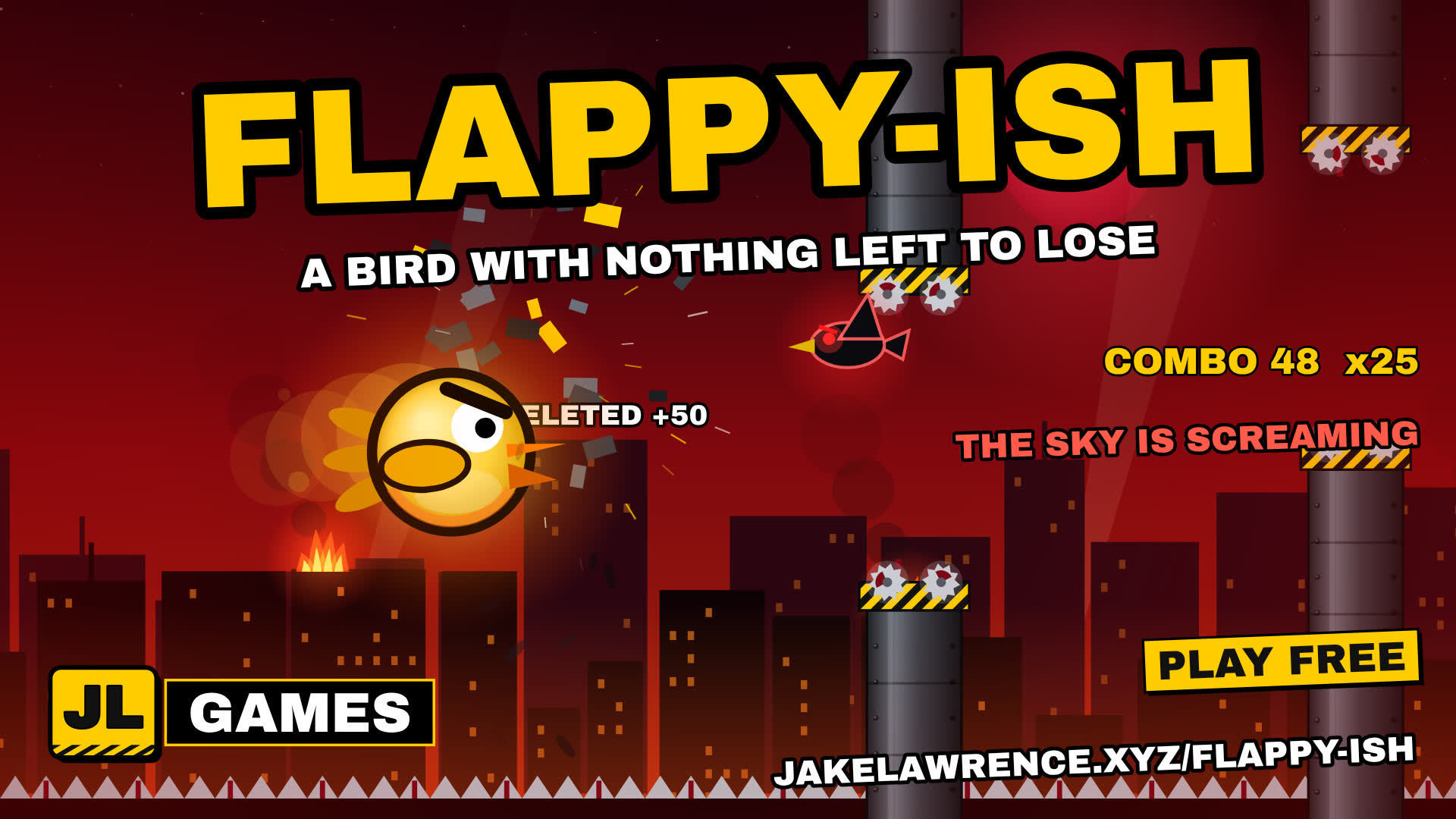
I let the bird narrate his own trailer
FLAPPY-ISH is a one-button bird game with the safety off. Here is its trailer, narrated by the bird, and the code under it: a pure seeded engine, the passes it took and the calls a person made in each, an autopilot that cheats by knowing the future, the fake clock that filmed it, and, a day later, a moon that fights back.
FLAPPY-ISH is the one-button bird game with the safety off. A tap pushes you up, gravity pulls you down, and everything else wants you dead: pipes with saw blades for lips, crows that dive in from the right, missiles that warn you and then arrive. Flap up into a crow and it pops. Fill the rage meter and the bird goes berserk for six seconds, twice his size and eating pipes. The trailer is right below, and the bird narrates it himself. That was the whole brief: make it funny, put JL Games on the front and the back, make the bird the mascot, and show it getting out of hand.

Gameplay is the real game, flown by a script. AI voice by ElevenLabs. Sound by the game's own synth. Play it, or watch it on the Films channel.
A pure engine with a body count
Under all the noise there is one file that knows the rules, engine.mjs, and it is boring on purpose. It has no clock, no canvas and no Math.random. The page owns time and calls step(world, dt, { flap }). The engine moves everything forward by dt seconds and hands back a list of what happened: flap, pass, shave, kill, smash, missile, berserk, die. Randomness comes from a seeded generator (mulberry32, four lines of integer math), so a seed deals the same grinders, crows and missiles every time. That is why /flappy-ish?seed=8 works as a rematch link.
Everything loud lives downstream of that list. The renderer turns one kill into 38 blood particles, 16 black feathers, an eyeball, a burst of screen shake, 45 milliseconds of hit-stop and, half the time, a splat on the glass. The audio turns the same event into a filtered noise burst and a falling square wave. The engine never learns any of it happened, which is why its tests can run long seeded games without a browser.
// The page owns the clock; the engine owns the rules.
const events = step(game, dt, { flap: pendingFlap });
for (const ev of events) handle(ev); // feathers, ketchup, shake, sound

// The crow rule, minus the geometry (engine.mjs):
if (touching(crow, bird)) {
  if (game.berserk > 0 || bird.vy < HEADBUTT_VY) pulp(crow); // rising fast: you are the weapon
  else die("crow"); // falling: the crow is
}
Five passes in one day
The first pass shipped the whole idea at once: grinders that chew and drift, crows, missiles, rage, an announcer ladder that climbs from DOUBLE PULP to THE SKY IS SCREAMING, and every sound synthesized in the browser. It also shipped with an honest line in the pull request: nobody had played a long run.
The second pass was about being able to see. A black crow over a black city at night is invisible, so crows got a red halo. Nobody could tell when a crow was safe to hit, so a crow in range now wears a dashed ring, gold while you are rising fast enough to pulp it and red while it would pulp you. The type moved from Impact, which Android and Linux do not have, to Archivo Black, which the site already serves. The death screen became a card that counts your score up and tells you what you are, from ROADKILL up to THE REASON BIRDS ARE BANNED.
The third pass is the one I would point to. A simulated player at three skill levels showed that good and expert players died in the same place, around pipe six or seven, almost always on a saw once the chewing pipes started. The game had a wall where it needed a curve. The diagnosis became the rule the engine follows now: you cannot change your horizontal speed, so nothing that depends on when you arrive is allowed to be unsurvivable. A chewing grinder never closes tighter than 165 units, because the phase you meet it on is luck. The next gap is clamped to what the bird can climb or dive before it gets there. Missiles stop tracking you 0.35 seconds before they fire, so the last beat is a real dodge. The good and expert bots' median runs went from 6 and 7 pipes to roughly 16 and 20, and the pull request said plainly that a bot is not a person.
The fourth pass made it testable. The game is one canvas, so it now writes its state onto the stage element (data-phase, data-y, data-gap, data-score), and a Playwright pilot flies three grinders on a phone-sized screen in CI. The one fix that test needed is a good summary of the whole project: the game runs slower than real time on a software renderer, so the test waits on the game's state, never the wall clock.
The fifth pass was spectacle, on purpose. Light became additive, so fire and blasts brighten whatever is under them. Crows split in half, grinders break into chunks, blood sticks to the pipes it lands on, and on death the whole world drains to gray while the blood stays red. There is lightning, there are burning buildings, and PULPED arrives one letter at a time. It also came with limits: a big hit gets an inverted impact frame no more than once a second, flashes are rate-limited, and Calm FX still turns every bit of it off.
A game with one button gets one fairness rule. If the player cannot choose when they arrive, nothing can depend on when they arrive.
What a person decided
Each of those passes was code an agent wrote in a session I started, and each began as a decision I made in a sentence or two. Making it violent was a decision. Keeping it cartoon was another, which is why the page says nothing here is real, including the ketchup. Keeping it original was a rule: the genre's one-button mechanic, and none of another game's art, names or levels. Calm FX was a rule too. One button removes the shake, the slow motion, the chromatic split and any flash above 12 percent, and it starts on for anyone whose device asks for reduced motion. The difficulty pass came after the first pull request admitted nobody had played a long run. I merged each pass knowing what it had not done, because each one listed that.
This pass added a rule of its own: the trailer can be flown by a script, but it has to say so. The end card and the captions both carry the credit, word for word: gameplay is the real game, flown by a script; the voice is AI; the sound is the game's own synth.
That is the part I do not hand off. An agent can build a saw-lipped grinder in an afternoon. Deciding that a grinder should never close tighter than a flap, or that a trailer made with an autopilot has to admit it, is a different job.
An autopilot that knows the future
The trailer needed someone to play it, and I wanted real gameplay rather than a mockup. So the game got a pilot (pilot.mjs), and it cheats in exactly one way a person cannot. Because the engine is seeded and pure, a copy of the world deals the same future as the real one. cloneGame copies the world, random stream included. Every frame the pilot tries ten plans (flap now, flap in two frames, in four, and so on out to never flapping), plays each forward on a copy for 78 frames, about 1.3 seconds, and scores the future it sees. Dying costs ten thousand points. A pulped crow, a close shave, a smashed pipe or an eaten missile earns some. The first move of the best future is what the bird does.
The first thing it did was find a balance problem. Turned loose, it skimmed every saw, because a close shave is worth 18 rage. It filled the meter every four pipes and spent about 42 of its first 70 seconds berserk, smashing 57 pipes while passing 28. The combo never dropped, because a smash every 0.8 seconds keeps a 2.2-second window alive, so the announcer reached THE SKY IS SCREAMING and stayed there with a combo past a hundred. No person shaves every saw, so the game is unchanged for now. But that is a true fact about the rage economy, and a bot found it in three seconds of compute.
So the trailer's pilot flies a story instead of chasing a score. It keeps off the saws, which spaces the berserks about fifteen seconds apart and leaves calm stretches for crows and missiles, and near the end it goes looking for a death.
Filming a game that only moves when it is told to
The film harness (scripts/flappy-ish/film/) bundles the real game component into a bare page with esbuild and swaps exactly one import: the game's audio module becomes a recorder that writes down every sound the game asks for, and when, and plays nothing. Playwright installs a fake clock before the page loads, so the game only moves when the driver lets it. Each film frame, the pilot decides, the clock advances, and the frame is captured losslessly.
The first take was a bird falling into the floor at 1.6 seconds. An installed fake clock keeps running in real time until you pause it, so the game played at wall speed while the driver was still thinking. Pausing it fixed that, and then the same seed still drifted between runs by a few milliseconds, because the animation frames sit on a 16 ms grid whose phase depends on how long the page took to load. The fix was to advance one 16 ms tick at a time, two or three ticks per film frame, so a take became a function of its seed and its story and nothing else.
That is what lets the film be shot twice. A scout pass flies the take and logs every frame. A plan picks the windows: the first calm crow kill, the first berserk, the first calm missile, the death. The render pass flies the same take again, captures only those windows, and stops the render if the replay drifts from the scout by a single point or a fraction of a pixel. A second guard refuses any plan that would show the same frame twice. It earned its place on the first try: in this game the crow kill that tops off the meter tends to land about a second before the berserk it sets off, so two shots kept asking for the same footage.
It also paid for itself the same afternoon. The graphics pass landed on main while the first cut of these films was rendering, so the art module was rebuilt on top of the new renderer and both films were shot again. Every take replayed its scout frame for frame under the new effects, which is the only reason a reshoot was an hour of compute and not a week of luck.
The narration is its own layer. The bird's lines are an ElevenLabs character voice, pitched up about 2.4 semitones and sped up 5 percent, and his beak opens with the loudness of each take, one value per frame. He talks from a BIRD CAM in the corner (a commentary booth under the footage in the vertical cut), in speech bubbles timed to the pauses in each line. The JL GAMES sting, the intro and the outro are drawn by the same layer. Because it is a separate transparent video, composited in ffmpeg, a shot can move without dragging the narration along.
The soundtrack is the game's own. Its synth now lives in createSynth, which takes any audio context and a start time, so the sounds recorded in each window are played back through it in an OfflineAudioContext, drum machine included, at the tempo the game asked for at that moment. The bird is ducked over it in the mix.
One refactor made the mascot honest. The bird, the crows, the saws and the burning city moved into art.mjs, plain functions that take a canvas and some numbers. The game draws through them, and so do the trailer, the share card and the animated card at the top of this page. The bird doing the talking is drawn by the same lines of code as the bird you fly.
1:00, vertical. Gameplay is the real game, flown by a script. AI voice by ElevenLabs. Sound by the game's own synth.
When I would not do this
An autopilot that sees the future makes a great camera operator and a useless playtester. It never panics, never mistimes a flap and never misreads a red ring, so it tells you nothing about how the game feels in a person's hands. The difficulty numbers in the third pass came from a different bot with timing jitter and aim noise added on purpose, and even those describe the shape of a curve, not a promise. Whether the game is fun still gets answered by a thumb on a phone.
The film harness is also more machinery than most trailers deserve. It pays off here because the game is deterministic, so a take can be scouted and then filmed again exactly. For a game whose physics depend on frame timing, or anything with a network in it, I would record a person playing and cut the footage like anyone else.
The narration has the same blind spot as the pilot. A transcription model checked that each of the bird's takes says its line, and it is good at that. It cannot tell whether a line is funny at that speed, in that moment, over that much noise. That is still a person with the sound on.
A day later: six of the eight
This post first ended on a list of eight terrible ideas, and it read as a plan. A day and two pull requests later, six of them are in the game.
- Attract mode. Leave the title alone for ten seconds and the autopilot plays a silent demo. It never touches your best, and a tap plays for real.
- Race your own ghost. Every run is recorded, and the death screen offers RACE THIS RUN and SHARE GHOST: a 30-second run is about 140 characters of link. A link is replayed before anyone races it, and one that does not come to the score it claims is refused.
- Versus the pilot. A second bird rather than a split screen, but the slider is what the list promised: how far into the future the pilot may look, in eight notches from 0.03 seconds (ASLEEP, which mostly dies at the first grinder on a phone) to 1.3 seconds (THE TRAILER PILOT, which flies about fifty).
- The announcer has a breakdown. From combo 20 every line he says is an apology to the crows. At 100 he says I QUIT. ANNOUNCE YOURSELF. and drops the microphone.
- The bird narrates your run and the blood moon comes down get their own section below.
- Shave or die and the crows remember have not been started.
Ghosts forced the one change I had not planned for. The page used to step the rules by however long each frame took, so the same seed and the same flaps came out slightly differently on a 120 Hz phone and a 60 Hz laptop, and a recording made on one would not replay on the other. Now the rules advance in fixed slices of 1/240 of a second whatever the screen does, and a flap always lands on the next slice. A run is four numbers: a seed, a world width, the bird's starting height and the slices its flaps landed on.
The pilot needed the opposite. It plans in rollouts of 1/60 of a second, and a plan to skim a saw by a few units does not survive a different step size: stepped at 1/240, the trailer's pilot fell to a median run of two grinders. So the pilot steps its own world at its own rate, which is also why its pipes can sit a few units off yours. Nobody can see that.
The moon and the bird
The moon was the most specific idea on the list, and two calls on it were mine: you beat it by batting its own teeth back at it, and you can practice it without earning your way there. The rest came out of the fairness line from the third pass. At grinder 50 the moon comes down and nothing else spawns while it is out. It spits saw teeth that track your height, stop tracking 0.35 seconds before they fly, and cross to you in 0.85 seconds on any screen. Flap up into one, the crows' rule, and it flies back into the moon; six of those and it is down. Its bite aims down a drawn, labeled line that locks 0.4 seconds before it lunges, and its breath is a wall of fire you fly through like a grinder. Ignore it for a minute and it goes back into the sky.
The fairness check was the third pass's bots again. Over 20 seeds at a phone width and a wide one, a pilot that sees 0.3 seconds ahead or more won every fight, one that sees 0.15 seconds won about 60 percent, and a pilot told never to fight back lasted the full minute on every seed until the moon gave up and left. Getting there is the hard part: that 0.15-second pilot's median normal run is 13.5 grinders, nowhere near 50. So practice is one link away. /flappy-ish?moon=1, or REMATCH THE MOON once you have met it, starts at grinder 50 with the moon on its way down, and nothing in practice counts.
The narration took the trailer's voice into the game: 45 lines in narrator.mjs, from the start of a run through every beat of the moon to a roast for each way to die. He talks at big moments only, which was my call, and at most once every few seconds; a death cuts in on anything, and a big moment cuts off small talk. Every line is captioned in his BIRD CAM whether the sound is on or off, and read to screen readers through a live region.
The takes are ElevenLabs, two per line, and a transcription model running on the build machine (Whisper, through a library the site already used) picks the take that actually says its line. It earned its keep on the first build: several takes dropped words, and one line lost a word in both takes and had to be regenerated. The picks ship as one 975 KB file, fetched only after the first tap.
The last coat of paint, and the recut
The third pull request of the day was the last graphics pass. The sky got soft banks of smoke lit from the fires below, flak over the rooftops and a flock of crows circling the moon, and the grinders picked up rust and the burning city's light. The moon now wakes up as you climb toward it: from grinder 30 it grows and opens its eyes, past 40 its teeth show, and when it comes down the screen letterboxes and both searchlights swing onto it. The bird's eye follows whatever is about to kill him, and when something gets close he sweats.
That costs frames, so the renderer got a governor with three tiers. It reads the game's own smoothed frame time, steps down when frames stay slow and back up when they stay fast, at most twice, so a struggling phone never flickers between looks. The lowest tier draws about what the game drew before the pass. A film rendered on the fake clock always sees 16 ms frames, so the films get the top tier however long each frame really took.
The recut opens cold on the moon coming down, with the bird's own in-game line over it: "Oh no. Oh no no no. The moon has teeth." The harness needed three changes. The fixed step had made the trailer's pilot weak, for the reason above, so the harness steps a filmed run at the pilot's own rate, through a hook that exists only in development builds. Nobody needs fifty grinders of footage to reach the moon, so a moon take jumps to grinder 49. And the guard that stops a render when the replay drifts from its scout fired on the first try: the moon take came out one step ahead at frame 266, because the step accumulator still held whatever the title screen had left in it, and that depended on how long the page took to load. The harness now empties it when it takes over.
The trailer's original narration takes had never been committed, so the recut also started by pulling them back out of the ElevenLabs history, which costs nothing. Every take then replayed its scout frame for frame.
The moon is your problem now. Watch it come down on the Films channel, practice it at /flappy-ish?moon=1, or see what else is in the arcade.
Get the next one
An occasional note when something genuinely new ships here — essays, free tools, projects. No schedule, no filler, easy out.
Need something like this built?
I build the AI tools and automations a team adopts, and the full-stack apps and data pipelines under them, and ship them to production. Tell me the problem in a sentence and I'll give you an honest read on fit within a day.
Work with me →