2026-06 · DevOps
An autonomous mobile QA rig for a thirty-game library
Most players arrive on a phone and the QA team is me. A nightly LLM-judged smoke sweep files issues; a deterministic Playwright gate blocks merges. Both start from a cold profile, because that is the only state where the worst bug lived.
33
games in the manifest, swept in 2D and 3D
0
secrets the merge gate needs
2
rungs: judgment and enforcement, split
before
No capture of the install prompt sitting over a game's control dock survives from before the rig existed. The bug lives on as the gate's dock-reachability assertion, which fails if anything ever covers a control again.
during
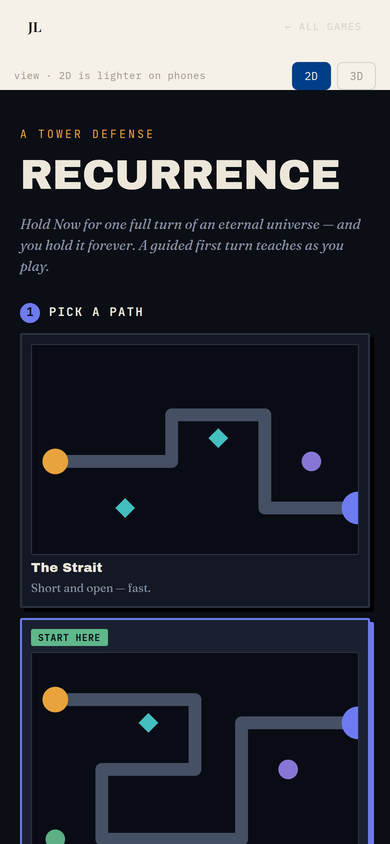
The frame the nightly judge reads: cold profile, cover state, nothing dismissed.
2026-09-20 · The smoke harness's own capture: headless Chromium with SwiftShader WebGL, a fresh browser context, 390 by 844 at 3x
after
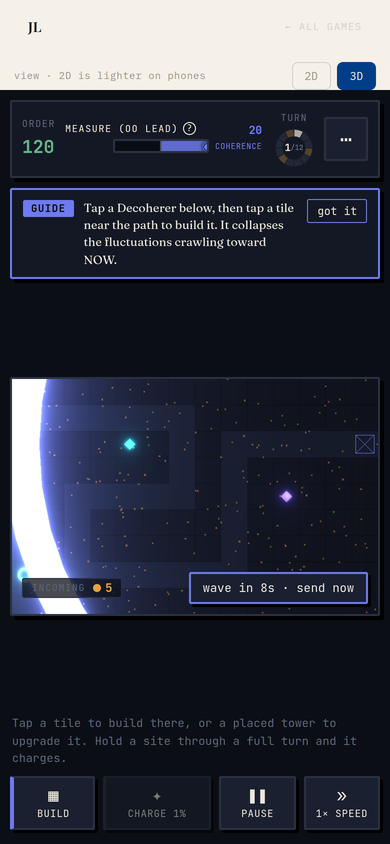
Playing state in 3D on software WebGL, the dock unobstructed: the invariant the gate asserts.
2026-09-20 · The smoke harness's own capture: headless Chromium with SwiftShader WebGL, a fresh browser context, 390 by 844 at 3x
Walkthrough video: coming soon.
Problem
The site ships an install prompt that stays dismissed for thirty days. On my warm, logged-in profile every game looked fine. A first-time visitor on a cold profile got the prompt layered over the in-game control dock, and the taps that should have built a tower hit the prompt instead. Nobody files a bug for that. They leave.
Constraint
CI runners have no GPU, and the flag that disables it gives you a black canvas. No human visits every game in both render modes from a clean profile on a phone every day. And an LLM's opinion can never be the thing that blocks a merge.
Decision
Two rungs, built with different tools because they answer different questions. A nightly smoke sweep boots headless Chromium at an iPhone-class viewport with software WebGL, screenshots every game in 2D and 3D from a fresh browser context per shot, writes a report of console errors and failed assets, then hands the shots to Claude Code, which judges them against a written invariant list and files one labeled issue per failing game. A deterministic Playwright gate encodes the same invariants as hard assertions on every pull request: dock unobstructed, board large enough, WebGL context alive, scripted interaction error-free.
Rejected
One LLM loop that both judges and blocks
A non-deterministic gate trains people to re-run until green. The judge files evidence; the gate blocks by determinism and uploads traces, so a failure is replayable, not arguable.
Test from my own logged-in profile
That profile had dismissed the install prompt. Every shot uses a fresh context, so the cold-profile bug can never be masked by a tester who already dismissed it.
What shipped
The capture harness, the nightly workflow that hands the shots to Claude Code and files issues, the per-PR gate with a reference spec, a stale-game advisory mode, and an operator that drains the playtest backlog into reviewed pull requests.
What I'd do differently
The gate then broke for the runner's reasons twice: one game's Claim button never stabilized and blocked every pull request (#1415), and the runner ran out of disk, not memory (#2381). Each was its own fix, because a gate that is red for the wrong reason is a gate people learn to skip.
Verify it yourself
- Run the deterministic merge gate
npm run playtest:gate - Run the nightly smoke sweep locally
npm run playtest:smoke - The reference gate spec
- The nightly workflow that hands the shots to a judge
- The per-PR gate workflow
If you ask me about this
- Why software WebGL?
- CI runners have no GPU. Routing the renderer to SwiftShader draws the full 3D pipeline on CPU, and the harness inspects the live WebGL context afterward because flags drift across Chromium versions.
- What can the nightly LLM run change?
- Nothing. It is read-only: its whole output is an issue naming the game, the mode, the invariant, and the screenshot. The fix is always a separate reviewed pull request.
Evidence
Wire up the playtest games QA harness and gate
#722 · 2026-06-07 · feature
Add stale-game advisory mode to the playtest harness
#725 · 2026-06-07 · feature
playtest smoke: inspect WebGL after the game starts, not at the cover screen
#742 · 2026-06-07 · feature
Agents Store: ship the game-builder operator — games.fix drains the playtest backlog
#1002 · 2026-06-11 · bugfix
the-pull: fix the Claim button never stabilizing (unblocks the playtest gate)
#1415 · 2026-06-18 · bugfix
Playtest gate: the runner runs out of disk, not memory
#2381 · 2026-09-18 · feature
Receipts
Checked at build against the published corpus.
- Every cited PR exists in the published corpus6 / 6
- Pending PRs are named as pending, never passed off as mergedall merged
- Cited PRs sit in the case's disciplinesDevOps, CI, Games
- Numbers with no source say so0 unmetered
www.jakelawrence.xyz/research/case-study-library/playtest-rig
Cite: Lawrence, J. (2026). An autonomous mobile QA rig for a thirty-game library. jakelawrence.xyz case study library.
Need something like this built?
I design and ship AI tools, full-stack apps, and data pipelines — end to end, to production. Tell me the problem in a sentence; I'll give you an honest read on fit within a day.
Work with me →