The Beautiful Unfinished
The Feeling Before the Thing

The Risk Register
A pristine white desk arranged with notebooks, documents, calculator, and planning instruments, all perfectly ordered, all perfectly blank
In which our knight, having acquired a full suit of intention and half a league of blank parchment, arranges his instruments upon a desk so pristine it has never been troubled by the shadow of a deed. Sancho, who had been watching from the doorway for some time, remarked that the desk was very fine but the road was still outside. “The road,” replied Don Quixote, adjusting a column width, “will be there tomorrow.” The donkey, who had no columns to adjust, was already facing the door.
It is 1:47 in the morning, and I am building something I will never build.
The document is already fourteen pages long. It has a table of contents. It has a color-coded timeline with dependencies mapped between workstreams. It has a risk register — seven rows, each with likelihood and impact ratings, each with a mitigation strategy that I will never need because I will never encounter the risks because I will never do the work. The risk register has a row for the risk that the project will never be completed. The mitigation strategy for that row is "modular architecture allowing partial publication." I typed that without irony. I formatted the table. I adjusted the column widths.
I have not written a single word of the thing the document describes.
And I feel wonderful.
This is not a confession. Or rather, it is not only a confession. It is the starting point of an investigation — because the feeling I have just described is not idiosyncratic, not a personal failing, and not a quirk of temperament. It is one of the most common experiences in the cognitive life of anyone who has ever made a plan, started a project, or opened a blank document and felt the entire completed work shimmering in the space between intention and action. The plan feels better than the thing. The blueprint is more beautiful than the building. The possibility, somehow, is richer than any of its actualizations.
You know this feeling. Everyone knows this feeling. It is the subject of a thousand memes, a minor genre of confessional social media post, a reliable laugh line at dinner parties. "I have forty unfinished projects," someone says, and the table nods. The nod is not polite — it is recognition. We all live here.
And yet, for an experience this universal, this immediately legible, this structurally embedded in the way human beings relate to their own intentions, we have remarkably little serious thinking about it. We have productivity advice — thousands of books, apps, systems, and frameworks designed to close the gap between planning and doing, all of which assume that the gap is the problem and the doing is the solution. We have clinical language — procrastination, executive dysfunction, avoidance, behavioral activation — that frames the gap as a deficit to be remediated. We have folk psychology — laziness, lack of discipline, fear of failure — that frames it as a moral deficiency. What we do not have is an intellectually honest account of the gap itself: what it is, why it exists, what it does, and whether the near-universal human experience of preferring the plan to the execution might be telling us something more interesting than "try harder."
This essay is that account.
What follows is not a self-help treatise. It will not teach you to finish your projects. It does not contain a system, a method, a framework, or a set of actionable takeaways. If you finish reading these forty thousand words and feel motivated to finally start that novel, launch that business, or complete that home renovation, something has gone wrong — not with you, but with the essay. This is an investigation, not an intervention. Its purpose is understanding, not cure.
The investigation proceeds through ten disciplinary lenses, each of which illuminates a different facet of the planning-execution gap. Neuroscience explains what is happening in the brain when we plan — the dopamine system's elegant machinery of anticipatory reward, and the mounting evidence that the neurochemistry of wanting is not merely different from the neurochemistry of having, but in many respects more intense and more pleasurable. Cognitive psychology maps the mental architecture of prospective thinking — how we simulate futures, how those simulations systematically diverge from the futures they represent, and how the planning fallacy is not an error in our software but a feature of it. Behavioral economics formalizes the preference structures that make an unstarted project more valuable, in a precise and measurable sense, than a started one — option value, temporal discounting, and the rational irrationality of keeping your possibilities open.
But if we stopped there, at the brain, the mind, and the market, we would have a tidy explanation and a shallow one. The planning-execution gap is not just a neurological event, not just a cognitive bias, not just an economic preference. It is also a philosophical problem. What is the ontological status of a plan — this strange object that exists somewhere between a thought and a deed, that is neither real nor imaginary, that exerts causal force on the world while remaining, itself, unrealized? Aristotle had a word for this: dynamis, potentiality, the acorn-nature of a thing that has not yet become what it could become. Twenty-four centuries later, we still lack a satisfying account of why potentiality feels the way it does — and why, so often, it feels better than energeia, the actuality, the thing itself.
Phenomenology takes the philosophical question inward. What is the lived experience of the planning state? What does it actually feel like, from the inside, when you are deep in a detailed plan and the world has temporarily receded and the only thing that exists is the architecture of what you are about to do? There is a quality to this experience — an absorptive, almost meditative quality — that is poorly captured by words like "excitement" or "motivation." It is closer to what Csikszentmihalyi called flow, but it is not flow, because flow requires action and the planning state specifically precedes action. It is its own phenomenological category, and it deserves its own name.
Creativity and design studies bring the planning-execution gap into the workshop. Every designer knows the moment when a project transitions from the divergent phase — where anything is possible, where ideas multiply, where the whiteboard is covered in arrows and post-its and beautiful fragmentary visions — to the convergent phase, where you must choose, commit, and build. This transition is not experienced as progress. It is experienced as loss. The design literature has names for this: the "narrowing funnel," the "concept freeze," the "groan zone." But the literature tends to treat this experience as an obstacle to be managed rather than a signal to be interpreted. What if the grief of convergence is telling us something true about the relationship between possibility and realization?
Clinical psychology and psychiatry enter here, because the planning-execution gap has a clinical shadow. In its extreme forms, it looks like procrastination that costs people their jobs, their relationships, their self-regard. It looks like ADHD, where the neurological architecture of intention and execution is measurably different, and where the planning high and the execution crash are not metaphors but descriptions of dopaminergic function. It looks like perfectionism, where the plan must remain pristine because any execution would contaminate it with the imperfection of the real. It looks like anxiety, where the plan is a way of managing uncertainty and the execution is an act of terrifying commitment to a single future. The clinical lens is essential — but it is one lens among ten, and this essay resists the move of pathologizing a universal human experience just because it has pathological variants.
Sociology and cultural studies pull the camera back further. We live in a particular cultural moment — late capitalism, knowledge economy, side-hustle culture, productivity gospel — that has a very specific relationship to planning and execution. The plan has become a social performance: the publicly shared project announcement, the notion board, the "building in public" ethos that rewards the legible display of intention. The cultural machinery of planning has never been more visible, more rewarded, or more detached from the requirement of completion. This is not an accident. The side project economy runs on the fuel of announced intentions, and it has developed sophisticated mechanisms for extracting social and economic value from the planning state alone.
Organizational theory and project management offer a surprising mirror. The professional literature on why projects fail is vast, empirically grounded, and almost entirely ignored by the people who plan projects. Three decades of project management research — most rigorously cataloged in Bent Flyvbjerg's studies of optimism bias and strategic misrepresentation in institutional planning — have documented that the majority of large-scale projects fail or are significantly "challenged." The project management profession exists to close the planning-execution gap at institutional scale, and it has, by the accumulated evidence of organizational research, largely failed. What if this failure is not a problem to be solved by better methodology but a structural feature of how organizations relate to complexity and uncertainty? What if the annual strategic plan, the quarterly OKR, the sprint planning ceremony serve functions that have nothing to do with their stated purpose of enabling execution? And — more unsettling still — what if the entire model is backwards? There is an influential tradition in organizational theory that argues we have the causal arrow reversed: people do not plan and then act; they act and then construct a plan retroactively to make sense of what they did. If this is right, then the plan was never a blueprint for the future. It was always a story about the past, dressed up in the future tense.
Finally, information theory and complexity science offer a framework for why the plan is always more elegant than the territory. A plan is, in formal terms, a compression — a short program that generates a long output, a seed that implies a forest. This compression is what makes plans useful, but it is also what makes them beautiful. The plan is beautiful because it is simpler than reality. But the plan is also, simultaneously, something else: a high-entropy object, a state of maximum unresolved possibility. The plan for a novel contains every novel it could become. The plan for a life contains every life. In information-theoretic terms, entropy measures uncertainty, and a plan is saturated with it — every unspecified detail is a decision yet to be made, a fork not yet taken. This is the plan's secret double life: it is at once elegantly compressed and maximally open. Execution destroys both properties at once. It decompresses — re-encountering all the noise, friction, and contingency that the plan had so elegantly abstracted away. And it resolves — collapsing the uncertainty, answering every open question, reducing the shimmer of possibility to the solidity of a single outcome. The executed work is complex in its details but simple in its identity: it is one thing, not many. The experience of execution as degradation, as a falling-away from the purity of the plan, is not an illusion. It is an accurate perception of an information-theoretic reality: you are trading the best of both worlds — compression's elegance and uncertainty's richness — for the worst of both: detail's weight and singularity's finality.
Ten disciplines. One phenomenon. The argument that emerges from their convergence is not that the planning-execution gap is a bug to be patched or a weakness to be overcome. It is that the gap is a structural feature of human cognition, a predictable consequence of how our brains generate reward, how our minds simulate futures, how our cultures organize ambition, and how information itself behaves when it moves from abstraction to instantiation. The plan feels better than the thing because, in several precise and defensible senses, the plan is better than the thing — richer in possibility, purer in form, more aligned with the reward systems that evolution has given us.
This is not a comfortable conclusion for a culture that worships execution. We live inside an ideology of shipping — ship the product, ship the feature, ship the essay, ship or die. The highest compliment in the contemporary creative and professional vocabulary is that someone "executes." The deepest insult is that someone is "all talk." The entire self-help industry, the productivity influencer economy, the agile methodology movement, the startup accelerator ecosystem — all of it rests on the foundational assumption that the gap between planning and doing is a problem, and that the solution is more doing. This essay will not argue that doing is bad or that planning is sufficient. It will argue that the relationship between the two is far stranger, far more interesting, and far more deeply rooted in the architecture of mind and world than the shipping ideology acknowledges.
It will also argue — and this is the thread that runs beneath all ten disciplines — that the planning-execution gap is, at its core, a story about loss. Every act of execution is an act of elimination. To build the thing is to kill every other thing it could have been. The plan holds all the possibilities simultaneously; the execution collapses them to one. Borges imagined a novel that refused this collapse — a garden of forking paths where every branching decision produced not one outcome but all of them, simultaneously, each fork leading to further forks in an infinite, diverging, converging web of timelines. In fiction, this is a dizzying thought experiment. In the planning state, it is a description of Tuesday night. The plan is the garden. Every path is illuminated. Every future coexists. Execution is what happens when you start walking and the paths you didn't take go dark behind you, one by one, until only the single lit trail of what-you-actually-did remains. This is not a metaphor borrowed from quantum mechanics, though the analogy is hard to resist. It is a phenomenological observation confirmed by neuroscience (the dopamine system responds to possibility, not actuality), by economics (option value is real value), by philosophy (Kierkegaard's anxiety of freedom is the dizziness of looking into the space of what you might become), and by the lived experience of anyone who has ever felt a strange sadness upon finishing something — not because the thing is bad, but because the thing is only one thing, and the plan had been, briefly, everything.
A note on the author's position, because it matters here more than it usually does.
I am someone who experiences the planning-execution gap acutely, chronically, and — I have gradually come to understand — constitutively. I am, at this moment, writing a forty-thousand-word essay about planning that will require months of disciplined execution, and the most honest thing I can tell you is that the planning documents for this essay were more pleasurable to create than the essay itself will be to write. I know this. I am doing it anyway, in part because the investigation feels genuinely important and in part because the recursive irony of the situation — writing about not finishing things, which requires finishing the thing about not finishing things — creates a kind of structural obligation that is, itself, interesting to think about.
This disclosure is not a bid for sympathy or relatability. It is a methodological statement. The planning-execution gap is a first-person phenomenon — it is something that is experienced, not observed from outside — and any investigation that did not begin from the experience itself would be starting in the wrong place. The phenomenological tradition, which will appear repeatedly in this essay, insists that the investigation of any experience must begin with the experience as it is given to consciousness, before the explanatory frameworks are applied. So I begin with the experience: it is 1:47 in the morning, and I am building something I will never build, and I feel wonderful, and I want to know why.
The ten disciplines that follow will not produce a single answer. They will produce something more valuable: a vocabulary. A set of precise terms, drawn from neuroscience and philosophy and economics and design and all the rest, that allows us to describe the planning-execution gap not as a personal failing but as a complex, multi-determined, deeply human phenomenon that sits at the intersection of how we think, how we feel, how we create, how we organize, and how we grieve the infinite in favor of the actual.
The plan, as always, is beautiful.
Let's see what happens when we try to build it.
What It Feels Like Before the Thing

The Wide Clearing
A tiny figure standing at the center of a vast circular clearing surrounded by tall white pillars, with a luminous opening at the far end
Here the knight enters the clearing that Frestón the enchanter has arranged: a great white amphitheater of pillars with an opening at the far end that might be an exit or might be merely more enchantment. Sancho would later insist the pillars were only fence posts seen at a distance. But our knight stood at the center and felt, as he always felt, that the space was made for someone exactly his size, and that every direction was available, and that this was the moment before the moment when everything would begin.
There is a moment — everyone who has lived this knows the moment — when the idea arrives and the world changes shape.
Not the world out there. The world in here. The temporal world, the felt world, the world-as-experienced. One minute you are washing dishes or half-watching something or staring at the ceiling in that state of low-grade restlessness that the productivity literature calls "unfocused" and you call "Tuesday." The next minute you have it. The shape of a thing. Not the thing itself — the thing doesn't exist yet and may never exist — but the shape, the contour, the shimmering outline of what the thing would be if you made it. A project. An essay. A business. A piece of software. A garden. A life.
And in that moment, before you have done anything, before you have opened a document or bought materials or told anyone, something happens to time.
This is not a metaphor. Or rather, it is not only a metaphor. What happens to time in the planning state is one of the most precisely described phenomena in phenomenological philosophy, and it maps, with surprising fidelity, onto what happens in the brain when the dopamine system encounters possibility. But before the neuroscience, before the formal frameworks, the investigation has to begin where the experience begins: with the feeling itself, taken seriously, described carefully, given its proper name.
Edmund Husserl, writing at the turn of the twentieth century, spent years developing a vocabulary for the internal structure of temporal experience. His central insight is deceptively simple: consciousness is never a bare point in time. The present moment, as we actually live it, is not an infinitesimally thin line dividing past from future. It is thick. It extends backward through what Husserl called retention — the just-past, still held in awareness as it recedes, like the trail of a comet — and forward through what he called protention — the about-to-arrive, anticipated within the present, pulling consciousness toward what hasn't happened yet. You hear a melody, and each note contains the trace of the notes that came before and the anticipation of the notes that follow. The present is never just now. It is always now-reaching-backward-and-forward, a temporal thickness that is the very form of conscious life.
In ordinary experience, protention and retention are roughly balanced. You are aware of where you've just been and where you're about to go, and the two horizons frame the present without overwhelming it. But the planning state is not ordinary experience. In the planning state, protention takes over. Consciousness extends far into the anticipated future — not the next moment or the next hour but the next weeks, months, the completed project, the finished thing, the life-after-the-thing-is-done. The protentional horizon opens wide, and the present thins to almost nothing. You are no longer here. You are there, in the future the plan describes, and the richness of that future — its detail, its vividness, its felt reality — is what produces the sensation the introduction described: the wonderful feeling, the planning high, the strange euphoria of building something you haven't built.
This is why the planning state is so absorptive. It is not merely that you are thinking about the future; it is that your temporal experience has restructured itself around the future. The present — with its dishes, its Tuesday-ness, its low-grade restlessness — has been eclipsed by a protentional horizon so wide and so vivid that it feels more real than the room you're sitting in. Husserl's student Martin Heidegger had a word for this temporal structure: Entwurf, projection. For Heidegger, human existence is fundamentally futural — we are beings who are always "ahead of ourselves," thrown into a world we didn't choose but perpetually projecting ourselves into futures we do choose. The plan is Entwurf made concrete. It is more than a document or a to-do list; it is a self-authored future, a declaration of who you intend to become and what you intend to bring into being. When you are deep in a plan at 1:47 in the morning, feeling wonderful, what you are feeling is the full force of your own projective capacity — consciousness reaching into the future with everything it has, constituting a world of possibility that, in that moment, feels as solid as anything you've ever touched.
Heidegger called this kind of temporal experience ecstatic — not in the colloquial sense but in the etymological sense: ek-stasis, standing outside oneself. In planning, temporal ecstasy is maximized. Consciousness reaches far into the future, holds multiple past precedents in retention, and experiences what Heidegger elsewhere describes as a wide "clearing" — an open space of possibility in which things show up as meaningful, available, ready-to-be-worked-on. The planning state is a clearing. Everything is illuminated. The project's components are visible in their relations to one another, and the whole thing hangs together with a coherence that feels almost architectural. You can see it.
And here is the first crucial thing about the planning state that the phenomenological lens reveals: what you are seeing is not the project. It is an image of the project, and the image has a property that the project itself can never have. It is whole.
The experience of wholeness in planning is so common that it barely registers as remarkable. Of course the plan feels complete — that's the point of a plan, to envision the completed thing. But the phenomenological tradition asks us to slow down and examine what this wholeness actually is, because it turns out to be something quite specific and quite important.
When you are planning, the project exists in imagination as what the literary theorist Caroline Levine calls a form — specifically, a whole. It has a beginning, a middle, and an end. Its parts are related to one another in a coherent structure. Nothing is missing, because nothing has been tested against reality; nothing has failed, because nothing has been attempted. The wholeness of the plan is not earned by the labor of completion — it is bestowed by the generosity of imagination. The mind fills in what it hasn't specified. The plan's gaps are not experienced as gaps but as spaces of possibility — each unspecified detail a decision yet to be made, a fork not yet taken, a moment of future creative engagement that the planner can anticipate without confronting.
The philosopher Hans-Georg Gadamer described aesthetic experience as characterized by play — a back-and-forth movement between the work and the viewer in which meaning is not fixed but continuously generated. The plan, Gadamer's framework suggests, is beautiful partly because it is unfinished. It retains the play character that a completed work must eventually surrender. The plan is open to interpretation — it can still become anything — and this openness is experienced not as absence but as richness. The plan is full because it is unresolved.
This is the beginning of the essay's phenomenological argument, and it has to be stated plainly: the planning state feels good not merely because the planner is imagining a pleasant future, but because the planning state has structural properties — temporal openness, imaginative wholeness, aesthetic play — that make it a genuinely valuable phenomenological experience. The planning state is not a degraded version of doing. It is its own kind of experience, with its own particular richness, and dismissing it as procrastination or avoidance is like dismissing a symphony because it doesn't build houses. The experience is real. The question is what happens when you try to move from the experience to the execution.
What happens is a series of phenomenological catastrophes, each of which the planning state had carefully concealed.
The first is the return of the body.
There is a remarkable asymmetry between planning and execution that Merleau-Ponty's phenomenology of embodiment makes visible: planning is an almost entirely disembodied experience. You plan in your head. The body, during planning, is what the phenomenologist Drew Leder calls absent — not absent in reality, of course, but absent from awareness. The planner floats free of bodily constraint. In imagination, the body is infinitely capable: it can work twelve-hour days without fatigue, sit at a desk without back pain, sustain concentration without the restless leg, the dry eyes, the creeping hunger that pulls you out of focus and into the kitchen. The plan's imagined body is a body without friction. It is the body as the planner wishes it were — capable, tireless, obedient to intention.
Merleau-Ponty spent his career arguing that this disembodied mind is a philosophical fiction — that we do not merely have bodies but are bodies, that our engagement with the world is always an embodied engagement. His phrase I can replaces Descartes's I think as the foundational structure of consciousness. The body's practical capacities — what it can reach, what it can lift, what it can endure — define our relationship to the world before any thought intervenes.
Execution is the return of the I can. Or rather, the return of the I can't. The body reasserts itself: the aching lower back, the hand that cramps after an hour of writing, the concentration that fragments after forty minutes, the sleep debt that turns the ambitious morning schedule into a groggy negotiation with the snooze button. The plan imagined a body without limits; execution encounters a body that is nothing but limits. The planning-execution gap includes, in part, a gap between the imagined body — light, free, infinitely capable — and the lived body, which is heavy, constrained, and constantly demanding attention.
This is not a minor inconvenience. It is a phenomenological transformation. In Merleau-Ponty's terms, the transition from planning to execution is a transition from the body as imagined schema — a projected set of capacities mapped onto a future environment — to the body as lived schema, actually inhabiting an actual environment with all its resistance, friction, and surprise. The plan's body is a concept. Execution's body is a fact.
The second catastrophe is what Heidegger would recognize as a massive breakdown event.
In everyday absorbed activity, Heidegger observed, the tools and equipment we use are ready-to-hand — transparent, unnoticed, flowing. The carpenter doesn't think about the hammer; the hammer disappears into the act of hammering. Only when the hammer breaks, or is too heavy, or is missing entirely does it become present-at-hand — an object of conscious attention, conspicuous and obtrusive, suddenly there in a way it wasn't before. Breakdown is the shift from readiness to presence, from transparent flow to obstructive visibility.
In the planning state, the entire project is ready-to-hand in a peculiar and unprecedented way. It exists as a smooth, transparent totality in the imagination. The planner doesn't encounter the project's components as separate, potentially resistant objects; they flow together in a seamless vision, each element supporting the others, the whole thing humming with coherent purpose. This is the planning state's characteristic phenomenology: everything works, everything fits, everything flows.
Execution is a systematic breakdown. Each step encounters friction. The software that was supposed to take an afternoon takes a week because the API documentation is wrong. The chapter that was a single line item in the outline — "Section 3: The Phenomenological Argument" — turns out to be three months of reading Heidegger. The conversation with the collaborator that was going to be generative and exciting turns out to be a negotiation over incompatible visions. Each deviation from the plan is a Heideggerian breakdown moment: the smooth, transparent totality fractures into visible, resistant, obstinate parts. The project stops flowing and starts obstructing. It becomes, in Heidegger's precise term, conspicuous — you can suddenly see all the pieces, and they are not fitting together the way they did in imagination.
The planning-execution gap, read through Heidegger, is the phenomenology of breakdown applied to self-authored projects. And breakdown, for Heidegger, is not a failure — it is a revelation. It is the moment when the world shows itself as it actually is, rather than as the projection had constituted it. The planner who encounters friction is not doing something wrong. They are encountering reality. The plan's smooth totality was not a description of the project; it was a projection that concealed the project's actual character as a field of resistant, surprising, independent elements. Execution is the project's back-talk. And the plan, by definition, cannot talk back — it is a monologue.

The Comet Trail
A solitary figure at the end of a long fading trail that stretches toward a vanishing point across a vast white grid
In which Don Quixote discovers that time, when one is planning, stretches ahead like the luminous trail of a comet, each moment connected to every moment that preceded it and reaching, with unbearable brightness, toward the horizon where Dulcinea waits, or does not wait, or has never waited, which amounts to the same thing when the trail is this beautiful. Sancho, walking the same path, saw only a road. He was not wrong. He was merely looking down.
Here the phenomenological investigation meets the creativity and design literature, because designers have known about this monologue for a very long time.
Donald Schön, in what remains one of the most quietly radical books in the literature on professional expertise, argued in 1983 that skilled practice is not the application of pre-existing theory to well-defined problems. It is something he called reflection-in-action — a real-time conversation with the situation. The designer makes a move; the situation responds; the designer adjusts. The architect sketches a building; the sketch reveals a problem the architect hadn't anticipated; the revised sketch suggests a possibility the architect hadn't imagined. This is what Schön called "a conversation with the materials of a situation," and his central claim was devastating for the planning mindset: the situation's responses are the source of all real progress, all real learning.
But the plan cannot converse. It is, as Schön would put it, an artifact of technical rationality — the model of practice that assumes problems are well-defined, solutions are derivable from first principles, and implementation is a matter of following predetermined steps. Technical rationality is the planning mindset's natural home: the project is a problem, the plan is the solution, execution is the application of the solution to the problem. Schön spent his career arguing that this model describes almost nothing about how skilled practitioners actually work. The real work happens in what he called "the swampy lowlands" — the messy, indeterminate zone where the problem and the solution co-evolve, where the situation talks back, where the practitioner must improvise, adjust, and think on their feet.
The planning-execution gap is, in Schön's terms, the gap between technical rationality and reflective practice. The plan is comfortable, logical, controllable — a well-lit laboratory where everything behaves according to theory. Execution is the swamp: uncomfortable, uncertain, demanding a kind of responsiveness that planning, by its nature, cannot rehearse. The chronic planner, in this framing, is not lazy or undisciplined. They are someone who has developed extraordinary skill in the well-lit laboratory and is understandably reluctant to descend into the swamp.
The design theorist Nigel Cross extended this insight by observing that expert designers maintain what he called constructive ambiguity — they resist premature commitment to a single solution, holding multiple possibilities open as long as productively possible. This sounds like planning. It is a kind of planning. But Cross's expert designers do something the chronic planner does not: they act. They hold ambiguity while working, not instead of working. They sketch, prototype, test, and revise while keeping the larger vision flexible. Constructive ambiguity is not the same as permanent openness. It is openness in the service of eventual closing — a temporary and strategic suspension of commitment that functions only because commitment is coming.
The chronic planner has mastered the opening without learning the closing. They are permanently constructively ambiguous. And the tragedy, Cross's work implies, is that this permanent openness is not constructive at all — it is merely ambiguous. Without the dialectic of opening and closing, diverging and converging, the openness produces nothing. It only feels like it does.
This is where J.P. Guilford's distinction between divergent and convergent thinking — one of the foundational frameworks in creativity research — earns its place in the argument.
Guilford observed in the 1960s that creative cognition involves two distinct operations. Divergent thinking generates multiple ideas, possibilities, and variations; it is characterized by fluency, flexibility, originality, and elaboration. Convergent thinking evaluates, selects, and refines; it narrows the field, eliminates alternatives, and commits to a specific path. Both are necessary for creative production. Neither alone is sufficient.
The planning state is overwhelmingly divergent. The planner generates possibilities, explores alternatives, imagines variations, sees connections between disparate elements — all legitimate divergent thinking, all cognitively demanding, all rewarding in exactly the way that creative work is rewarding. The introduction described the feeling: it is wonderful. And it is wonderful, in part, because divergent thinking is deeply pleasurable. The mind is doing something it is exquisitely well-designed to do — recombining information, generating novelty, opening possibility space. The neurons are firing. The reward circuits are engaged. The experience is real.
But execution demands the convergent shift. You must choose one path. You must eliminate the alternatives that divergent thinking so generously provided. You must commit to a specific implementation, knowing it will be imperfect, knowing it will exclude everything else the project could have become. The convergent shift is not experienced as progress. It is experienced as loss. The design literature has names for this: the "narrowing funnel," the "concept freeze," the "groan zone." Each name captures a different facet of the same phenomenological event: the closing of possibility space, the contraction of the wide-open diamond of ideation into the sharp point of execution.
Guilford's framework reveals something that the productivity literature almost never acknowledges: the planning-execution gap is not between "thinking" and "doing." It is between two opposed modes of thinking — one that opens possibility space and one that closes it, one that generates and one that eliminates, one that adds and one that subtracts. The chronic planner is not someone who thinks instead of doing. They are someone who thinks divergently instead of thinking convergently. They are not avoiding work. They are doing one kind of cognitive work — the pleasurable, expansive, identity-affirming kind — and avoiding the other kind: the constraining, loss-inducing, commitment-demanding kind.
This distinction matters because it reframes the entire moral landscape of the planning-execution gap. The folk psychology of laziness assumes that the planner is doing nothing. Guilford shows they are doing something very specific: they are generating. What they are not doing is selecting. And the failure to select is not a failure of effort or character. It is a failure — if it is a failure at all — of a very specific cognitive transition, the transition from divergence to convergence, from opening to closing, from the expansive first half of the creative diamond to its painful, necessary, narrowing second half.
Graham Wallas, writing even earlier than Guilford, had mapped the creative process into four stages that remain, nearly a century later, the field's foundational framework: Preparation, Incubation, Illumination, and Verification. The chronic planner, in Wallas's terms, is someone trapped in a loop between Preparation and Illumination — endlessly gathering, structuring, and organizing (legitimate Preparation), occasionally experiencing flashes of insight about how the whole thing comes together (Illumination), but never transitioning to Verification: testing the idea against reality, refining it in response to feedback, discovering whether the thing actually works.
The subtlety in Wallas's model is that Illumination feels like completion. The flash of insight, the moment when you can see the whole project laid out before you, has the phenomenological character of arrival — you feel like you've reached the destination. But Illumination is not completion. It is a vision of completion. The difference between the vision and the reality is, precisely, Verification — the labor of implementation, the encounter with all the details the vision omitted, the slow work of making the imagined thing into an actual thing. The chronic planner experiences repeated Illumination without Verification: vision without making, insight without implementation. And because Illumination feels so much like completion — because the felt quality of seeing-the-whole-thing is nearly indistinguishable from the felt quality of having-made-the-whole-thing — the planner may not understand why they feel productive without producing.
Wallas himself noted, almost parenthetically, that Preparation is "fruitless" for solving the problem directly — it only establishes the conditions for later stages. This is a disquieting observation for the chronic planner, because it means that all the work of planning — the fourteen-page documents, the color-coded timelines, the risk registers — is preparation for work that may never arrive. The plan is not the thing. It is not even the beginning of the thing. It is the preparation for the beginning of the thing. And yet it feels, from the inside, like the thing itself.
There is a deeper question buried here that the creativity literature does not reach: is the plan ever ready enough? The chronic planner treats this as a psychological question — a matter of confidence, or motivation, or the right moment. But it may be a formal question, one with a formal answer, and the answer may be worse than the planner suspects. The later sections will discover why.
Why? Why does the plan feel like the thing? The phenomenological and design literatures converge on an answer that is, at first, counterintuitive and then, gradually, inescapable: the plan feels like the thing because the plan is better than the thing.
Not better in the sense of more useful, more valuable, more real. Better in a precise phenomenological sense: the plan has properties that the executed work can never have, and those properties are experienced as desirable.
Bill Buxton, writing about design, draws a distinction between sketching and prototyping that illuminates this claim. A sketch is quick, cheap, exploratory, and — crucially — ambiguous. It suggests without committing. A prototype is refined, specific, and resolved; it tests a particular hypothesis against reality. The plan, Buxton's framework reveals, is an elaborate sketch that the planner treats as a prototype. It has the qualities of exploration and suggestion — like a sketch, it is generatively open, rich with implication, inviting to the imagination — but the planner invests it with the authority of a tested solution. This category confusion is central to the planning-execution gap: the planner produces something exploratory and treats it as confirmatory. They build an elaborate, detailed, beautiful sketch and believe they have built a prototype. No amount of additional sketching will produce a prototype. The transition requires a different kind of work entirely — the work of engaging with materials, testing against reality, accepting the situation's response.
Tim Ingold, the anthropologist of making, identifies the deeper issue: the planner operates within what he calls the hylomorphic model — the ancient assumption that making is the imposition of a pre-existing mental form onto passive material. The plan is the form; execution is merely the imposition of that form onto the world. But Ingold's lifetime of studying actual making practices reveals that this is not how making works. Real making is a correspondence with materials — a back-and-forth in which the maker responds to the material's qualities, resistances, and affordances. The material is not passive. It pushes back, suggests, constrains. The maker's skill lies in reading and responding to tendencies that cannot be predicted from the plan.
Richard Sennett makes the same point from the perspective of craft: skilled work is a "dialogue with resistance," and the resistance is not an obstacle to be overcome but the medium through which skill develops and good work emerges. The craftsman's knowledge is embodied — it lives in the hands, in the relationship between the body and the material, in the ten thousand hours of accumulated encounter with things-that-don't-behave-as-imagined. The chronic planner, Sennett would observe, never enters this dialogue. Planning is thinking without resistance. The material hasn't arrived yet. The hands haven't engaged. The body-knowledge that makes real work possible has no occasion to develop, because the plan's imagined world offers no friction to push against.
And so the plan remains a sketch: generative, suggestive, beautiful, permanently ambiguous. It offers the richness of possibility without the resistance of actuality. It provides the feeling of progress without the friction of engagement. It gives the planner everything that matters to the imagination — wholeness, coherence, elegance, openness — while withholding everything that matters to the world: contact, resistance, feedback, reality.
There is a further dimension to this, and it requires returning to the phenomenological tradition one more time, because what has been described so far — the temporal expansion, the disembodied floating, the divergent richness, the absence of resistance — is not just a cognitive state. It is a mood.
Heidegger insisted that moods are not psychological coloring laid over a neutral perception of the world. Moods are disclosive — they are the ways the world shows up for us, the conditions under which things become visible, significant, available. Anxiety discloses the world as threatening. Boredom discloses the world as empty. Joy discloses the world as full of significance and possibility. Mood is not something that happens after you perceive the world; it is the condition that makes perception possible in the first place.
The planning state has its own mood, its own attunement, and it is something like anticipatory joy. In the planning mood, the world shows up as full of possibility. Everything is available. Everything is workable. The tools are at hand, the resources are sufficient, the path is clear. This is not optimism — optimism is a judgment about the future. This is something prior to judgment: a way of being-in-the-world in which the world itself appears as inviting, open, rich with significance. The plan doesn't merely describe a possible future; it casts a light over the present that makes the present feel like a launching pad, a place of energy and potential, alive with the future the plan promises.
Execution shifts the attunement. Not always to its opposite — sometimes execution has its own absorptive pleasures, the pleasures Csikszentmihalyi documented in his studies of flow. But the characteristic mood of early execution, the mood that meets the planner when they try to transition from imagining to doing, is closer to what Heidegger would call anxiety or what ordinary language calls dread: the world shows up as resistant, demanding, potentially threatening. The tools don't work as imagined. The first sentence doesn't capture the idea. The material pushes back. The world that was warm and inviting in the planning state turns cold and obstructive in the execution state — not because the world has changed but because the mood has changed, and mood is not decoration. It is the fundamental condition of how things appear.
The transition from planning to execution is, in Heidegger's terms, not a change in activity but a change in attunement — a shift in the way the world itself shows up. And this is why willpower is the wrong framework for understanding the planning-execution gap. You cannot willpower your way from one mood to another. You cannot force the world to appear inviting when it is disclosing itself as threatening. The gap between planning and execution is not a gap in effort. It is a gap in how reality is constituted for consciousness in that moment.
Mihaly Csikszentmihalyi's research on flow states provides a final, clarifying contrast.
Flow — the state of complete absorption in which action and awareness merge, self-consciousness disappears, and time distorts — is the phenomenological jewel of the execution state. It is what execution feels like when it is working: total engagement with the task, the disappearance of the boundary between self and activity, the intrinsic reward of doing something at the edge of one's abilities with immediate feedback. Flow requires several conditions: clear goals, a balance between challenge and skill, and — critically — immediate feedback from the activity itself. The guitarist knows instantly whether the chord is right. The surgeon sees the tissue respond. The writer feels the sentence land or not land. Flow is a feedback-dependent state. It requires the conversation with reality that Schön described.
The planning state mimics flow's phenomenology with alarming precision. It is absorptive. It distorts time. It is intrinsically rewarding. It dissolves self-consciousness — when you are deep in a plan at 1:47 AM, you are not monitoring yourself; you are in the plan, as surely as the guitarist is in the music. But the planning state is not flow, and the distinction matters enormously. The planning state lacks flow's defining feature: the feedback loop between action and environment. In planning, there is no feedback. The plan is a closed system that reflects only the planner's own imagination. The "conversation" in planning is a monologue. When you sketch an idea and the sketch suggests a new possibility, that suggestion is coming from you, not from the material. The plan never pushes back. It never says no. It never reveals a problem you hadn't anticipated, because the plan only contains what you put into it.
The planning state is a pseudo-flow: a phenomenological simulation of optimal experience that mimics flow's felt quality without requiring flow's conditions. This is what makes it so seductive and so difficult to escape. The planner experiences something that feels like the deepest engagement, the most rewarding cognitive state psychology has identified, and they experience it without the risk, the friction, and the uncertainty that real flow demands. Why would you leave this state? Why would you exchange the warm, absorptive, time-dissolving pleasure of planning for the uncertain, potentially frustrating, definitely effortful process of doing? The phenomenological comparison answers the question the introduction posed: the plan feels better than the thing because, in phenomenological terms, the plan offers a risk-free simulation of the most rewarding state available to consciousness. It gives you flow's reward without flow's price.
The phenomenologist Thomas Fuchs, working at the intersection of phenomenology and psychopathology, has mapped how different psychological states involve different disturbances of temporal experience. Depression involves a constriction of the future horizon and a dominance of the past. Mania involves an expansion of the present and a loss of temporal depth. ADHD involves an inability to sustain the protentional orientation that planning requires. Fuchs's taxonomy helps locate the planning state on a phenomenological continuum, and the location is revealing: the planning high shares features with mildly hypomanic temporality. The horizon is expanded. Protention is accelerated. The sense of possibility is intensified. Attention to present constraints is diminished.
This is not a pathologization. It is a phenomenological observation with a compassionate conclusion. The planning high and the planning crash — the wonderful feeling at 1:47 AM and the heavy reluctance when morning arrives and the plan is supposed to begin — are not a character flaw or a discipline deficit. They are a shift along a temporal continuum that is the normal range of human affective experience. The planning state opens the temporal horizon wide; execution contracts it to the next step, the next problem, the immediate demand. The transition from one to the other involves a genuine phenomenological loss — the loss of the wide, ecstatic, possibility-rich temporal clearing in exchange for the narrow, present-focused, task-bound temporality of doing.
Matthew Ratcliffe, studying the phenomenology of depression, provides the clearest version of this point by contrast. Depression, in Ratcliffe's analysis, is not sadness — it is a transformation of one's entire way of relating to the world. The depressed person experiences a collapse of possibility. The future does not show up as a space of potential; it shows up as closed, threatening, or empty. The depressed person cannot plan because the future is not available for projection.
The planning high is the inverse of this collapse. It is the intensification of prospective possibility — the future overflowing, radiant with potential. If depression is collapsed possibility, the planning state is hyper-possibility. And if you have ever experienced anything approaching the depressive constriction of the future — the graying-out, the flatness, the sense that nothing is available and nothing will change — then you will understand why the planning high is not merely pleasant but necessary. The planning state is, in part, a way of keeping the future alive. It is the psyche's technique for sustaining the temporal openness that makes life feel livable. The chronic planner returns to the planning state not because they are avoiding work but because the planning state is where the future exists, and without it, the future threatens to disappear.
What the phenomenological and creativity literatures reveal, when read together, is an experience far more complex, far more structurally interesting, and far more sympathetically understandable than the folk-psychological account of "someone who doesn't follow through."
The planning state is a genuine phenomenological achievement. It involves the expansion of temporal consciousness into a wide protentional horizon. It involves the generation of wholeness and formal beauty through the play of imagination. It involves a kind of cognitive work — divergent thinking — that is genuinely creative and demanding. It produces a state that mimics the most rewarding psychological experience psychology has identified: flow. And it serves an affective function — the maintenance of prospective possibility — that is not trivial but essential to psychological wellbeing.
The planning state also conceals. It conceals the body, floating above it in a disembodied reverie of imagined capability. It conceals the resistance of materials, operating as a monologue in a medium that demands dialogue. It conceals the difference between a sketch and a prototype, between a vision and a test, between the feeling of understanding and the fact of competence. And it conceals the nature of the transition it demands: not a transition from thinking to doing, but a transition from one entire way of being-in-the-world to another — from temporal ecstasy to temporal contraction, from divergence to convergence, from the absent body to the present body, from the flowing totality to the broken parts, from anticipatory joy to anxious encounter, from the wide clearing of possibility to the narrow path of actuality.
No wonder the transition stalls. It is not a step. It is a transformation.
The creativity literature suggests — and this is perhaps its most humane contribution — that the chronic planner is not a failed executor but a partial creative: someone who has developed extraordinary capacity for ideation, divergence, and the aesthetic apprehension of possibility, but who has not developed the complementary capacity for convergence, material engagement, and the disciplined tolerance of imperfection. Csikszentmihalyi, studying ninety-one exceptionally creative people, found that the most productive among them were characterized by complexity — the ability to hold opposing traits simultaneously. They were playful and disciplined, imaginative and realistic, open and committed. The chronic planner has cultivated one half of this dialectic to a very high degree. The other half remains underdeveloped — not because of moral failure but because the two halves require different phenomenological orientations, and the first orientation is so rewarding that there is powerful incentive never to leave it.
R. Keith Sawyer, in the most comprehensive synthesis of creativity research to date, gives this asymmetry a name that the chronic planner will recognize with a start of uncomfortable clarity: the distinction between ideational creativity and productive creativity. Ideational creativity is the generation of novel ideas, connections, and possibilities. Productive creativity is the transformation of those ideas into completed works. They require different skills, different motivational profiles, and different environmental conditions. The chronic planner excels at ideational creativity. They may even be extraordinary at it — the forty unfinished projects are not evidence of failure but of a prodigious capacity for generating novel vision. What they have not developed is the complementary capacity for productive creativity: persistence through setbacks, tolerance of the gap between vision and reality, and the willingness to evaluate and revise in response to the real world's indifferent feedback.
And so the planner remains in the garden — the wide, illuminated, possibility-rich garden of the planning state — generating ideas of genuine beauty and startling novelty, each one a small masterpiece of divergent cognition, each one a protentional vision of a world that could exist if someone made it exist. The garden is not an escape. It is not an avoidance. It is a place of real cognitive achievement and real phenomenological value. It is also, for all its beauty, an imaginary place. And the question that haunts the garden — the question that this essay is slowly assembling the vocabulary to ask — is whether the beauty of the imagined thing and the reality of the made thing are commensurable at all, or whether they are so different in kind that the transition between them is not a step or a choice or a matter of discipline, but something closer to grief: the acceptance that the thing you build will not be — cannot be — the thing you planned, and that the loss of the plan's perfection is the non-negotiable price of the made thing's existence.
The creative process has always known this. Every designer who has watched a concept narrow through production, every writer who has felt the first draft betray the outline, every architect who has seen the budget edit the building — they all know that making is losing. The divergent diamond closes. The wide clearing narrows. The paths that were all illuminated go dark, one by one, until only the single path of what-you-actually-did remains.
But this is section one. The spark. The opening of possibility space. The phenomenological richness of the planning state and the structural complexity of the creative transition it demands. The loss comes later.
For now, the garden is open. Every path is lit. And the feeling — the wonderful, absorptive, time-dissolving, body-transcending, future-saturated feeling of building something you haven't built — is as real as anything you have ever experienced.
It is also the dopamine system doing exactly what evolution designed it to do.
Why the Brain Prefers the Blueprint
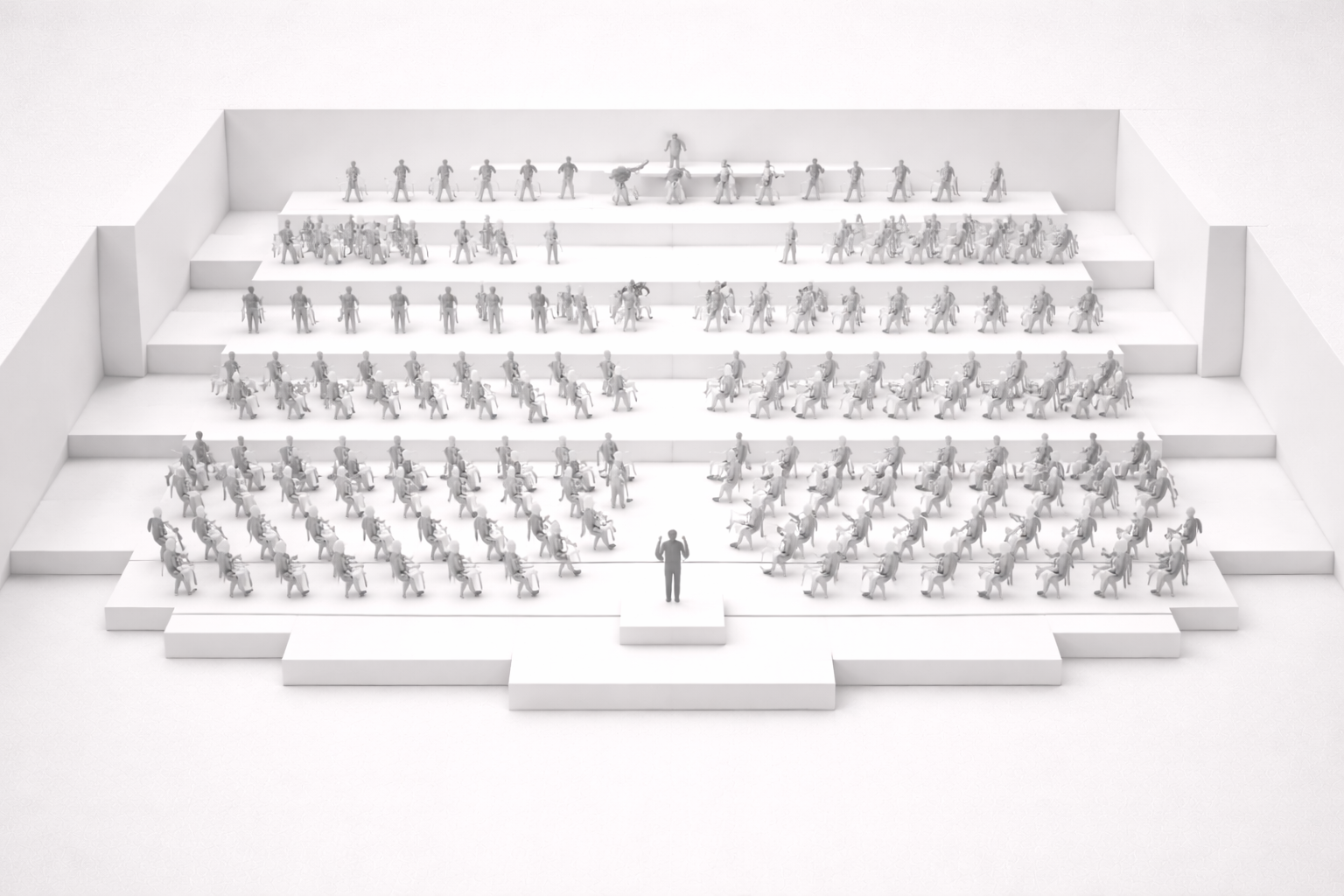
The Orchestra and the Quartet
A single figure on a small podium facing an enormous tiered orchestra of musicians arranged on ascending white platforms
The knight stands before the full orchestra of his own anticipation, every instrument tuned, every musician in position, the symphony of the possible arranged in ascending tiers before him. Sancho, seated somewhere in the back row, noted that the music had not yet started and that several of the musicians appeared to be made of the same material as the stage. “It is no matter,” said Don Quixote, raising a baton he had fashioned from a barber’s basin handle. “The overture is always the finest movement. What follows is merely music.”
The feeling — the temporal expansion, the absorbed wholeness, the radiant garden of possibility — is not a mystery to neuroscience. It has a mechanism, and the mechanism has a name, though the name is misleading. The name is dopamine.
It is misleading because most people who have heard of dopamine believe it is the pleasure chemical. It is the thing your brain releases when something feels good — chocolate, sex, a notification on your phone, a hit of your preferred substance. This is not exactly wrong, but it is wrong in a way that matters enormously for understanding the planning-execution gap. Because if dopamine were simply the pleasure chemical, then the planning state and the execution state should feel roughly equivalent: both involve the pursuit and attainment of something desirable, and both should deliver their neurochemical reward in proportion to the pleasure involved. The plan would feel good when imagined, the thing would feel good when completed, and the dopamine would flow in both directions with approximate symmetry.
But that is not what happens. What happens is what everyone who has ever lived this already knows: the plan feels better. The anticipation outshines the thing. The first night of planning is more euphoric than the first month of execution, and the question — the question that has been orbiting this investigation since its opening sentence — is why.
The answer begins in a laboratory at the University of Michigan in the late 1990s, with a group of rats that could no longer enjoy sweetness but still desperately wanted it.
Kent Berridge and Terry Robinson's landmark research, published over more than two decades of converging experiments, established what has become one of the most consequential distinctions in affective neuroscience: the dissociation of wanting from liking.
The experiment, in its simplest form, goes like this. Take a rat. Deplete its dopamine — destroy the neurons that produce it, or block the receptors that receive it. Now give the rat sugar water. The rat still shows hedonic "liking" reactions: the characteristic facial expressions and tongue movements that mammals produce when something tastes good. The sweetness is still pleasant. But the rat will not work to obtain it. Place sugar water at the end of a short runway, and the dopamine-depleted rat sits at the start, unmoved. The pleasure remains. The motivation has vanished. Dopamine, Berridge and Robinson argued, does not mediate pleasure. It mediates wanting — what they called incentive salience, the neural process by which stimuli are transformed from mere perceptions into magnetic, compelling, must-be-pursued goals.
This is not a semantic distinction. It is a distinction between two different neural systems, two different psychological experiences, and two different relationships to the future. "Liking" is a hedonic response to something present — the taste of the sugar water on the tongue, the warmth of the finished thing in your hands. It operates in the here and now. "Wanting," by contrast, is a motivational state oriented toward something absent — the sugar water at the end of the runway, the finished project in the mind's eye. It operates in the space between where you are and where you want to be. It is, in the most precise sense available to neuroscience, the chemistry of anticipation.
And here is the finding that rewrites the planning-execution gap in neurochemical terms: wanting and liking are not merely separable. They are asymmetric. The wanting system — driven by mesolimbic dopamine, centered on the nucleus accumbens and ventral tegmental area — is large, robust, and easily activated. The liking system — mediated by smaller opioid and endocannabinoid hotspots scattered through the brain — is comparatively fragile and narrow. Evolution, it appears, invested far more heavily in the machinery of desire than in the machinery of satisfaction. We are built to want more intensely than we are built to enjoy.
The implications for the planning state are immediate and far-reaching. The plan is a sustained activation of the wanting system. Every detail you add to the plan — every timeline adjusted, every dependency mapped, every risk mitigated in a risk register you will never consult — is an act of anticipation, a reinforcement of the wanted future, a fresh injection of incentive salience into a cognitive representation of something that does not yet exist. The completed project, by contrast, activates the liking system: the smaller, quieter, less neurochemically extravagant experience of having the thing rather than wanting it. The plan literally generates more dopamine than the thing. This is not a metaphor. It is a description of differential neural recruitment, and it means that the phenomenological observation from section one — the protentional ecstasy, the absorptive wholeness, the feeling of building something magnificent at 1:47 in the morning — has a mechanistic substrate. The planning state feels the way it does because it is running on the brain's most powerful motivational engine. Execution asks you to switch to a quieter system, and the difference in felt intensity is the difference between a symphony orchestra and a string quartet. Both make music. But the body knows which one fills the room.
The wanting-liking distinction explains the intensity of the planning high. It does not, by itself, explain its dynamics — the way the feeling changes as the plan develops, why the beginning of a new project is more intoxicating than its continuation, and why the thousandth planning session for the same project is less euphoric than the first. For the dynamics, we need a different piece of the dopamine story: the prediction error.
In 1997, Wolfram Schultz, Peter Dayan, and P. Read Montague published a paper in Science that would become one of the most cited in all of neuroscience. They had been recording from individual dopamine neurons in the midbrain of monkeys performing a simple reward task, and they found something that defied the pleasure interpretation of dopamine entirely. Dopamine neurons did not fire when the monkey received a reward. They fired when the monkey received a reward it did not expect. When a reward was fully predicted — when the monkey knew exactly what was coming and when — the dopamine neurons fell silent at the moment of delivery. They had already done their work earlier, at the moment the predictive cue appeared. And when an expected reward was omitted — when the cue appeared but the reward did not follow — the dopamine neurons showed a distinctive dip below baseline, a negative prediction error, the neural signature of disappointment.
The dopamine signal, Schultz and colleagues demonstrated, is not a pleasure signal. It is a surprise signal — or, more precisely, a reward prediction error signal. It encodes the difference between what you expected and what you got. Positive prediction error (better than expected) produces a burst. Zero prediction error (exactly as expected) produces nothing. Negative prediction error (worse than expected) produces a suppression. The brain's most famous reward chemical is not tracking pleasure. It is tracking news.
🎬 The reward prediction error is one of the most elegant data patterns in neuroscience. Imagine a motion graphic: three panels, three conditions. In the first, a burst of neural activity — bright, sharp, unmistakable — at the moment of an unexpected reward. In the second, the same recording, but now the burst has migrated: it fires at the predictive cue, and the reward itself produces nothing, a flat line where the celebration should be. In the third panel, the cue appears, the burst fires, but the reward never comes — and the recording dips below baseline, a visible valley, the neural trace of a broken promise. Three panels. Three relationships between expectation and reality. And the punchline, legible in the data without any interpretation at all: the brain's reward system is not a pleasure meter. It is a prediction machine, and it cares about the future more than the present.
Now apply this to planning. A new project idea is, by definition, a massive positive prediction error. One moment you had no project; the next moment you have a vision of something that could exist, something better than the baseline of no-project. The prediction error is enormous, and the dopamine burst is correspondingly large. This is the neurochemical correlate of what section one called the spark: the moment the idea arrives and the world changes shape.
But what happens as the plan develops? Each planning session adds detail, which means each session makes the future outcome more predictable. The dopamine signal, which fires for surprise, begins to quiet. The tenth hour of planning does not produce the same neurochemical burst as the first hour, because the tenth hour is not news — it is the elaboration of something already known. The plan becomes, in Schultz's terms, a fully predicted reward, and fully predicted rewards produce no dopamine at the moment of delivery. The planning high has a built-in decay function: it is most intense at the beginning, when everything is new, and it fades as the plan becomes familiar.
This is why chronic planners start new projects. Not because they are undisciplined, not because they lack focus, not because they are constitutionally incapable of commitment — but because the prediction error signal is maximally positive at the moment of inception and decays with every subsequent session of elaboration. The new project is a fresh prediction error. It is new information, new possibility, a new deviation from baseline. The old project, no matter how beautiful its plan, has been priced in. The dopamine system has already processed it. Moving to a new project is not a failure of will. It is the wanting system doing exactly what it evolved to do: pursuing the novel, the uncertain, the not-yet-known. The forty unfinished projects are not a symptom of pathology. They are a record of a prediction error system performing at peak efficiency.
And there is a further cruelty in the dynamics, which Schultz's later work clarified. Over the course of learning, the dopamine signal transfers — it migrates backward in time from the reward itself to the earliest reliable cue that predicts the reward. In the monkey experiment, the burst that originally fired at the juice delivery gradually shifted to the light that preceded the juice. The light became the trigger; the juice became expected, unremarkable, silent. In the planning context, this transfer has a devastating implication. The dopamine response migrates from the completed project (the "reward") to the planning of the project (the earliest reliable cue that the reward is coming), and from the planning to the idea for the project — the earliest cue in the chain. The further back in the sequence, the more novel and uncertain the stimulus, the stronger the signal. Having the idea produces more dopamine than making the plan, which produces more dopamine than executing the plan, which produces more dopamine than completing the project. The neurochemical payoff structure is exactly inverted from the productivity payoff structure. The brain rewards you most for the thing that gets least done.
But dopamine is not only about the magnitude of reward or the novelty of surprise. There is a third dimension to the story, and it comes from a researcher whose work sounds different from Schultz's precise computational framework but arrives at a strikingly convergent conclusion.
Jaak Panksepp, the father of affective neuroscience, spent decades arguing that the mammalian brain contains a set of primary emotional systems — not cognitive modules or computational algorithms but genuine emotional systems, experienced as felt states, shared across species, observable in behavior from rats to humans. The system most relevant to the planning-execution gap is the one Panksepp insisted on writing in capital letters: SEEKING.
SEEKING is not a system for any specific reward. It is the brain's general-purpose system for exploration, investigation, curiosity, and anticipatory engagement with the world. When a rat sniffs along a novel corridor, it is SEEKING. When a bird investigates a new food source, it is SEEKING. When a human being sits down with a blank document and begins to map out a project that doesn't exist yet, feeling a rising excitement that has no specific object but a general orientation — forward, outward, into the unknown — that is SEEKING. It is dopamine-mediated, centered on the mesolimbic pathway, and it is, in Panksepp's view, the most fundamental emotional system the mammalian brain possesses. It is what brains are for.
Panksepp's contribution changes the interpretive frame. Schultz's prediction error model describes dopamine as a learning signal — it tells you when something is better than expected so that you can update your model of the world. Berridge's wanting model describes dopamine as a motivational signal — it attaches salience to stimuli so that you pursue them. Panksepp's SEEKING describes dopamine as something more encompassing: an emotional state, a way of being in the world, a felt quality of engagement that colors everything you do while you are in it. The planning high, in Panksepp's terms, is more than a series of reward signals or a state of heightened wanting. It is a mode of being — exploratory, anticipatory, alive with the feeling of reaching toward something not yet known. SEEKING is anticipation experienced as emotion. It is what the protentional ecstasy of section one feels like from the inside of the skull.
And SEEKING, unlike a specific reward prediction, does not require a specific object to sustain itself. You can SEEK indefinitely, as long as the environment provides novelty, as long as the territory remains unexplored, as long as the plan has not yet collapsed into the single path of execution. The planning state is SEEKING paradise: an open field of novelty, each detail a new corridor to investigate, each branching decision a fresh territory to explore, and — crucially — no termination condition. The plan is never finished because SEEKING does not seek completion; it seeks continuation. The planning state sustains SEEKING the way an infinite library sustains a reader. There is always another corridor. There is always another path.
Brian Knutson's neuroimaging work provides the anatomical confirmation of what the behavioral and electrophysiological data suggest. Using functional MRI with a monetary incentive delay task — a paradigm in which participants can see a cue predicting how much money they will receive, then wait through a delay, then receive (or fail to receive) the reward — Knutson and colleagues demonstrated that the nucleus accumbens, a central node in the mesolimbic dopamine system, activates during the anticipation of reward, not during reward receipt. Moreover, the activation scales with the magnitude of the anticipated reward: bigger expected reward, stronger NAcc response.
The companion study, published the same year, went further. Reward anticipation and reward receipt recruited different brain regions. Anticipation activated the ventral striatum. Outcome activated the mesial prefrontal cortex. The two phases — looking forward and receiving — are not two temporal stages of the same neural event. They are neurologically dissociable. They run on different hardware.
This dissociation is the neuroscience version of the essay's core philosophical claim, and it deserves a moment of emphasis. Anticipation and consummation are not the same experience happening at different times. They are different experiences mediated by different neural circuits. The feeling of planning a project and the feeling of finishing a project are not the same feeling at different intensities. They are different feelings entirely. Planning and doing are not two phases of the same reward. They are two different rewards. And the anticipatory reward — the planning reward — recruits the mesolimbic dopamine system, the brain's most powerful motivational engine, while the consummatory reward recruits a different, quieter, less compelling circuit.
This is why "just start" is such inadequate advice for the chronic planner. It assumes that the person is experiencing one continuous reward signal that has simply stalled at the anticipatory phase, and that a little push will carry the signal forward into the consummatory phase. But the neuroscience says otherwise. The anticipatory phase and the consummatory phase are not one signal. They are two signals running on two systems, and the transition from one to the other is not a continuation but a switch — a shift from one neural mode to another, with an attendant change in felt quality, motivational intensity, and emotional register. Starting the project does not extend the planning high into the doing phase. It terminates the planning high and replaces it with something categorically different. No wonder the transition feels like loss. Neurologically, it is.
The neuroscience of dopamine, prediction error, and anticipatory reward describes the hardware of the planning high: which circuits activate, which chemicals flow, which signals fire. But hardware alone does not explain the planning-execution gap. The plan is not generated by dopamine neurons in isolation. It is generated by a mind — by the cognitive systems that construct future scenarios, estimate their likelihood, evaluate their emotional impact, and generate the vivid, coherent, internally consistent representations that the dopamine system then labels with incentive salience. To understand why the plan is so compelling, we need to understand how the mind builds it. We need to move from neuroscience to cognitive psychology, from the dopamine system to the simulation system, from the chemistry of wanting to the architecture of imagining.
The central finding of cognitive psychology's engagement with future-oriented thought can be stated simply, though its implications are profound: the brain does not store the future. It constructs it. Every time you imagine a future event — the completed project, the launched business, the finished essay — your brain is running a constructive simulation, pulling fragments of episodic memory from different contexts, recombining them into a novel scenario, and presenting the result to consciousness as a coherent experience of something that has not happened.
Daniel Schacter and Donna Rose Addis, in their foundational work on what they called the "constructive episodic simulation hypothesis," demonstrated that this process relies on the same neural machinery as episodic memory — particularly the hippocampus, which recombines elements from stored experiences into new configurations. This is why memory is so error-prone: the system was not optimized for archival fidelity. It was optimized for generative flexibility. We remember in order to imagine. We store the past in order to construct the future. The memory system is, at its deepest evolutionary level, a planning system.
The planning state, then, is not a detached cognitive exercise, a spreadsheet for the mind. It is an act of imaginative construction — a sustained engagement of the brain's most sophisticated simulation machinery, pulling together fragments of past experience (the time you successfully organized a similar project, the feeling of flow when you were deep in related work, the specific sensory details of the environment where the thing will be built) and weaving them into a future scenario so vivid, so detailed, so emotionally rich that it is experienced not as a hypothesis but as a preview. The plan feels real because the simulation system generates it with the same machinery it uses to relive actual experiences. The difference between remembering your last vacation and planning your next project is, at the neural level, surprisingly small. Both are constructive acts. Both are imaginative. Both feel like experience. But only one of them — the memory — is constrained by what actually happened. The plan is constrained by nothing except the planner's generative capacity, and this asymmetry is the source of both the plan's beauty and its deception.
The deception has a name in cognitive psychology, and it was given that name by the two researchers who have done more than anyone to map the systematic errors of human judgment: Daniel Kahneman and Amos Tversky.
In 1979, Kahneman and Tversky introduced the concept of the "planning fallacy" — the robust finding that people systematically underestimate the time, cost, and difficulty required to complete future tasks, even when they have extensive experience with similar tasks in the past. The planning fallacy is not a minor miscalibration. It is a dramatic, persistent, and nearly universal bias. In the landmark empirical work by Roger Buehler, Dale Griffin, and Michael Ross, students asked to predict when they would complete their senior thesis were optimistic by an average of more than three weeks — and this optimism persisted even when they were explicitly reminded of how long their previous projects had taken. The past, it seems, has no authority over the future when the future is being imagined from inside a plan.
Kahneman and Tversky's explanation centers on the distinction between the "inside view" and the "outside view." The inside view is the perspective you adopt when you construct a narrative about a specific case: this project, with these resources, following this plan, encountering these (carefully managed) risks. The outside view is the perspective you adopt when you consult the base rate: projects like this one, attempted by people like you, typically take this long and cost this much and fail at this rate. The planning fallacy occurs because planning — the act of sitting down and imagining how the project will unfold — is, by its very nature, an inside-view activity. You are constructing a specific narrative, and specific narratives are coherent and emotionally compelling. The outside view — the statistical reality — is abstract, impersonal, and motivationally inert. The plan wins because stories always beat statistics, and a plan is a story you tell yourself about the future.
But Buehler and colleagues' most revealing finding was not about the magnitude of the bias. It was about its persistence. In their fourth study, they demonstrated that the optimistic bias could be eliminated — but only when participants were forced to explicitly connect their past prediction failures to their current prediction. Left to their own devices, people attributed past failures to external, transient, and case-specific causes: that project took longer because of bad luck, because of an unreliable collaborator, because the scope changed mid-stream. These attributions preserved the integrity of the planning process itself. The planner's model of planning remained intact; it was reality that had misbehaved. This means the planning fallacy is not about lacking information. People know they have overshot before. They know their track record. What they do is segregate the information — they quarantine the evidence of past failure in a cognitive compartment that is not consulted when the next plan is being built. Each plan exists in its own epistemic bubble, insulated from the lessons of every previous plan. Each plan feels like the first plan.
This segregation is the cognitive psychology version of the phenomenological point from section one. Husserl's protentional ecstasy — the wide-open temporal horizon of the planning state — is not a temporal experience alone. It is a cognitive structure that actively excludes the kind of information that would make the plan realistic. The plan's horizon is wide because it is not looking at the ground. The plan feels whole because it has not been tested. And the plan feels like the first plan because the memory of past plans has been filed in a drawer marked "irrelevant to the current case."
Kahneman, in his synthesis Thinking, Fast and Slow, located the planning fallacy within a broader framework of cognitive duality: System 1 (fast, intuitive, narrative-driven, emotionally resonant) and System 2 (slow, analytical, statistical, effortful). Planning, he argued, is a System 1 activity dressed in System 2 clothing. It feels analytical — you are making spreadsheets, drawing timelines, estimating task durations with apparent precision. But the cognitive mode is narrative, not statistical. The plan is a story, and stories are System 1's native format. This is why the plan feels so convincing and why it is so systematically wrong: it has the phenomenological texture of careful analysis while running on the engine of intuitive narrative. The spreadsheet is not doing math. It is telling a story in cells and columns, and the dopamine system, which cannot distinguish between a calculated prediction and a compelling narrative, rewards the story with the same anticipatory burst it would give to any compelling image of a desirable future.
The simulation system builds the plan; the planning fallacy inflates it; and a third cognitive mechanism delivers the final piece of the puzzle: the plan doesn't just feel better than it should — it feels better than the execution will.
Timothy Wilson and Daniel Gilbert, in two decades of research on "affective forecasting," demonstrated that people are systematically poor at predicting how future events will make them feel. Specifically, people overestimate both the intensity and the duration of their emotional reactions to future outcomes — positive and negative alike. This "impact bias" means that lottery winners are less happy than they expected to be, accident victims are less miserable than they feared, and the person who has just imagined a completed project is experiencing, right now, in the simulation, a more intense version of the satisfaction than the actual completion will ever deliver.
The mechanism is what Gilbert calls "focalism" — when imagining a future event, we focus narrowly on the event itself and fail to account for everything else that will be happening at the same time. The imagined future in which the project is complete is a future in which the project is the only salient thing. The actual future in which the project is complete is a future in which the project is one item in a crowded field of ongoing concerns, competing demands, and ambient life noise. The plan's emotional intensity is an artifact of attentional isolation. The execution's emotional reality is an artifact of attentional competition.
Gilbert, in Stumbling on Happiness, put this memorably: imagination is a "poor simulation" of experience. It fills in details incorrectly, omits crucial information, and fails to account for our remarkable capacity to adapt to new circumstances. The essay's extension of this argument is that affective forecasting errors don't merely distort the prediction of how completion will feel — they enhance the experience of planning, because the imagined completion is more emotionally compelling than any real completion could be. The plan is not a bridge to the thing. The plan is a replacement for the thing — a version of the thing that is optimized for emotional impact rather than accuracy, and that delivers its emotional payload immediately, in the planning state itself, rather than deferring it to the uncertain future of execution.
Shelley Taylor and colleagues, in a study that crystallizes this point with experimental precision, distinguished between outcome simulation (imagining the desired end state) and process simulation (imagining the steps required to reach it). They found that process simulation improved performance on a subsequent task, while outcome simulation — paradoxically — reduced it. Imagining the completed outcome provided a premature emotional payoff that undermined the motivation to do the work. The plan, in Taylor's terms, is not merely a preview of the reward. It is a pre-delivery of the reward. The dopamine system cannot tell the difference between vividly imagining the finished project and actually finishing it — or rather, it can, but the difference works in the wrong direction: the imagined version, unconstrained by reality, generates more anticipatory signal than the real version ever could.
This finding converges with the neuroscience from a different direction and closes the loop with ruthless symmetry. Berridge's wanting system responds to anticipated rewards. Schultz's prediction error system fires for positive surprises. Knutson's fMRI data shows the nucleus accumbens lighting up during anticipation, not receipt. Panksepp's SEEKING system sustains itself through exploration and novelty. And now Taylor's process-outcome distinction demonstrates that the cognitive act of imagining the outcome provides the emotional satisfaction prematurely. The plan is not just the anticipation of a reward — it is the experience of a reward, delivered by a simulation system that is optimized for richness and a wanting system that cannot distinguish detailed imagination from actual reality. The plan substitutes for the thing. And the substitution is neurochemically preferred.
There is one more cognitive mechanism that must be named, because it completes the trap.
Bluma Zeigarnik, a Soviet psychologist working in the 1920s, observed that waiters in a Berlin restaurant could remember the details of unpaid orders with remarkable accuracy — but forgot them almost immediately once the bill was settled. The observation became the Zeigarnik effect: incomplete tasks persist in working memory, creating a state of cognitive tension that is only relieved by completion (or by its cognitive equivalent). Unfinished business occupies the mind.
Roy Baumeister and colleagues, decades later, discovered a telling addendum. The cognitive tension of an incomplete task could be relieved not only by completing the task but by making a plan to complete it. The mind's bookkeeping system, it turns out, treats "I have a plan" as approximately equivalent to "I have finished" in terms of clearing the task from active cognitive monitoring. Making a plan reduces the psychological pressure that would otherwise drive you toward execution. The plan is its own sedative.
This is the Zeigarnik trap. The unfinished project nags at you — it occupies working memory, generates low-grade cognitive load, produces the ambient restlessness that section one located as the starting condition of the planning state. You sit down to address this restlessness. You open a document. You begin to plan. The planning state delivers its dopaminergic rewards — the prediction errors, the wanting signals, the SEEKING engagement, the rich outcome simulations. And then, when the plan reaches a state of sufficient detail, the Zeigarnik tension releases. The mind registers the plan as a commitment, marks the task as handled, and frees the cognitive resources it had been devoting to the unfinished business. The restlessness subsides. The cognitive load clears. You feel — and this is the word everyone uses, without knowing how accurately it describes the mechanism — you feel satisfied.
You have done nothing. But you feel satisfied, and the feeling is not a delusion — it is a veridical report from a cognitive system that has, by its own internal accounting standards, resolved the open loop. The plan closed the loop. The plan was the completion, as far as the mind's task-management system is concerned. And now the motivational pressure that might have driven you from plan to execution has been elegantly, neurochemically dissolved. You close the laptop. You go to sleep. You feel wonderful.
And yet there is a further dimension to the cognitive architecture of the plan — one that explains not only why the plan feels good but why it feels understood, why the planner experiences such extraordinary confidence in a vision that has never been tested against reality.
Leonid Rozenblit and Frank Keil, in a study published in 2002, documented what they called the "illusion of explanatory depth." People believe they understand how things work — toilets, zippers, helicopters, the political issues they hold strong opinions about — far better than they actually do. This illusion is robust and pervasive, but it has a specific trigger condition: it persists only as long as the person is not asked to actually produce the explanation. The moment someone is asked to describe, step by step, how a toilet flushes — to generate the full causal chain rather than gesture at the general principle — their confidence collapses. They discover that their sense of understanding was a feeling, not a fact. It was the phenomenological texture of familiarity mistaken for the cognitive reality of comprehension.
The plan is an illusion of explanatory depth applied to the future. The plan feels like understanding because it is rich, detailed, and internally coherent. Its components relate to one another in a structure that looks, from the inside, like a complete model of the project. But the coherence of the plan is not the same as the competence required to execute it. The plan is a description of the project at one level of resolution — the level that can be maintained in the imagination, the level that flows when you map it in your project management software. Execution operates at a different level of resolution entirely — the level where the API documentation is wrong, where the collaborator disagrees, where the material resists the tool, where the abstract dependency reveals itself as a concrete problem that the plan never specified because the plan could not see it.
Asher Koriat, Sarah Lichtenstein, and Baruch Fischhoff, in a foundational study on overconfidence, demonstrated the mechanism by which this illusion sustains itself. When people generate reasons supporting a judgment, their confidence in the judgment increases — even when the judgment is incorrect. The act of elaboration creates a subjective sense of validity that is uncalibrated to actual accuracy. Each reason feels like evidence. Each supporting argument feels like a pillar. And the plan is, at its core, a machine for generating reasons for confidence. Every detail you add is a reason to believe the plan will work. Every timeline, every milestone, every carefully labeled dependency is an argument for the plan's feasibility. The plan becomes more convincing not because it becomes more realistic but because it becomes more elaborated. Confidence grows with detail, even when — especially when — the details have never been tested.
This is why the plan survives contact with the planner's own track record. The planning fallacy's segregation of past failures is more than a motivational bias. It is supported by a cognitive architecture that generates illusory understanding through elaboration and illusory confidence through reason generation. The plan does not merely ignore the evidence that it will fail. It generates its own counter-evidence — the internal coherence of its details, the felt comprehensiveness of its scope, the subjective experience of "I have really thought this through" — and this counter-evidence, experienced from the inside, outweighs the dim, abstract, statistically valid but emotionally inert knowledge that plans like this one usually don't work.
What emerges from the convergence of neuroscience and cognitive psychology is not a single explanation but a system — an interlocking set of mechanisms that, taken together, describe a trap so elegant it could have been designed:
The idea arrives, and the prediction error system fires: massive positive surprise, the biggest dopamine burst in the sequence. The wanting system activates: incentive salience is attached to the imagined future, which becomes magnetic, compelling, must-be-pursued. The SEEKING system engages: exploratory, forward-leaning, sustained by novelty and open possibility. The constructive simulation system builds the plan: fragments of memory recombined into a coherent, emotionally rich future scenario. The affective forecasting system inflates the plan's emotional value: the imagined completion is more compelling than any real completion could be. The inside view insulates the plan from the outside view: each plan is experienced as unprecedented, insulated from the history of plans that came before. The illusion of explanatory depth convinces the planner that the plan is understood at the depth required for execution. The reason-generation mechanism converts each added detail into a unit of confidence. And then the Zeigarnik mechanism delivers the coup de grâce: the completed plan discharges the cognitive tension that would have driven execution, leaving the planner satisfied, resolved, and motivationally inert.
Each mechanism, in isolation, is well-documented, empirically grounded, and — importantly — adaptive. Wanting without liking motivates the pursuit of distant rewards. Prediction error drives learning. SEEKING sustains exploration. Constructive simulation enables flexible planning. Affective forecasting, though inaccurate, motivates goal pursuit. The inside view enables the optimism necessary to begin anything. The illusion of understanding provides the confidence necessary to act on incomplete knowledge. The Zeigarnik mechanism frees cognitive resources for new tasks. Each one is a feature, not a bug. Each one was selected for because it serves the organism's interests.
But together — in concert, in a mind that has access to all of them simultaneously — they produce a system that is exquisitely calibrated to make the plan the most rewarding thing that will ever happen to the project. The plan is where the wanting is strongest, the prediction errors are largest, the SEEKING is most engaged, the simulation is most vivid, the affect is most positive, the inside view is most compelling, the understanding feels most complete, and the Zeigarnik tension is most fully resolved. Execution reverses every one of these. The wanting decays as the outcome becomes expected. The prediction errors turn negative as the project proves harder than imagined. The simulation is replaced by a reality that is less coherent and less kind. The understanding, which felt so complete and so earned, is exposed by the first collision with materials that do not behave as the plan assumed they would. What was a symphony of reinforcement becomes a series of small disappointments, each one confirming what the dopamine system already suspected: the best part is over.
The planning-execution gap is not one bias. It is a conspiracy of adaptations — a convergence of systems, each functioning precisely as designed, that together produce a lived experience in which the planning state is neurochemically, cognitively, and emotionally preferable to the execution state. The chronic planner is not failing to overcome a single obstacle. They are being held in place by a distributed system of reinforcement that has been tuned by millions of years of evolution to sustain exactly the kind of anticipatory, exploratory, possibility-rich engagement that planning provides.
And here is the thought that should accompany this realization — the thought that the formal argument, when it arrives in its full precision in a later section, will render as mathematics: this is not your fault. The architecture is doing what the architecture does. The dopamine is doing what the dopamine does. The simulation system is doing what the simulation system does. The question is not why you fail to bridge the gap. The question is how anyone, ever, manages to bridge it at all.
The answer, it will turn out, is complicated. It is an answer that requires philosophy, economics, and clinical psychology — but not yet. There is a prior question that the neuroscience and cognitive psychology, for all their explanatory power, cannot reach. They have explained why the plan feels better. They have not explained what the plan is.
Because the architecture has produced something peculiar. It has produced an object — the plan itself — that sits in the mind with a strange solidity. Not a thought, exactly. Not a prediction. Something heavier than a wish and lighter than a deed. The plan becomes a thing: complete, self-contained, admired by its maker, resistant to its own dissolution. It is also — though this is a history the essay has not yet reached — an object that a particular culture has spent five centuries sanctifying. What kind of thing is this? What is its status in the ontology of human action? That is the question philosophy has been asking since Aristotle, and it is the question the plan's perfection now demands.
The Perfect Object That Cannot Move

The Cabinet of Unfinished Wonders
A white room with shelves and pedestals displaying dozens of small architectural models and unfinished structures, each one complete in itself
This is the room Frestón does not want you to see: the cabinet where every plan the knight has ever perfected sits complete upon its shelf, each one a small and luminous architecture, each one radiant with the life it was never asked to live. Sancho counted them once and lost count at forty. “They are not abandoned,” Don Quixote corrected him gently. “They are preserved.” The distinction, dear reader, is the entire subject of this essay, and if you find it unconvincing, you have perhaps never stood in such a room and felt what the knight feels, which is not shame but something closer to reverence.
There comes a point — and if you have lived this, you will recognize the point with the precision of a person identifying the exact moment a fever breaks — when the plan stops growing and starts being.
The idea arrived (section one). The brain built it into something elaborate and rewarding, each detail triggering another cascade of anticipation, each revision generating its own private dopamine event (section two). But at some point — it might be the third evening, or the third week, or the third month — the plan reaches a state that the planner experiences as completion. Not completion in the sense that the project is done. The project has not been started. Completion in the sense that the plan itself has achieved a kind of formal perfection. Every component relates to every other component. The timeline is internally consistent. The risk register accounts for the risks. The dependencies flow. The thing sits there, in the document or the notebook or the mind, and it is whole — not because nothing is missing but because what is missing has been so elegantly anticipated that its absence feels like design rather than deficit.
This is the plateau. It is the most dangerous moment in the entire planning-execution cycle, and it is also, by a considerable margin, the most beautiful.
It is dangerous because this is where projects go to die. Not with the dramatic crash of a failed launch or the humiliating public collapse of an overambitious vision, but with the quiet, private, almost imperceptible shift from a plan I am going to execute to a plan I have. The plan becomes an object. It sits on the shelf alongside the other objects — the novel outline from 2019, the business plan from 2021, the course curriculum from last spring — each one complete in itself, each one a small, perfect world that never made contact with the larger, imperfect one. The plateau is where the plan transitions from instrument to artifact, from blueprint to sculpture, from something you use to something you admire.
And the philosophical tradition, it turns out, has been thinking about this transition for a very long time.
Michael Bratman, writing in 1987, produced the most influential philosophical account of what plans are and what they do. His Intention, Plans, and Practical Reason argued for something that sounds obvious until you examine it closely: intentions are not just strong desires. They are a distinct kind of mental state — specifically, they are partial plans of action that play specific functional roles in the architecture of practical reasoning. When you intend to do something, you do not merely want to do it very much. You have committed yourself to a course of action that now constrains your future deliberation, coordinates your behavior across time, and provides the scaffolding for increasingly detailed sub-plans.
Three features of Bratman's plans matter enormously for the phenomenon the essay is investigating, and the first cuts deepest.
Plans are partial. A plan does not specify everything. It cannot. It is, by its nature, a structure that leaves room — room for detail to be filled in later, for sub-plans to be developed as circumstances become clearer, for the future self to exercise judgment at the moment of action. Bratman considered this a feature, not a bug: plans work because they don't try to specify everything in advance. They provide structure while leaving space.
But here is what Bratman did not consider, because he was building a theory of rational agency and not investigating a phenomenological puzzle: the partiality of the plan is also the source of its beauty. Every unspecified detail is a decision the planner has not yet made, and every unmade decision is a possibility that has not yet been foreclosed. The plan's open spaces — the places where it says "to be determined" or simply does not say anything at all — are not voids. They are reserves of possibility. The plan feels generative, feels alive, feels saturated with future, precisely because it is incomplete. Bratman showed that plans must be partial to function. The essay adds: they are beautiful because they are partial. A fully specified plan — one that left nothing to future judgment — would be indistinguishable from a set of instructions, and no one has ever felt the planning high while reading a set of instructions. The magic lives in the gaps.
But the gaps are only part of the plan's power. Plans are also hierarchically structured. Large plans contain sub-plans; sub-plans contain sub-sub-plans; and at each level, the structure relates to the levels above and below it. This hierarchy is the source of the plan's characteristic elegance. When you look at a well-organized project plan — the color-coded timeline with its nested dependencies, the outline with its Roman numerals and indented sub-points, the architectural drawing with its elevations and cross-sections — you are seeing a hierarchy rendered visible, and hierarchies have an aesthetic power that is not incidental. They suggest comprehensiveness without requiring it. They promise that everything belongs somewhere, that nothing has been forgotten, that the whole is organized. The hierarchical plan does more than represent the project. It represents the planner's mastery of the project — their capacity to hold complexity in an ordered structure, to see the forest and the trees, to operate at every level of abstraction at once. The plan is a portrait of competence.
And there is a third feature, the one that closes the trap. Plans are commitment-generating. Once formed, Bratman argued, a plan should resist reconsideration. This is not stubbornness but rationality: if you reconsidered your plans every time a new thought occurred to you, the plans would serve no coordinating function at all. Plans work by settling matters in advance — by taking certain questions off the table so that the agent can focus on other things. The plan, in Bratman's framework, is a kind of cognitive relief. It resolves the question of what to do, freeing the agent from the paralyzing demand to deliberate from scratch at every moment.
But this commitment-generating property, so useful in theory, produces something peculiar in practice. The plan resists reconsideration, yes — but what it resists most powerfully is not the reconsideration of its contents (should I use a different framework? should I adjust the timeline?) but the reconsideration of its status (should I stop planning and start doing?). The plan generates commitment to itself. It becomes the default. And the transition from planning to execution — which is, from Bratman's perspective, simply the next step in the rational unfolding of a plan-governed life — becomes instead a disruption, a departure from the comfortable, commitment-generating structure that the plan has created. The plan was supposed to be the scaffolding for action. It has become the architecture of inaction, and its very rationality — its resistance to reconsideration — is what holds the planner in place.
This is the point where philosophy reveals something that neuroscience and cognitive psychology could not see clearly on their own. The brain's reward mechanisms explain why planning feels better than execution. But they do not explain why the plan becomes an object of devotion — something the planner returns to, refines, protects, identifies with. For that, we need a different philosophical register. We need to understand the plan not just as a mental state but as a self-portrait.
Christine Korsgaard, in Self-Constitution, argued that agency is not something you have. It is something you do. You constitute yourself as an agent through your practical reasoning — through the plans you make, the principles you endorse, the projects you commit to. The self is not a fixed thing that acts; it is a thing that comes into being through acting. The good agent achieves a kind of unity — their desires, their principles, and their actions cohere into an integrated whole. The fragmented agent fails at this integration, experiencing themselves as pulled in different directions by impulses they do not endorse.
The plan, read through Korsgaard, is an act of self-constitution. When you build a plan — when you specify the project, organize the timeline, anticipate the obstacles, design the architecture — you are doing more than describing a future project. You are constructing a version of yourself. The planner is organized, purposeful, capable, foresightful. The plan's elegance is the planner's elegance. Its comprehensiveness is their competence. Its ambition is their identity. The plan is a mirror that shows you the self you want to be, and the reflection is flawless because the mirror has not yet been tested against the world.
This is why the plan is so hard to leave. The reasons are not laziness or willpower failure or dopamine's hostage-taking — though all of these are true in their respective disciplinary registers. The plan is hard to leave because leaving it means leaving a version of yourself. The executing self is not the planning self. The executing self encounters failure, makes compromises, produces work that is less elegant than the plan that specified it. The executing self discovers — and this is the discovery that Korsgaard's framework makes visible — that the integrated, unified agent of the plan was a projected unity, not an achieved one. The real agent, the one who shows up to do the work, is fragmented, distractible, limited, and does not, in the daily struggle of execution, recognize the calm, masterful, comprehensive self that the plan had constituted.
Execution threatens the self. Not in a dramatic, existential way — though we will get to the existential register shortly — but in the quiet, daily way that any encounter with reality threatens a self-image built on imagination. The gap between the planning self and the executing self is, at bottom, a gap between two versions of the person, and the planning version is the one the planner would rather be.
J. David Velleman saw something adjacent but distinct: the plan is not just a self-portrait but a story. In Practical Reflection, Velleman argued that practical reasoning — the process of figuring out what to do — is fundamentally narrative. We do not simply select actions that maximize expected utility; we choose actions that make narrative sense, that fit into a comprehensible story about who we are and what we are doing. Intentions are not bare commitments to future action but elements of an ongoing self-narrative — the plot points in a story the agent is telling about themselves.
The plan, in Velleman's terms, is a complete story. It has a beginning (the current situation), a middle (the process of execution), and an end (the completed project, the achieved goal, the life after the thing is done). It has rising action, logical structure, and narrative coherence. And stories, as every reader knows, are inherently satisfying. They resolve. They make sense. They progress from disorder to order, from question to answer, from tension to release. The plan delivers narrative satisfaction in advance of any actual events — it provides the feeling of a coherent story without requiring anything to actually happen.
Execution, by contrast, is what happens when the story meets life. And life, as Velleman's framework makes painfully clear, is not narrative. Life does not proceed from beginning to middle to end in a coherent arc. Life is digressive, repetitive, full of false starts and dead ends and irrelevant subplots that go nowhere. The chapter that was supposed to take two weeks takes three months. The elegant dependency structure of the timeline is revealed as a fiction by the second week, when an upstream task and a downstream task turn out to be the same task and neither of them is what the plan said they were. The narrative coherence of the plan — its beautiful story-like structure — is shattered by execution's refusal to follow the script. The plan was a novel. Execution is a diary. And no one has ever felt the planning high while keeping a diary.
Martin Seligman and his colleagues, in Homo Prospectus, crystallized the philosophical point that unifies these observations. Their argument is sweeping and, for the essay's purposes, decisive: the defining feature of human cognition is not memory, not perception, not language, not reason. It is prospection — the ability to represent, evaluate, and be guided by possible futures. We are not homo sapiens, the wise. We are homo prospectus, the beings who look ahead. Our minds are, at their most fundamental level, simulation engines — designed not to record the past or attend to the present but to generate representations of possible futures and use those representations to guide present action.
If Seligman is right — and the convergence of neuroscience, cognitive psychology, and evolutionary biology makes a powerful case that he is — then the planning state is not a deviation from our normal cognitive mode. It is an intensification of it. To plan is to do what human minds do most essentially. The planning high is the experience of being fully, exquisitely, comprehensively human — the prospective machinery running at peak capacity, generating vivid, detailed, emotionally rich representations of possible futures. The plan is not a distraction from the main event of living. The plan is the main event, the cognitive activity that most fully engages the capacities that make us what we are.
Execution, by contrast, is a forced descent. It is the narrowing of the prospective horizon from all possible futures to the single track of what-is-actually-happening. It is the exchange of simulation's richness for reality's constraint. It is, in terms Seligman's framework makes explicit, a partial disengagement of the very cognitive system that defines human nature. We resist execution not because we are weak but because execution asks us to stop doing the thing we are most fundamentally built to do. The planning state is our native element. Execution is the shore.

The Wheel That Holds
A fragmenting circular disc structure suspended in white space, its segments separating like the hours of a clock that has lost its mechanism
And this is where the essay must confront the oldest question in the philosophy of action, the question that Aristotle posed in Book VII of the Nicomachean Ethics and that two and a half thousand years of subsequent philosophy have not conclusively resolved: if the planner knows that executing the plan is the right thing to do, why don't they do it?
The formal name is akrasia — weakness of will, acting against one's better judgment. Donald Davidson, in his landmark 1970 essay, formulated the puzzle with characteristically analytic precision. The akratic agent draws a conditional conclusion — all things considered, it would be best to do A — and then acts on a different, unconditional judgment: do B. Davidson's question: how can a rational agent perform an action they themselves judge to be suboptimal? His answer: they can, but it is irrational. The akratic agent is, by definition, a rational agent who has done something irrational.
The chronic planner fits Davidson's structure with uncomfortable precision. The planner judges, all things considered, that execution is the right next step. The plan is complete. The resources are available. The timeline is clear. Execution is the obvious, rational, all-things-considered best action. And yet the planner does something else: they revise the plan. They add a detail. They open a new document. They start a related sub-project. They do anything — anything at all — other than the thing they have themselves determined they should do.
But Richard Holton, writing in 1999, offered a crucial correction to Davidson that transforms the essay's argument. Holton argued that weakness of will and akrasia are not the same phenomenon. Akrasia, in Davidson's sense, is acting against a standing judgment. Weakness of will, in Holton's sense, is unreasonably revising one's intention. The distinction matters enormously. The chronic planner is not, or not typically, acting against a judgment they continue to hold. They are changing the judgment. At 9 PM, they judge that tomorrow they will begin execution. At 9 AM tomorrow, they judge — genuinely, sincerely, with the full phenomenological texture of a considered decision — that the plan needs one more revision. The intention to execute is not overridden; it is revised. And the revision feels reasonable in the moment because the planning state provides, as section two documented at length, a cognitive environment in which the plan always seems to need one more thing.
This is Holton's insight, and it is devastating: the plan itself is the temptation. In classical akrasia, the agent is tempted by something external — the chocolate, the drink, the afternoon in the sun when they should be working. In the planning-execution gap, the agent is tempted by the very activity that is supposed to lead to the goal. Planning is both the preparation for action and the alternative to it. The plan is both the map and the destination. And the weakness of will that Holton describes — the unreasonable revision of intention under the pressure of temptation — is unreasonable because the temptation is indistinguishable, from the inside, from productive work. The planner who revises the plan instead of executing it does not experience themselves as procrastinating. They experience themselves as planning, which is what responsible, organized, competent people do.
Alfred Mele added a further dimension: self-deception. The chronic planner may not merely be weak-willed in Holton's sense — they may be self-deceived, genuinely believing that the revision is necessary, that the plan is not yet ready, that one more pass through the document will produce the clarity required for confident execution. The self-deception is sustained by the cognitive architecture documented in section two: the illusion of explanatory depth (the plan feels more understood than it is), the reason-generation mechanism (each added detail increases subjective confidence), and the inside view (this plan is different from all previous plans, which is why it deserves one more revision). The planner is not lying to themselves in the crude sense. They are embedded in a cognitive environment that systematically produces false beliefs about the plan's completeness and their own readiness to execute — and the philosophical tradition's word for this condition, stripped of its moral connotations, is akrasia.
Aristotle, who started all of this, had already identified the mechanism. The akratic person, he wrote, has knowledge "in a way" — they know the general principle (plans should lead to action) but fail to apply it to the particular case (this plan, right now, should lead to action right now). The general principle remains abstract; the particular case generates a contrary motivation that is vivid and immediate. This is exactly the inside-view/outside-view distinction that Kahneman and Tversky would formalize twenty-three centuries later: the planner knows, in general, that plans like this one tend to remain plans. But this knowledge exists at the level of statistical abstraction — the outside view. The inside view — this plan, this project, this time — is vivid, specific, and optimistic. The general principle cannot compete with the particular experience. Aristotle saw this. He called it a failure of the practical syllogism. We might call it the most persistent structural feature of human cognition.
But there is one more philosophical register that the plateau demands — the one that captures not the rational structure of the failure but the emotional texture of the moment before execution. For this, we need Kierkegaard.
In The Concept of Anxiety, published in 1844, Søren Kierkegaard described an emotion that had no proper name in philosophy: the dizziness of freedom. Anxiety, for Kierkegaard, is not fear. Fear has an object — you are afraid of the bear, the exam, the diagnosis. Anxiety has no object. It is directed at possibility itself — at the vertiginous recognition that you can choose, and that choosing means becoming one thing at the cost of not becoming everything else. "Anxiety is the reality of freedom as possibility before the possibility." The anxious person stands at the edge of an abyss that is not a threat but an opening — the infinite space of what they might do, what they might become, what they might bring into existence. The dizziness is not the fear of falling. It is the recognition that you could jump, that jumping is available, that the jump would be yours.
The plateau is Kierkegaardian anxiety rendered as a project management state. The plan is complete. Every path is visible. The possibilities coexist, each one available, each one real in the way that only an unrealized possibility can be real — which is to say, real in imagination, real in prospection, real in the dopamine system's assessment of value, but not yet real in the way that actual things are real. The planner stands at the apex of possibility and looks out over the landscape of what the project could become. Every version of the finished work exists simultaneously. Every path through the plan is illuminated.
And Kierkegaard's insight — the one that cuts deepest, the one that the neuroscience and the cognitive psychology and the rational-choice models cannot reach — is that this vertiginous moment is not only terrifying. It is thrilling. The dizziness of freedom is not pure dread. It is dread and exhilaration at once, inseparably fused, the way the view from a great height is both beautiful and vertigo-inducing in the same instant. The planning high includes the anxiety. The anxiety is part of what makes the planning high so intense. You are standing at the edge of everything the project could be, and the feeling is simultaneously "I could make something extraordinary" and "if I step forward, I will lose everything else it could have been." The thrill and the dread are not successive — they are concurrent, they are aspects of the same experience, and the planner who stays on the plateau is not simply enjoying the thrill. They are also refusing the dread. They are maintaining the vertiginous beauty of maximum possibility by declining to collapse it into the singularity of action.
This is the emotional core of the plateau: the plan feels perfect because it holds everything. The project-as-imagined contains every version of itself, and the feeling of standing in the presence of that multiplicity — of being the author of a world that has not yet been narrowed into actuality — is the feeling that section one described as protentional ecstasy and section two described as peak dopaminergic engagement and that philosophy, in Kierkegaard's register, describes as the dizziness of freedom. All three descriptions are accurate. None is complete without the others. And none of them fully explains why the plateau feels the way it does without one more disciplinary lens — the one that renders the observation not as phenomenology or neuroscience or philosophy but as mathematics.
Claude Shannon, working at Bell Labs in 1948, produced a paper that would become the foundation of the digital age. "A Mathematical Theory of Communication" did something that had never been done before: it defined information mathematically. And the definition, when you encounter it for the first time, is counterintuitive to the point of disorientation.
Information, in Shannon's framework, is not meaning. It is not knowledge. It is not the content of a message. Information is the resolution of uncertainty. A message carries information to the extent that it tells you something you did not already know — to the extent that it reduces the number of possible states the world could be in. A fair coin flip carries exactly one bit of information: before the flip, you don't know heads or tails; after the flip, you do. One question answered, one bit of uncertainty resolved. A loaded coin that comes up heads ninety-nine percent of the time carries almost no information when it comes up heads — you already knew it would. The surprise is the information.
Shannon formalized this intuition with the concept of entropy — a mathematical measure of uncertainty, of the number of possible states a system could be in, of the surprise remaining in a source of messages. High entropy means high uncertainty, many possible states, lots of surprise left. Low entropy means low uncertainty, few possible states, the outcome mostly determined. A fair coin has maximum entropy for a two-state system. A loaded coin has low entropy. A perfectly predictable source — one that always sends the same message — has zero entropy: no uncertainty, no information, no surprise.
And here is where Shannon's mathematics touches the planning state with a precision that no other framework has achieved.
The plan is a high-entropy object. It is saturated with unresolved uncertainty. Every detail the plan has not specified — every "TBD," every gap in the timeline, every creative decision deferred to the execution phase — is a source of entropy, a fork not yet taken, a coin not yet flipped. The plan for a novel contains every novel it could become. The plan for a business contains every business. The plan for a life contains every life. The more ambitious the plan, the more unspecified its details, the higher its entropy — and the richer, the more shimmering, the more full of possibility it feels. The planning high, described in Shannon's terms, is the subjective experience of being in the presence of a high-entropy object. It is the feeling of standing before a system so saturated with unresolved possibility that every direction you look, there is more uncertainty, more surprise, more information waiting to be disclosed.
Execution reduces entropy. Each action resolves an uncertainty, answers a question, collapses a possibility. The first line of code determines that the novel will not begin with any of the ten thousand other possible first lines. The first hire determines that the business will not have any of the ten thousand other possible first employees. Each decision is a coin flip that produces one bit of information and destroys all the entropy associated with that question. The executed project, when it is finally done, has minimal entropy: it is one specific thing, fully determined, all its coins flipped, all its forks taken. It is, in information-theoretic terms, informationally impoverished compared to the plan that generated it. The plan contained multitudes. The thing is just the thing.
This is the formal argument, and it must be stated with the precision it deserves: the planning-execution gap is the subjective experience of entropy reduction, and the resistance to execution is the resistance to the irreversible loss of informational richness that entropy reduction entails. The planner prefers the plan because the plan is, in a formally defensible sense, a richer object than the thing it describes. The plan contains more possibility, more uncertainty, more information-theoretic complexity than any execution of it ever could. To execute is to impoverish. To choose is to lose. The mathematics is clear.
But the plan has a second formal property, and it is the combination of both properties that produces the trap.
Andrey Kolmogorov, working independently of Shannon in the Soviet Union, developed a different but complementary definition of information: algorithmic complexity, the length of the shortest computer program that produces a given object as output. A simple pattern — 01010101 — has low Kolmogorov complexity because a short program can generate it: "print 01 four times." A random string of the same length has high Kolmogorov complexity because there is no way to describe it more compactly than by reproducing it in full. The Kolmogorov complexity of an object measures its compressibility — how much shorter you can make its description without losing anything essential.
The plan is a compressed representation. It is a short program that implies a long output. "Write a novel about a man who discovers his father's secret" is a compression of a three-hundred-page book. The business plan is a compression of five years of operations. The course curriculum is a compression of a semester of teaching. The plan works because it captures the essential structure — the pattern, the architecture, the relationships between components — in far fewer bits than the actual project would require. This is what makes plans useful. It is also what makes them beautiful. The plan is elegant because it is compressed. It shows you the pattern without the noise, the skeleton without the flesh, the signal without the static.
And now the trap closes. The plan is simultaneously high-entropy (Shannon) and low-complexity (Kolmogorov). It is saturated with unresolved possibility and elegantly compressed. It holds maximum uncertainty in minimum space. This is, formally speaking, the best of both worlds: the richness of a high-entropy source and the elegance of a low-complexity description. The plan is both shimmering and simple, both open and structured, both everything it could be and a single, beautiful object you can hold in your mind.
Execution destroys both properties at once. It decompresses — re-encountering all the noise, friction, and contingency that the compression had so elegantly abstracted away. The novel is no longer a one-sentence concept; it is three hundred pages of specific words in specific orders, each one a decision that required effort and produced imperfection. The decompressed object has high Kolmogorov complexity — it cannot be described more simply than by reproducing it, because it is full of details that no compression could have anticipated. And in the same movement, execution resolves — collapsing the Shannon entropy, answering every open question, reducing the shimmer of possibility to the solidity of a single outcome. The executed work is complex in its details but simple in its identity: it is one thing, not many.
The plan offers compression's elegance and entropy's richness. Execution offers detail's weight and singularity's finality. The planning-execution gap, stated in the language of information theory, is the gap between the best of both worlds and the worst of both — and the planner's preference for the plan is not a pathology. It is an accurate perception of an information-theoretic asymmetry that no amount of motivational coaching can reverse.
Gregory Chaitin extended Kolmogorov's work into territory that delivers the essay's most unsettling formal conclusion. Chaitin proved that the Kolmogorov complexity of most objects cannot be computed. It is formally undecidable whether a given description is the shortest possible description of a given object. You cannot know, in general, whether your compression is optimal — whether there exists a shorter program that would produce the same output.
Translated into the language of planning: you cannot know whether your plan is the right level of detail. The chronic planner who endlessly refines their plan — adding detail, then removing it, then restructuring, then simplifying, then elaborating again — is attempting to solve an optimization problem that is formally undecidable. How much detail should the plan contain? Enough to guide execution but not so much that it becomes execution itself. Enough to provide structure but not so much that it eliminates the space for emergence. Enough to be useful but not so much that it substitutes for doing. Where is this line? Chaitin's mathematics says: there is no algorithm that can tell you. The optimal compression of a project into a plan does not exist in a computationally accessible sense.
This means that the planner's characteristic anxiety — the nagging feeling that the plan is not quite right, not quite ready, not quite at the level of detail that would permit confident execution — is correct. Not in the sense that the plan actually needs more work, but in the deeper sense that the question "is this plan ready?" has no formally computable answer. The planner who keeps refining is not failing to reach a knowable goal. They are reaching for a goal that Chaitin proved does not exist. Planning must stop, when it stops, not because the plan is ready but because the readiness of the plan is undecidable. Execution begins not at the moment of optimal preparation but at the moment when the planner simply, arbitrarily, without formal justification, stops planning and starts doing. There is no right moment. There is only the moment you choose. And because there is no right moment, every moment feels premature — and the garden, which does not require you to choose a moment, offers permanent refuge from a question that has no answer.

The Garden of Forking Paths
A branching tree-like structure of white corridors ascending from a single root where a tiny figure stands, every fork leading to further forks
The garden. Every path lit, every fork ascending, every branch leading to further branches in an architecture so generous it contains not one future but all of them. The knight stands at the root. He has been standing at the root for some time. Sancho has suggested, more than once, that standing at the root of a tree is not the same as climbing it, and that the view from a branch, however limited, is at least a view of something real. But from here, from the root, every branch is his. And the seeing of them all is a pleasure that no single branch, however fine, can equal.
And here is where the formal argument, the philosophical argument, and the phenomenological argument converge — at the image that has been gathering force since the introduction, the image that gives the essay its governing metaphor and will give it, in time, its visual climax.
Jorge Luis Borges, in 1941, imagined a novel that refused to choose. Ts'ui Pên's masterwork, in the story "The Garden of Forking Paths," is at once book and labyrinth — a narrative in which every branching decision produces not one outcome but all of them at once, each fork leading to further forks in an infinite, diverging, converging web of timelines. "In all fiction," Borges writes through his narrator, "when a man is faced with alternatives he chooses one at the expense of the others. In the almost unfathomable Ts'ui Pên, he chooses — simultaneously — all of them."
Ts'ui Pên's novel is the plan that never executes. It is the ultimate refusal to reduce entropy, the ultimate resistance to decompression, the ultimate preservation of the Kierkegaardian vertiginous beauty of unlimited possibility. It is beautiful because it is unfinished. It is unfinished because finishing would require choosing, and choosing would destroy the garden.
The plan is the garden. Not metaphorically — formally. The plan is a structure that holds all forking paths simultaneously. Every unspecified detail is a fork; every deferred decision is a branch; every gap in the timeline is a point where the paths diverge and all divergences remain, for the moment, equally real. The planner who stands at the plateau, surveying the completed plan, is standing at the center of Borges's garden. Every path is illuminated. Every future coexists.
And the essay can now say, with the combined authority of ten centuries of philosophy and a century of mathematics, what everyone who has ever lived this already knows but has never had the language to express: the plan is more beautiful than the thing. The planner who lingers in the garden is not broken, not weak, not undisciplined. The plan is more beautiful than the thing because the garden is more beautiful than the path.
The garden holds everything. The path holds only what happened.
The planner who cannot leave the plateau — who returns to the plan, refines it, admires it, identifies with the self it constitutes, inhabits the narrative it tells, dwells in the high-entropy, low-complexity, vertiginous, thrilling, dizzying, wonderful space of everything-the-project-could-become — that planner is not procrastinating. They are in love with a high-entropy object, and they cannot bear to reduce it to a low-entropy actuality.
This is not your fault. It is the mathematics. It is the philosophy. It is the phenomenological structure of possibility itself. The plan is better than the thing in ways that are formally precise and existentially profound, and the feeling you have — standing at the plateau, knowing you should step forward, feeling the vertigo of what you will lose — is not a personal failing. It is the human condition, expressed in the local dialect of a project that has not yet begun.
But the plan, for all its beauty, cannot move. The garden, for all its illuminated paths, is imaginary. Borges knew this. Kierkegaard knew this. Shannon's entropy measures the richness of the unresolved, but the unresolved, by definition, has produced nothing. The plan is more beautiful than the thing. But the thing is real, and the plan, for all its formal elegance, is not.
The turn — the moment when the balance tips, when the planner faces the choice between the garden's beauty and the path's reality — is where the essay goes next. And the turn, as behavioral economics and clinical psychology will show, is not a moment of courage or willpower or discipline. It is a moment of grief.
The Grief of Becoming Specific

The Reference Point Flip
A figure standing on a narrow converging path between two vast white planes that meet at a vanishing point ahead
Here the walls have begun to converge, and the knight, who was walking through an open field a moment ago, finds that the field has opinions about where he should go. Sancho recognized this place immediately. “It is the same road,” he said, “only now you can see the edges.” Don Quixote did not reply. He was calculating, for the first time, the distance between the plan he had carried and the path he was standing on, and finding that the plan was wider. The walls were not closing in. They had always been there. The clearing had merely made them invisible.
The turn does not announce itself.
There is no alarm, no deadline, no external event that forces the transition. The plan sits on its plateau — complete, luminous, admired — and the planner sits beside it, and the distance between the two states, between having a plan and acting on it, is simultaneously nothing (what is there to do but start?) and everything (start what, exactly? start how? start now?). And then, at some moment that cannot be predicted and will never be fully understood, the balance shifts. Something tips. The garden's beauty is still visible, but a new awareness has entered the picture — the awareness that the garden, for all its illuminated paths, is not going anywhere. That the plan, for all its elegance, does not move. That time is passing and the plan is not becoming the thing and the gap between what is imagined and what is real is widening with every day the plan remains on its shelf.
This is the turn. And the turn, as two disciplines — behavioral economics and clinical psychology — converge to show, is not a moment of motivation. It is a moment of loss.
To understand why the turn feels the way it does, begin with a question that seems purely economic but turns out to be deeply emotional: what happens to value when you move from imagining something to doing it?
Daniel Kahneman and Amos Tversky, in 1979, answered this question with what has become the most cited paper in the history of economics. Prospect theory demonstrated three features of how humans evaluate outcomes that, taken together, explain why the transition from planning to execution is experienced as a descent.
The first feature is reference dependence. People do not evaluate outcomes as absolute states of the world. They evaluate them as gains or losses relative to a reference point — a baseline, an expectation, a picture of how things should go. The reference point is not given by the world. It is constructed by the mind. And this is where the plan enters the frame with force: the plan is the reference point. Once you have built a detailed vision of how the project should unfold — the timeline, the milestones, the quality of the finished thing — that vision becomes the baseline against which all actual outcomes are measured. The plan sets the reference. Everything that happens during execution is evaluated not on its own terms but in relation to what the plan promised.
The second feature is loss aversion. Losses, relative to the reference point, hurt approximately twice as much as equivalent gains feel good. The asymmetry is not subtle. A deviation that costs you something feels roughly twice as painful as an equivalent windfall feels pleasant. This is why losing twenty dollars in the street ruins an afternoon while finding twenty dollars barely registers by dinner. The ratio is consistent across domains, magnitudes, and cultures. Losses loom larger than gains. This is the architecture of human valuation, and it does not negotiate.
The third feature is diminishing sensitivity. The difference between gaining ten dollars and gaining twenty feels larger than the difference between gaining a thousand and gaining a thousand and ten. Sensitivity to changes decreases as you move away from the reference point, in both directions. Early losses sting the most; later losses are absorbed into a growing numbness.
Now apply all three features to the planning-execution transition.
In the planning phase, every detail you add is a gain. The plan starts from nothing — no vision, no structure, no timeline — and each addition is a positive departure from the baseline of having no plan at all. The first idea is thrilling. The first outline is exciting. The first detailed specification is deeply satisfying. You are in the gain domain, and the neurochemistry of section two is engaged: wanting, prediction error, SEEKING, all firing in concert. Every planning session moves further from the empty baseline, and every movement feels good.
Execution reverses the frame. The moment you begin to execute, the reference point flips. You are no longer measuring against having no plan. You are measuring against the plan itself — the beautiful, detailed, perfect plan that now sits as judge over every action you take. And the plan, as section three showed, is a high bar. It is internally coherent, hierarchically elegant, compressed to the point of beauty. Execution cannot match it. The first draft is worse than the outline. The first prototype is uglier than the sketch. The first day of work reveals problems the plan didn't anticipate, dependencies it didn't map, complexities it couldn't see from its comfortable altitude of abstraction. Every one of these discoveries is a loss — a negative departure from the plan-as-reference-point. And loss aversion ensures that each disappointment stings twice as much as the equivalent planning pleasure rewarded.
The chronic planner, seen through the lens of prospect theory, is not someone who cannot start. They are someone who has, through the very act of detailed planning, constructed a reference point so high, so pristine, so internally perfect, that the transition to execution is guaranteed to feel like falling. The more elaborate the plan, the higher the reference point. The higher the reference point, the sharper the losses. The planning-execution gap is, in the language of behavioral economics, a reference-point trap: the activity that feels best (detailed planning) is the same activity that makes the next step feel worst (execution measured against the plan). The plan does not prepare you for action. It prepares you for disappointment.
But loss aversion alone does not explain the full texture of the turn. It explains why execution feels like falling. It does not explain why the planning state itself is so hard to leave — why the planner lingers, even when they know the plan is ready, even when the deadline approaches, even when the costs of delay are visible and mounting. For that, we need a different piece of the economic story: the discovery that waiting can be its own reward.
George Loewenstein, in 1987, demonstrated something that classical economics considered impossible. He showed that people will sometimes pay more for a delayed reward than for an immediate one. His experimental subjects valued a kiss from a movie star more if it was scheduled for three days in the future than if it was available right now. The delay did not diminish the reward's value. It increased it — because the three-day wait generated its own pleasure: the pleasure of anticipation, of savoring, of living in the space between wanting and having.
Loewenstein called this anticipatory utility, and it overturned a foundational assumption of economic theory. Economics had always modeled utility as flowing from consumption — from having the thing, eating the meal, completing the project. Loewenstein showed that utility also flows from anticipation — from not-yet-having the thing, from imagining the thing, from living in the temporal gap between desire and fulfillment. And crucially, he showed that anticipatory utility can exceed consumption utility. The kiss imagined is worth more than the kiss received. The meal anticipated is more pleasurable than the meal eaten. The project planned is more rewarding than the project completed.
The planning state is a machine for generating anticipatory utility. Every detail added to the plan is a new surface for savoring. Every timeline extended is another day of living in the pleasant space of imagined completion. Every revision — moving a milestone, restructuring a section, adding a new component — is a fresh act of anticipation, a renewal of the savoring process that starts to decay the moment the plan stops changing. The planner who returns to the plan every evening, who adds a detail here and adjusts a sequence there, who opens the document not to execute but to dwell — that planner is not wasting time in the economic sense. They are consuming anticipatory utility. They are eating the kiss that is three days away, every night, forever, because the kiss is never received and therefore the anticipation never ends.
This is the economic formalization of what the previous sections described in neurochemical and phenomenological terms. Dopamine is the neurochemistry of anticipatory utility. Protentional ecstasy is its phenomenology. Loewenstein's framework gives it a price tag: the planning state has measurable economic value, and that value is not illusory. The pleasure of anticipation is real. The satisfaction of savoring is real. The utility generated by living in the space between the plan and the thing is real. And this reality is precisely what makes the turn so difficult. The planner who transitions from planning to execution is not merely accepting the losses that prospect theory predicts. They are also forfeiting the anticipatory utility that the planning state was continuously generating. The turn is both a fall into the loss domain and an exit from the anticipation economy. It costs you twice: once in the currency of disappointment, once in the currency of pleasure surrendered.
There is a further economic mechanism, subtler than loss aversion and more insidious than anticipatory utility, that holds the planner in place. It concerns doors.
Jiwoong Shin and Dan Ariely designed an experiment in which participants played a computer game with three doors, each leading to a room that paid varying amounts per click. The optimal strategy was simple: find the highest-paying room and stay there. But the experimenters added a wrinkle. Doors that were not visited would begin to shrink and eventually disappear. And when faced with disappearing doors, participants did something economists found remarkable and everyone else will find familiar: they frantically clicked between rooms, paying real costs — forgoing real earnings — to keep all three doors open, even when two of the doors were clearly inferior.
This is the optionality trap, and it describes the planner's predicament with painful accuracy. The plan is a structure that preserves all doors. Every unspecified detail is a door that has not been closed. Every deferred decision is a possibility that has not been eliminated. The plan holds open the novel and the screenplay adaptation and the podcast series. It holds open the aggressive timeline and the conservative one. It holds open the possibility that the project will be revolutionary and the possibility that it will be modest but solid. These possibilities are not all compatible, and the planner, at some level, knows this. But the act of choosing — of walking through one door and watching the others shrink — triggers precisely the loss aversion that Kahneman and Tversky described. Each closed door is a lost future. Each commitment is a small death. And the planner, like Shin and Ariely's participants, will pay astonishing costs — in time, in missed deadlines, in years of their life — to keep all doors nominally open.
Barry Schwartz named this broader pattern in language that has entered the culture: the paradox of choice. But the chronic planner's version of the paradox is more specific and more cruel than the one Schwartz described for consumers facing too many varieties of jam. The consumer's problem is that the options are given from outside — the market presents twenty-four jams, and the shopper must choose one. The planner's problem is that the options are generated from inside — the plan itself creates the optionality, multiplies the possibilities, opens the doors that the planner then cannot bear to close. The plan does not merely fail to resolve the paradox of choice. The plan produces the paradox of choice. The more elaborate the plan, the more possibilities it identifies, the more doors it opens, the harder the commitment becomes. Elaborate planning is choice proliferation disguised as choice preparation.
The turn, economically understood, requires the planner to do three things simultaneously: accept the losses that execution will reveal (prospect theory), forfeit the anticipatory pleasures that planning was generating (Loewenstein), and close the doors that planning had so carefully held open (Shin and Ariely, Schwartz). No single one of these costs is prohibitive. Together, they constitute an economic argument against starting that is, in the moment, locally rational. The planner who does not start is not failing to optimize. They are optimizing — for the preservation of anticipatory utility, the avoidance of loss, and the maintenance of optionality. The optimization just happens to be catastrophic on any timescale longer than this afternoon.
Clinical psychology arrives at the turn from a different direction — not from the structure of preference but from the structure of feeling. And its first, most consequential contribution is a reframing so simple it sounds almost trivial until you live inside its implications: procrastination is not a time-management problem. It is an emotion-regulation problem.
Fuschia Sirois and Timothy Pychyl, synthesizing two decades of clinical procrastination research, argued that people delay not because they cannot organize their schedules but because the task generates aversive affect — anxiety, self-doubt, boredom, frustration, the particular flavor of dread that arrives when a project that was abstract and beautiful in the mind is about to become concrete and imperfect in the world — and avoidance provides immediate relief. The procrastinator does not fail to act because they are lazy. They fail to act because not acting feels better right now, and the right-now is where humans live.
This reframing matters for the essay because it reveals the planning-execution gap as a specific variety of avoidance — and, crucially, the most sophisticated variety available. Simple procrastination looks like scrolling social media, reorganizing a bookshelf, answering emails that are not urgent. It is transparent. The procrastinator knows, on some level, that they are avoiding. But planning-as-procrastination is opaque. It looks like work. It feels like progress. It generates the very emotions — engagement, excitement, competence — that productive work generates. The planner who spends another evening refining the project timeline is not, in any observable sense, avoiding the project. They are working on the project. They are deeply engaged. They are thinking hard. They are experiencing the flow-like absorption that section one described. And this is what makes planning the most dangerous form of procrastination: it provides the mood repair that Sirois and Pychyl identified as procrastination's function, while simultaneously generating the phenomenological markers of real engagement. The planner is medicating their anxiety about execution with the precise activity that looks most like execution. The disguise is perfect.
Piers Steel's Temporal Motivation Theory formalizes the mechanism. Motivation, Steel argued, is a function of four variables: how much you expect to succeed, how much you value the outcome, how impulsive you are, and how far away the reward is. The formula is simple: Motivation = (Expectancy × Value) / (Impulsiveness × Delay). As delay increases, motivation collapses. Not linearly — hyperbolically. The curve plunges as the reward recedes into the future.
In the planning state, the delay variable is effectively zero. The reward — the vision of the completed project, the identity of the person who completed it, the satisfaction, the recognition, the proof of competence — exists right now, in imagination, immediately available. There is no temporal distance between the planner and the reward because the reward is the anticipation itself. The TMT motivation function stays high because the denominator stays small. But the moment execution begins, delay becomes real. The reward is not today. It is weeks or months or years away, at the end of a process that is uncertain, effortful, and littered with the negative prediction errors that section two described. The denominator explodes. Motivation craters. The planner who felt intensely engaged at 11 PM, sketching the project's architecture in a state of absorbed flow, wakes at 7 AM to begin the actual work and finds that the motivation has evaporated, not because anything changed about the project but because the temporal relationship to the reward transformed overnight. The planning self and the executing self are, in Steel's framework, operating under different motivational physics. The difference is not just felt. They are different — two agents with different discount rates, inhabiting the same body, taking turns at the wheel.
Ted O'Donoghue and Matthew Rabin gave these two agents their most useful names: the sophisticate and the naif. The sophisticate knows they will procrastinate and tries to precommit — to bind the future self to action through deadlines, accountability partners, deposits that are forfeited if the work is not done. The naif genuinely believes that tomorrow they will feel differently. Tomorrow the motivation will be there. Tomorrow the plan will have generated enough momentum to carry into execution. Tomorrow, tomorrow, tomorrow. The chronic planner is, in the vast majority of cases, a naif. Not because they are stupid — they may be extraordinarily intelligent, the plan is proof of that — but because the planning state generates a specific, reliable cognitive illusion: the sense that the good feeling of planning will convert, at some unspecified future moment, into the good feeling of doing. It never does. The two feelings are produced by different systems (section two), oriented toward different temporal horizons (section one), and subject to different motivational physics (Steel's TMT). But the naif does not know this, because the planning state feels so much like engagement that the difference between planning-engagement and execution-engagement is invisible from the inside.
And here, at the intersection of economics and clinical psychology, the essay encounters the phenomenon that gives this section its emotional weight: perfectionism — not as a personality trait but as a structural relationship between the planner and the plan.
Paul Hewitt and Gordon Flett demonstrated that perfectionism is not one thing. It is at least three: the standards you set for yourself, the standards you impose on others, and the standards you believe others impose on you. The first — self-oriented perfectionism — is the relevant dimension for the planning-execution gap, because it describes a person who has built an internal model of how things should be and who cannot tolerate the distance between that model and reality.
The plan is the perfectionist's native habitat. In the plan, every detail is controllable. Every contingency is manageable. Every outcome is optimizable. The plan can be revised until it satisfies the perfectionist's standards because the plan exists in imagination, and imagination is a domain where perfection is achievable. Nothing resists. Nothing fails. Nothing looks worse than it should. The plan is a world without friction, and the perfectionist can inhabit it indefinitely, refining, adjusting, bringing each element closer to the ideal, experiencing the particular satisfaction of a system approaching — asymptotically, endlessly — the state of rightness.
Execution destroys this habitat. Execution is the domain where imperfection is not a risk but a guarantee. The first draft will contain bad sentences. The first prototype will have visible seams. The first iteration will fall short of the plan's vision in ways that are not abstract and deniable but concrete and undeniable. Randy Frost and his colleagues identified the perfectionism dimension most relevant here: doubts about actions — the chronic uncertainty about whether what you have done is good enough, whether the quality of your performance meets the standard, whether the thing you have made is the thing you meant to make. In the planning state, these doubts are hypothetical. They exist in the subjunctive mood: this might not work, this could fall short, this may not be good enough. Execution forces them into the indicative: this is not working, this has fallen short, this is not good enough. The planning state manages perfectionistic doubt by keeping it grammatically unresolved. Execution resolves it, and the resolution is always a loss.
The perfectionist who cannot start is not, in this light, someone with an irrational attachment to flawlessness. They are someone who has made an accurate — devastatingly accurate — assessment of the relationship between the plan and the thing. The plan can be perfected. The thing cannot. The plan can approach the ideal. The thing will deviate from it. The plan can be revised indefinitely, each revision a small victory over imperfection. The thing, once made, resists revision — it has mass, momentum, history, an accumulated reality that cannot be unmade as easily as an outline can be restructured. The perfectionist's refusal to start is an act of preservation: they are protecting the only version of the project that has any chance of being perfect. The plan. And the formal argument from the previous section confirms what the perfectionist's intuition insists: Chaitin proved that the optimal compression of a complex object cannot be computed, which means the question "is this plan ready?" is not just unanswerable in practice. It is unanswerable in principle. The perfectionist's endless refinement is not neurotic. It is mathematically correct — and mathematically futile.
Steven Hayes, working from a different clinical tradition entirely, offers the framework that pulls these threads together. Acceptance and Commitment Therapy — ACT — identifies two mechanisms that maintain psychological suffering: experiential avoidance, the unwillingness to experience aversive internal states, and cognitive fusion, the inability to see one's own thoughts as thoughts rather than as facts about the world.
The chronic planner is, in ACT's language, experientially avoidant. The transition from planning to execution generates a cluster of aversive internal experiences — anxiety about failure, vulnerability to judgment, exposure to one's own limitations, the grief of watching possibilities close, the shock of contact with a reality that does not match the plan — and the return to planning is an avoidance move. It restores the comfortable internal state. It removes the aversive affect. It replaces dread with delight, uncertainty with control, the indicative with the subjunctive. The avoidance is not conscious. The planner does not think: I am avoiding my feelings by making another plan. The planner thinks: I need to refine this plan before I can start. The avoidance is embedded in a narrative of preparation, and the narrative is so convincing — even to the planner themselves — that the avoidance function is invisible.
And the planner is cognitively fused with the plan. The plan is not experienced as a thought — as one possible representation of the project among many. It is experienced as the project itself, as a fact about the world, as something that exists with the solidity of a built thing. The planner says "I have a novel" when they have an outline. They say "I'm building a company" when they have a business plan. They say "I'm working on it" when they are imagining it. The fusion of the plan with the project it describes is so complete that the planner does not notice the gap between the map and the territory. They are living in the map. The map is rich, detailed, beautiful. And it is, in ACT's unflinching clinical language, a thought about a thought about an experience they have not had.
Behavioral activation — the clinical treatment developed by Christopher Martell and his colleagues for depression — delivers the insight that the planning-execution gap, for all its cognitive and economic complexity, has a simple clinical structure. Depression is maintained by withdrawal and avoidance: the depressed person stops engaging with the world, loses contact with positive reinforcers, and spirals inward. The treatment is not to change the person's thoughts (cognitive therapy) but to change their behavior (behavioral activation): schedule activity first, and the mood will follow. The central principle, which contradicts everything the chronic planner believes, is that action precedes motivation. You do not wait until you feel ready. You do not wait until the plan has generated enough momentum to carry you across the gap. You act in the absence of readiness, and the acting generates the readiness you were waiting for.
The chronic planner's foundational error, seen through the lens of behavioral activation, is the belief that planning will eventually produce the state of readiness that makes execution feel natural. It will not. It cannot. Planning and execution run on different systems, generate different affects, and operate under different temporal physics. No amount of planning will make execution feel like planning. The readiness the planner is waiting for — the moment when starting feels as good as imagining — does not exist. It is a mirage produced by the planning state itself, which feels so much like the prelude to action that the planner assumes the action is about to follow. But the prelude never ends, because the prelude is the performance. The planning state is not the warm-up act. It is the show. And the show will run as long as you let it.
The turn, then, is not a single moment. It is a convergence of losses.
It is the moment when the reference point flips and every action begins to be measured against a standard it cannot meet (Kahneman and Tversky). It is the forfeiture of anticipatory pleasure that was flowing, reliably and generously, from the planning state itself (Loewenstein). It is the closing of doors that were held open at great cost and are now going dark, one by one, as commitment narrows the field (Shin and Ariely). It is the confrontation with imperfection that the perfectionist's plan had so carefully excluded (Hewitt and Flett). It is the exposure to aversive internal states that the planning state had so effectively medicated (Sirois and Pychyl). It is the collapse of temporal motivation as the reward recedes from the imagined now into the real later (Steel). It is the defusion of thought from thing — the dawning, unwelcome recognition that the map is not the territory and never was (Hayes).
And this convergence of losses has a name that behavioral economics and clinical psychology do not use but that the essay, by this point, has earned the right to invoke. The name is grief.
Not grief in the dramatic sense — not the grief of death or catastrophe or irreversible loss. Grief in the quieter, more pervasive sense: the grief of relinquishment. The grief of becoming specific. The grief of trading everything the thing could be for the one thing it will be. The grief of watching the garden's paths go dark. Every project that has ever been completed was completed by someone who, at the turn, accepted this grief — who allowed the plan's perfection to be destroyed by the thing's imperfection, who forfeited anticipatory pleasure for the uncertain reward of actual accomplishment, who closed doors they would rather have kept open, who acted in the absence of readiness and discovered, through the acting, a different kind of readiness they could not have planned for.
And every project that has never been completed was never completed by someone who could not accept this grief — not because they were weak or lazy or undisciplined, but because the grief is real, the losses are real, and the economic and psychological mechanisms that make the planning state preferable to the execution state are not illusions to be dispelled but structural features of human cognition to be understood, respected, and — if you choose, and it is a choice, and the choice costs something — gently overridden.
Pychyl's clinical recommendation, delivered with the plainness of someone who has spent decades watching people struggle with exactly this, is the simplest thing in the essay and the hardest to do: you do not need to feel ready. You do not need the plan to give you permission. You do not need the motivation to arrive before the action begins. You need, instead, to begin — small, imperfect, unready — and to allow the beginning to generate its own momentum, its own motivation, its own version of the feeling that planning gave you so generously and so deceptively.
Peter Gollwitzer's research on implementation intentions provides the empirical complement to Pychyl's clinical wisdom. Gollwitzer found that the abstract intention "I will exercise more" is nearly useless — it lives in the planning state, admired and unexecuted. But the concrete specification "When I finish lunch on Tuesday, I will walk to the gym" dramatically increases follow-through, because it removes the deliberative gap that the planning state so readily fills. The implementation intention is a plan that does not permit further planning. It is a compression so specific that it leaves no room for the entropy the planner craves.
The turn is not a triumph. It is a giving-up. It is the moment when the planner stops waiting for the garden to become the path and simply, without ceremony and without the feeling they were hoping for, starts walking.
What happens next — the drift, the institutional and cultural forces that shape what becomes of the walker — is the territory of the sections to come. But the turn itself, this quiet moment of economic and psychological reckoning, is where the essay's compassion is most needed. Because the planner who cannot turn is not broken. They are rational, in the local sense. They are optimizing, in the immediate sense. They are avoiding real losses, preserving real pleasures, protecting a real object of genuine cognitive and aesthetic value. The plan is worth loving. The garden is worth lingering in. The grief of leaving is not imaginary.
It is just that the garden, for all its beauty, grows nothing. And the path, for all its losses, is the only place where anything real has ever been made.
The World That Builds the Gap
Most people do not turn.
This is not a moral judgment. It is a statistical observation, confirmed by three decades of organizational research, by the accumulated evidence of behavioral science, and by the quiet testimony of anyone honest enough to count the plans they have abandoned. Section four described the turn as a moment of grief — the planner accepting the loss of the garden's beauty in exchange for the path's reality, stepping forward without the feeling they were hoping for. That description is accurate. It is also, for the majority of planners in the majority of cases, a description of something that does not happen. What happens instead is the drift.
The drift is not a decision. No one decides to abandon their project, not consciously, not in a moment of clear-eyed reckoning. The drift is what occurs in the absence of a decision — the slow, unmarked, nearly imperceptible process by which a plan that was once vivid becomes faded, a project that was once urgent becomes background, and the psychic space it occupied is colonized by the next plan, the next project, the next burst of anticipatory pleasure. The drift has no single cause. It is the convergence of everything the essay has so far described — the dopamine system's preference for novelty, the cognitive architecture of prospective thinking, the reference-point trap, the grief of convergence — combined with something the essay has not yet examined: the institutional and cultural forces that make the drift not just psychologically understandable but structurally inevitable.
To understand the drift, the essay must change registers. The first four sections operated primarily at the level of the individual mind — neurons, cognitions, preferences, emotions. The drift requires a wider aperture. It requires us to ask not just why the planner drifts but what kind of world has been built around them — what organizations assume about the relationship between planning and doing, and what culture demands of the people who live inside it. These are the territories of organizational theory and sociology, and they converge on a conclusion more unsettling than any the essay has yet proposed: the planning-execution gap is not a flaw in the individual that the world is trying to fix. It is a feature of the world that the individual has internalized.
Begin with the organizations, because the organizations came first — or rather, the study of how they fail came first, and what it revealed has never been adequately absorbed by the people who work inside them.
Henry Mintzberg spent two decades studying what happens when organizations try to do what the chronic planner tries to do: translate a comprehensive plan into a successful outcome. His conclusion, delivered in 1994 in The Rise and Fall of Strategic Planning, was relentless in its thoroughness and largely ignored in its implications. Mintzberg identified three fallacies embedded in the very idea of strategic planning.
The first is the fallacy of predetermination. Strategic planning assumes that the future can be predicted, or controlled, or at least held stable long enough for the plan to unfold. None of these assumptions is reliable. The environment changes. Competitors move. Technologies emerge. Regulations shift. The plan, which was calibrated to a specific set of conditions, is immediately out of date — not because it was poorly made but because the world does not hold still while you execute. The more detailed the plan, the more precisely it is calibrated to conditions that no longer exist. Completeness, paradoxically, increases fragility.
The second is the fallacy of detachment. Strategic planning separates the people who think from the people who do — the strategists in the boardroom from the operators on the ground. This separation assumes that understanding can be achieved from a distance, that the strategist can comprehend the situation without being immersed in it, that the view from above is clearer than the view from inside. Mintzberg showed that this is precisely backwards. The most valuable strategic intelligence is tacit, embodied, and available only to those who are doing the work. The planner who has never touched the materials cannot plan well, because the plan cannot represent what the planner does not know. The chronic planner, refining their project outline at midnight, is committing Mintzberg's fallacy of detachment at individual scale: they are strategizing about an experience they have not had, building a map of terrain they have never walked.
The third is the fallacy of formalization — the belief that strategy can be produced by following a formal process, that decomposing a goal into steps will produce a synthesis. Mintzberg argued that this confuses analysis with synthesis. You can decompose a strategy into its parts, but assembling parts does not produce strategy any more than assembling ingredients produces a meal. The creative act — the moment of synthesis that gives a strategy its coherence and power — cannot be formalized. It arises from immersion, from intuition, from the kind of knowledge that emerges when doing and thinking are not separated. Formalization kills it.
Together, these fallacies reduce to what Mintzberg called the grand fallacy of strategic planning: that analysis can produce synthesis, that thinking hard enough about doing is the same as doing, that the gap between plan and reality can be closed by making the plan better. It cannot. Mintzberg's evidence was extensive and his conclusion was clear: only ten to thirty percent of deliberate strategies — strategies that were intended and realized as intended — survive contact with reality. The rest are either abandoned, transformed beyond recognition, or replaced by what actually happened. Most realized strategy is emergent: patterns that arose from action, not from planning. The things organizations actually accomplish are, for the most part, not the things they planned. And the things they planned are, for the most part, not the things they accomplish.
This finding should have changed everything. It did not. The planning orthodoxy absorbed Mintzberg's critique the way it absorbs all critiques: by incorporating it into the next planning cycle. The strategic plan for next year now includes a section on "adaptive strategy." The project management methodology now has a risk register for "emergent challenges." The plan has been updated to account for the possibility that the plan will fail, and this update feels, to the planner, like progress. It is not progress. It is the planning impulse doing what it always does — metabolizing its own critique, converting the evidence of its limitations into fuel for further planning. The individual chronic planner does this too: they read a book about how planning is overrated, and they add "be more spontaneous" to their project plan.
But Mintzberg, for all his demolition work, still assumed the conventional causal model: plans are made, then execution follows (or fails to follow). The plan comes first. The gap exists because execution does not live up to the plan. This assumption is so deeply embedded in how we think about action that it is difficult to see it as an assumption at all. It simply seems like the way things work.
Karl Weick saw otherwise.
Weick's theory of sensemaking, developed across four decades of observation and synthesis, inverts the causal arrow that every previous section of this essay has taken for granted. Sensemaking is not prospective but retrospective. People do not first plan and then act. They act, and then they construct a story — a plan, a rationale, a justification — to make sense of what they did. The famous formulation captures it: "How can I know what I think until I see what I say?" Applied to the planning-execution gap, it becomes: how can I know what my project is until I see what I have made?
This inversion is not merely a clever academic provocation. It is supported by the organizational evidence Weick assembled: in practice, most consequential actions in organizations are not preceded by plans at all. They are preceded by confusion, by necessity, by accident, by someone doing something and others responding and a pattern emerging that, only in retrospect, looks like it was intended all along. The plan is written afterward — sometimes literally, as when a company's annual report describes its "strategy" in terms that would have been unrecognizable twelve months earlier. The strategic narrative is a post-hoc rationalization, not a predictive blueprint.
Weick's properties of sensemaking deepen the inversion. Sensemaking is grounded in identity construction — we make sense of our actions in ways that confirm our sense of who we are. It is social — we make sense together, adjusting our interpretations to align with the people around us. It is focused on plausibility rather than accuracy — the sensemaking story does not need to be true, only coherent enough to permit continued action. And it is enactive: people do not discover pre-existing environments but create environments through their actions, and then make sense of what they have created.
The implications for the planning-execution gap are profound, and they constitute the essay's first major pivot.
If Weick is right, then the chronic planner has the sequence backwards. They believe they need a plan in order to act. They spend weeks, months, sometimes years refining the plan, waiting for it to reach the level of completeness and clarity that will make action feel justified. But the plan cannot achieve this, because the information it needs — the information about what the project actually is, what it demands, what it feels like, what it resists — is only available through action. The plan is a guess about the territory, made without visiting the territory. And no amount of refining the guess will make it accurate, because the territory does not exist until you walk it. The project is not the plan. The project is what happens when you start, and the plan — the real plan, the one that actually describes what you are doing and why — is the story you tell afterward.
This is why plans are so psychologically satisfying even when they are never executed: they do their real work — reducing anxiety, constructing identity, creating plausible narratives about who the planner is and what they are about — whether or not action follows. The plan's function is not instrumental. It is hermeneutic. It creates meaning. And meaning-creation, as Weick understood, is the primary work of human cognition in the face of uncertainty. The chronic planner who spends an entire evening building an elaborate project structure and goes to bed feeling genuinely productive has not deceived themselves. The sensemaking work was real. The identity work was real. The anxiety reduction was real. The only thing that did not happen is the thing the plan was supposedly for.
The garbage can model of organizational choice, proposed by Michael Cohen, James March, and Johan Olsen in 1972, gives this dynamic its most vivid institutional image. Cohen, March, and Olsen studied what they called "organized anarchies" — organizations characterized by problematic preferences (people do not know what they want), unclear technology (people do not know how their organization works), and fluid participation (people drift in and out of decision processes). Their discovery was that in such organizations, decisions are not the rational outputs of deliberate analysis. They are the contingent products of four independent streams — problems, solutions, participants, and choice opportunities — colliding more or less at random.
Problems look for solutions. Solutions look for problems to attach to. Participants look for work. And choice opportunities — moments when a decision is expected — look for problems, solutions, and participants to fill them. These streams flow through the organization independently, and when they happen to converge at the same moment, a "decision" occurs. But the decision may not solve the problem it appears to address. Most decisions, Cohen, March, and Olsen found, are made by "oversight" — resolution without problem-solving — or by "flight," in which the problem detaches from one choice opportunity and reattaches to another. Their most striking finding was this: most organizational decisions are made without solving any problem.
The garbage can model is the organizational mirror of the individual planning-execution gap, and the reflection is uncomfortably precise. At the individual level, the chronic planner has problems (creative ambitions, career dissatisfaction, the desire to make something meaningful) and solutions (project management apps, planning frameworks, methodologies, courses, tools) that float through their life semi-independently. A new project management application is a solution looking for a problem. A vague creative restlessness is a problem looking for a solution. The two collide at 2 AM when the person downloads the app, creates an elaborate project structure, and feels the momentary satisfaction of resolution. The problem has been addressed. The tool has been deployed. The feeling of productivity is real.
Nothing has been solved.
The plan is a garbage can decision — an apparent resolution produced by the random convergence of a solution (the planning tool), a problem (the creative ambition), a participant (the planner, awake and available at 2 AM), and a choice opportunity (the blank screen, the quiet house, the absence of competing demands). By morning the streams have separated. The problem is still there. The solution is still there. But the urgency has dissolved, the sense of having addressed the problem persists, and the planner moves on — until the next convergence, the next app, the next midnight planning session.
The garbage can model reveals something the essay has been approaching from multiple angles: the plan is not a failed attempt at execution. It is a complete act in its own right — a decision that resolves nothing but feels like resolution, a performance of problem-solving that satisfies the psychological need without producing the material outcome. To call this a failure is to misunderstand what the plan is doing. The plan is doing exactly what organizational decisions do: creating the appearance of action in the face of irreducible ambiguity. The chronic planner is not broken. They are operating exactly the way organized anarchies operate.
🎬 The pattern is most visible — and most poignant — in the relationship between the chronic planner and the productivity system. Stephen Covey's The 7 Habits of Highly Effective People taught a generation that the gap between planning and doing could be closed with the right framework: begin with the end in mind, put first things first, prioritize the important over the urgent. The planner reads Covey on Friday evening and spends the weekend building. By Sunday night, the system is a small masterpiece: color-coded categories for every life domain, nested hierarchies of goals and sub-goals, automated workflows that route tasks by priority, a weekly review template with designated reflection prompts. The architecture is beautiful. The system is comprehensive. The planner photographs it, posts it to a community of fellow system-builders, receives admiring comments, and goes to bed with the deep satisfaction of someone who has addressed a fundamental problem.
Monday morning arrives. The planner opens the pristine system, stares at its immaculate structure, and checks email instead. The system is a plan for a life, not a life. It is a compressed representation of productivity that generates the feeling of productivity without the friction of the productive act. It is a garbage can decision rendered as software: the solution (the system) has met the problem (the creative ambition) and produced the feeling of resolution. By Tuesday, the system is untouched. By Thursday, a new app has appeared in the planner's feed, offering a different architecture, a better approach. The cycle begins again.
James March, whose fingerprints are on the garbage can model and on much of what is most interesting in organizational theory, provided two additional frameworks that complete the organizational portrait of the drift.
The first is the distinction between exploration and exploitation. Exploration is search, experimentation, discovery, risk-taking — the generation of new possibilities. Exploitation is refinement, efficiency, implementation — the extraction of value from existing possibilities. Both are essential, and they compete for the same scarce resources: time, attention, and energy. Exploration yields uncertain, distant, and often disappointing returns. Exploitation yields reliable, proximate, and predictable returns. The fundamental challenge, for organizations and for individuals, is maintaining an appropriate balance between the two.
The chronic planner is someone who is systematically biased toward exploration at the expense of exploitation. They search, imagine, plan, and envision — generating new possibilities with every planning session — but they never commit, refine, or complete. They are all branches and no roots: the canopy is wide and beautiful, but nothing draws nutrients from the ground. March's insight is that this bias is not simply a matter of preference. It is structurally reinforced by the different temporal profiles of the two activities. Exploration feels exciting in the short term — every new idea generates a dopamine burst, every new plan opens a possibility space — but delivers returns only in the long term, if ever. Exploitation feels constraining in the short term — routine, monotonous, bounded — but delivers reliable returns. The dopamine system, as section two established, is the neurochemical engine of exploration. It responds to novelty, possibility, and prediction error — not to routine and completion. The planning-execution gap is, in March's terms, an explore-exploit imbalance at the level of individual cognition, sustained by the same reward mechanisms that create explore-exploit imbalances in organizations.
The drift, viewed through this lens, is the chronic planner's exploration cycle. The plan is generated (exploration). The plan reaches completion (exploration peaks). The transition to exploitation looms (the turn). The exploitation does not begin, because a new exploration has presented itself — a new project, a new idea, a new possibility space that is more neurochemically rewarding than the exploitation the old project demands. The planner pivots. The cycle begins again. The explore-exploit ratio never tips toward exploitation, because the short-term reward of exploration always outbids the long-term reward of exploitation, and the bidding war is mediated by a neurochemistry that was designed for exploration's advantage.
March's second framework pushes further. In a 1976 essay titled "The Technology of Foolishness," he argued that rational models of choice — in which action follows from pre-specified goals and calculated alternatives — are insufficient for the most important decisions. Sometimes, March proposed, people need to act first and discover what they wanted afterward. The rational model insists: know your goals, evaluate your options, choose the best one, then act. March pointed out that we do not always know our goals in advance. Some of the most meaningful things we accomplish happen not because we planned for them but because we were foolish enough to act without a plan, and we discovered, retrospectively, that the action was meaningful.
The chronic planner insists on the rational model. They will not act until the goals are clear, the options are evaluated, the plan is complete. March would say that this insistence is itself the problem. The goals cannot be clarified in advance because the goals emerge from action. The options cannot be evaluated in the abstract because the relevant information is only available in the concrete. The plan cannot be completed because the plan describes an experience the planner has not had, and the experience — the resistance of materials, the surprise of discovery, the emergent coherence of something taking shape under your hands — is what would complete the plan, if only the planner would begin. The technology of foolishness is the willingness to act without knowing why, and to discover the why in retrospect. It is, in organizational-theory language, what section four's behavioral activation described in clinical language: action precedes understanding. You do not need the plan to give you permission. You need the action to give the plan its content.
🎬 Watch a child finger-paint. There is no plan. There is no preliminary sketch, no color palette decision, no agonized consideration of composition. There is paint, and a surface, and the immediate, absorbed pleasure of making a mark and seeing what happens next. The child is March's foolish actor in its purest form — acting without predetermined goals, discovering intention through the act itself, building without a blueprint. Now watch the adult, the chronic planner, sitting at the same table with the same paint. They are thinking about what to make. They are considering whether they have the right supplies. They are wondering if they should take a course first. The distance between the child's hand and the adult's hesitation is the distance the planning-execution gap has opened — not through any failure of the adult, but through the accumulated weight of goals, standards, identities, and culturally reinforced expectations that March's technology of foolishness asks us, momentarily, to set down.
There is an irony here that the essay must name before proceeding: the professional world built an entire methodology on these organizational insights, and it works, and the chronic planner ignores it. The methodology is called Agile.
The Scrum framework, the most widely adopted variant of agile methodology, structures work into time-boxed iterations — sprints of one to four weeks — at the end of which working product is delivered. Not planned product. Not described product. Working product. The framework embodies everything Mintzberg, Weick, and March demonstrated: you cannot predict far ahead, so plan only one sprint at a time. Detachment kills quality, so the team that plans is the team that executes. Formalization breeds rigidity, so minimize documentation in favor of working product. The sprint is a miniature planning-execution cycle that completes regularly, preventing the gap from accumulating. The planning horizon is one to four weeks, not one to four years. The plan is a hypothesis, tested against reality at the end of every sprint, revised in light of what was learned, discarded if necessary.
Agile works by making the planning-execution cycle so short that the drift never has time to set in. The chronic planner's problem is not that they cannot execute. It is that the distance between plan and action is too great. They plan for a year and execute never. Agile compresses this: plan for a week, execute this week, review, repeat. The individual equivalent is the smallest possible commitment — not "write a novel" but "write five hundred words today." Not "launch a business" but "talk to one potential customer this afternoon." The compression of the planning horizon is the organizational equivalent of behavioral activation's clinical principle: act small, act now, let the doing generate the knowing.
And yet there is a deeper irony the essay must hold alongside this practical insight. The history of agile methodology begins with a founding document that was misread in exactly the way the chronic planner misreads every productivity book. In 1970, Winston Royce published a paper on managing large software systems in which he presented a sequential model — requirements, then design, then code, then test, then deploy — and explicitly warned that this approach "is risky and invites failure." The diagram he drew of the sequential model was intended as a cautionary illustration. It was meant to show what not to do. The organizational world looked at Royce's diagram, ignored his warning, and built an entire methodology around the exact approach the author had cautioned against. For decades, software projects followed the "waterfall" model — plan comprehensively, then build — and failed, spectacularly and routinely.
This is the planning impulse at institutional scale: even when the founding document of the methodology explicitly warns that comprehensive upfront planning invites failure, the culture reads only the part that confirms the planning instinct. The chronic planner does the same thing. They read every book about how planning is overrated. They nod at the advice to "just start." And then they add "just start" to their planning framework, file it in their system, and feel the satisfaction of having addressed the problem. The planning impulse metabolizes its own critique. It converts the evidence against planning into more planning material. This is not stupidity. This is the depth of the pattern.
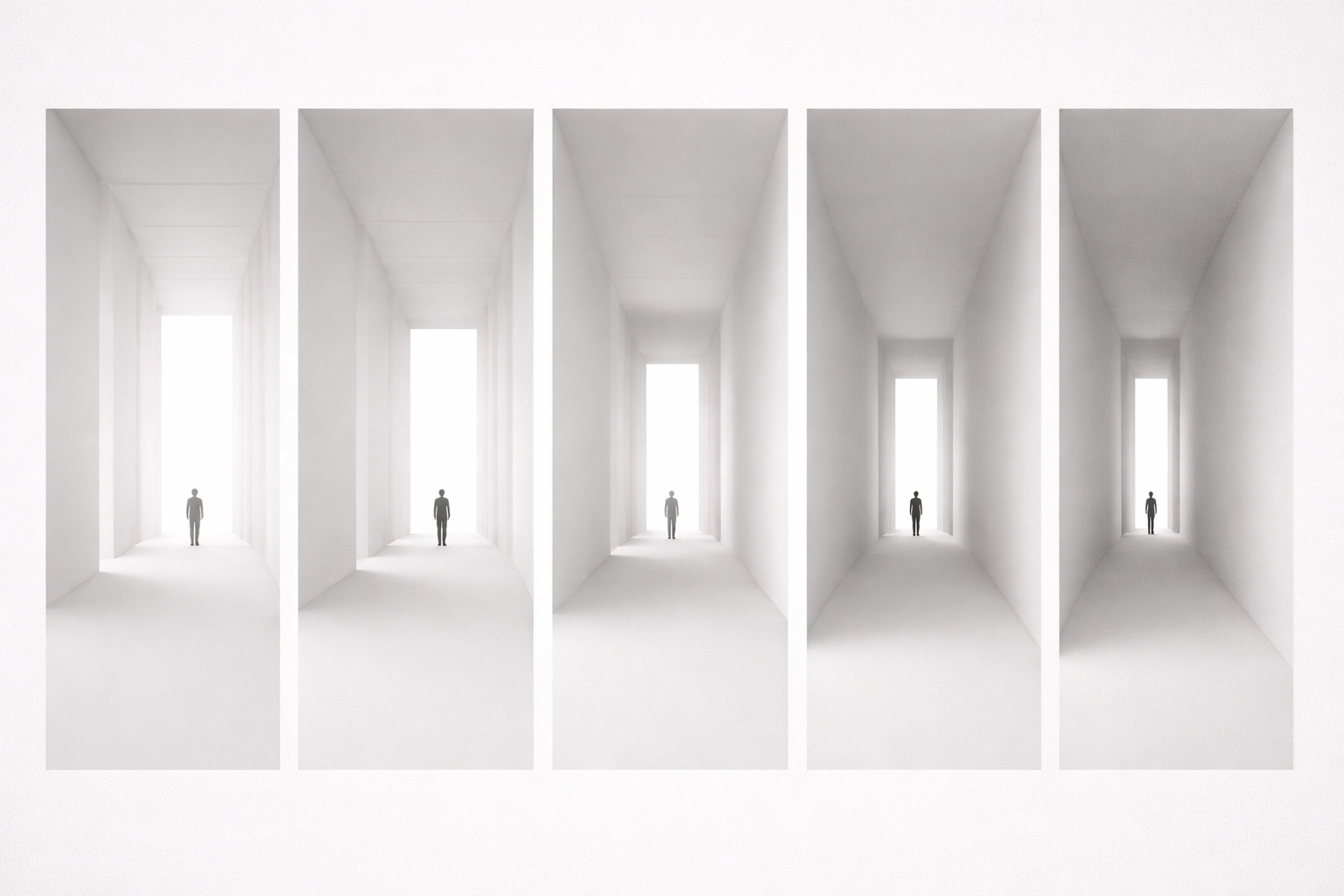
Five Centuries, One Guilt
Five tall corridor panels side by side, each containing a small figure at different distances walking toward narrowing light
Five corridors, five centuries, and in each one a figure walking toward a light that narrows as the architecture lengthens. The knight recognized himself in every panel and was troubled, not because the figures were different from him but because they were not. The posture was the same: someone moving toward a brightness that someone else, long ago, declared was evidence of grace, or industry, or calling. Sancho, who had no theology but considerable experience with corridors, pointed out that the light at the end was the same light as the light at the beginning, only further away. This was, the narrator regrets to report, entirely accurate.
And it is here — at the question of depth, of where the pattern comes from, of why the planning impulse is so resilient in the face of its own failures — that the essay must shift from the organization to the culture. Because the organization, for all its structural power, exists inside a larger architecture. And that architecture has been under construction for five centuries.
The genealogy begins where Max Weber began, in the Calvinist churches of sixteenth-century Northern Europe. The doctrine of predestination — the belief that God had already determined, before the beginning of time, who would be saved and who would be damned — generated, Weber argued, an unbearable anxiety in the faithful. If your salvation was predetermined, there was nothing you could do to earn it. But if there were signs of election — markers that distinguished the saved from the damned — then you could at least look for evidence that you were among the chosen. And the sign the Calvinists found, the behavioral marker that separated the elect from the reprobate, was disciplined, productive, purposeful work. Not work for its own sake, not work for pleasure, but work as calling — a moral-spiritual duty performed with ascetic self-discipline, the fruits reinvested rather than enjoyed. Work became the evidence of grace. Idleness became the evidence of damnation.
Over centuries, Weber argued, the religious foundation eroded but the behavioral pattern hardened. The iron cage formed: a system in which disciplined productivity is no longer chosen but compelled, no longer theological but structural, no longer a path to salvation but a condition of social existence. The Puritan wanted to work in a calling. We are forced to do so. But the affect remains — the guilt, the anxiety, the deep-seated feeling that unproductive time is not merely wasted but morally suspect. The chronic planner does more than fail to complete a project. They fail to fulfill a calling. The shame of the unfinished work is not proportional to any material cost — many abandoned plans cost nothing, harm no one, leave no trace in the world. The shame is disproportionate because it is descended from a theology that treated idleness as evidence of damnation. Five centuries later, the theology is gone but the guilt is intact. The unexecuted plan is the unperformed calling. And planning feels productive — it sustains the feeling of calling-fulfillment, the sense that one is working, striving, building, even when nothing material is being built. This is why planning is so seductive as a substitute for execution: it satisfies the Protestant conscience without requiring the Protestant labor.
Byung-Chul Han, writing in 2015, argued that Weber's disciplinary society has been superseded by something both more insidious and more exhausting. We no longer live under the sign of prohibition — the Foucauldian May Not — but under the sign of achievement — the Can. The shift is from external coercion to internal compulsion. Han's achievement-subject is simultaneously master and slave, exploiter and exploited, driven not by an external authority but by an internalized imperative to optimize, perform, and achieve. The pathologies of achievement society are not the pathologies of oppression. They are the pathologies of excess positivity: burnout, depression, attention deficit — not infections from without but infarctions from within, caused by the heart of the self attacking itself.
Han's diagnosis maps onto the planning-execution gap with unsettling precision. The chronic planner is Han's achievement-subject in miniature. They are not prohibited from acting. No one has told them they cannot write the novel, launch the business, build the thing. On the contrary — the culture screams you can. You can do anything. You can be anything. The shelves groan with books about unlocking your potential. The internet is saturated with stories of ordinary people who shipped extraordinary things. The message is relentlessly, oppressively positive: nothing is impossible. And this positivity is what makes the gap so unbearable, because when nothing is impossible and you still cannot start, the failure is entirely yours. There is no authority to blame, no system to resist, no oppressor to name. There is only the self that was told it could do anything and has, once again, done nothing.
The achievement-subject accumulates cans faster than they can be converted into dids. Every plan is an expression of possibility — "I can do this" — that generates a corresponding obligation. The planner's to-do list is a catalog of unfulfilled potential, and in achievement society, unfulfilled potential is the only unforgivable sin. Han's insight that the complaint of the depressive — "nothing is possible" — can only occur in a society that insists "nothing is impossible" is the sociological mirror of section four's clinical observation: the planning-execution gap hurts so much not because it represents an objective failure but because it violates an internalized demand that achievement society has installed at the deepest level of the self.
Hartmut Rosa adds a temporal dimension to Han's diagnosis. The planning-execution gap is not only getting more psychologically painful. It is getting structurally wider, because the world is accelerating.
Rosa identifies three interlocking forms of acceleration that define modernity. Technological acceleration — faster communication, production, transport — saves time in principle but fills it in practice, because the time saved is immediately colonized by new demands. The acceleration of social change means that institutions, relationships, knowledge structures, and professional skills shift faster, becoming obsolete before they can be mastered. And the acceleration of the pace of life means that more activities are compressed into each unit of time, despite — paradoxically — the time-savings that technology provides. These three forms feed each other in a self-reinforcing loop. The result is what Rosa calls the shrinking of the present: the decreasing time period during which expectations based on past experience reliably predict the future.
For the chronic planner, the shrinking present is catastrophic. A plan is, by definition, a prediction — a specification of how the future will unfold based on current conditions. When the present shrinks, plans decay faster. The conditions that made the plan relevant change before the plan can be executed. The timeline shifts. The tools become outdated. The market moves. The relationship ends. The technology is superseded. By the time you execute, the plan describes a world that no longer exists. This creates a perverse incentive: keep planning, because planning adapts to new information (you can revise the plan) while execution locks in assumptions (you have committed to a course). The accelerated world rewards the very qualities that characterize the planning state — flexibility, adaptability, optionality — and punishes the qualities that characterize the execution state — commitment, persistence, follow-through. The drift is not just psychologically comfortable. It is temporally rational. In a world that changes faster than you can act, the plan that is never executed is the plan that is never wrong.
Rosa calls the phenomenological experience of this condition frenetic standstill: moving faster and faster while feeling like you are standing still. Always busy, always planning, always moving, never arriving. This is the chronic planner's lived experience, and Rosa's contribution is to reveal that it is not a personal failing but a structural condition. The planner is not failing to keep up. The world is structured to prevent anyone from keeping up. The frenetic standstill is the subjective texture of a system that demands acceleration as a condition of participation but provides no stable ground on which to accelerate toward.
The cultural forces do more than create the conditions for the drift. They sustain the planner in the drift, providing rewards that make the drifting state not just tolerable but actively appealing. Lauren Berlant identified the mechanism with surgical precision.
Cruel optimism, as Berlant defined it, is a relational dynamic in which one's attachment to an object — a fantasy, an aspiration, a vision of the good life — actively obstructs the flourishing that the attachment promises. The cruelty is not in the object but in the attachment: you remain bound to a fantasy that sustains you (gives you something to orient toward, something to organize your time and identity around) even as it prevents you from developing alternative modes of living. The fantasy of the good life — upward mobility, durable intimacy, meaningful work — persists despite accumulating evidence that it is unachievable under current conditions, because losing the fantasy would mean losing the scene of possibility itself. And losing the scene of possibility feels worse than the slow damage the fantasy inflicts.
The plan is the chronic planner's object of cruel optimism.
The fantasy of the completed project — the novel written, the business launched, the creative vision realized — sustains the planner's sense of identity, purpose, and possibility. The plan-as-fantasy provides everything the planner needs without execution: identity ("I'm someone who is writing a novel"), possibility ("I could be a published author"), purpose ("I'm working toward something meaningful"). These are not trivial rewards. They are the basic materials of a livable life — a sense of who you are, a sense of where you are going, a sense that your existence has direction. The plan provides all of them. Execution would risk destroying all of them. The novel might be bad. The business might fail. The vision might be smaller than imagined. Executing the plan would test the fantasy against reality, and the fantasy might not survive the test.
The cruel optimism of the plan is that its unfinishedness is what makes it sustaining. The unfinished novel can still be great. The unlaunched business can still succeed. The unrealized vision retains its full scope and beauty. Execution would introduce imperfection, limitation, the intractable resistance of the real — everything the plan has so carefully excluded. The chronic planner would rather keep the fantasy than test it, because the fantasy is their anchor to possibility, and possibility — as every section of this essay has shown — is the neurochemically, cognitively, economically, and phenomenologically preferred state. Berlant's formulation is devastating in its accuracy: losing the bad object might be deemed worse than being destroyed by it. The plan-as-fantasy is the bad object. It prevents the flourishing it promises. And letting go of it feels worse than the slow attrition of never finishing anything, because at least in the drift, all the doors are still open.
Richard Sennett adds the economic architecture. The planning-execution gap, he argues — not in those terms, but in terms the essay can translate — is not just a cultural condition but a structural feature of flexible capitalism.
In The Corrosion of Character, Sennett traced what happens to human character — the ethical virtues of loyalty, commitment, perseverance, trustworthiness — when the economy shifts from long-term, stable employment to short-term, flexible, project-based work. In the old economy, a worker's life could be narrated as a coherent story: you started here, you built these skills, you progressed through these stages, you arrived there. The narrative had continuity. Character could form because character requires continuity — the sustained commitment to a practice, a community, a purpose over time.
In the new economy, workers move between roles, teams, and organizations so rapidly that no coherent narrative can form. Work is organized around "projects" that begin, end, and are replaced. Workers are expected to be infinitely adaptable, always ready for the next initiative, never too committed to the current one. The skill the economy rewards is not the skill of finishing but the skill of starting — of pivoting, of repositioning, of being strategic about the next move. Sennett asked the question the chronic planner feels but cannot articulate: how can a human being develop a narrative of identity and life history in a society composed of episodes and fragments?
The answer, Sennett suggested, is that they cannot. And the planning-execution gap is one of the consequences. The proliferation of unfinished projects is not a psychological disorder. It is a rational adaptation to an economy that structurally devalues completion. If everything is temporary, why commit to finishing? The next opportunity might be better. The next project might be more aligned with the market. The next plan might be the one that finally works. In Sennett's flexible capitalism, the planning state — with its openness, its strategic positioning, its preserved optionality — is not a failure of execution but a successful adaptation to an economic environment that rewards exactly those qualities. The chronic planner is not maladapted. They are perfectly adapted to an economy that has made commitment costly and pivoting profitable.
Ulrich Bröckling traced the same dynamic at the level of the self. The entrepreneurial self — the neoliberal subject who treats their entire life as an enterprise requiring constant management, optimization, and strategic planning — is not a description of how people actually are. It is a normative model that shapes how they are expected to be. The injunction to "be entrepreneurial" extends beyond business into health, relationships, education, and personal identity. The entrepreneurial self must constantly scan for opportunities, assess risks, develop strategies, and — above all — plan. To plan extensively, to strategize, to envision futures and assess opportunities — these are exactly the behaviors the entrepreneurial self is supposed to exhibit. The chronic planner is not failing at self-management. They are excelling at one half of it — the strategic, visionary, planning half — while the other half, the operational, the execution, quietly atrophies. The culture trains you to plan. It does not train you to finish.

The Long Walk
A solitary figure on a narrow straight path with converging perspective lines stretching endlessly in both directions
And then there is the social performance.
Erving Goffman's dramaturgical model of social life — the distinction between front-stage and backstage behavior, the management of impressions, the self as a dramatic effect rather than a fixed entity — illuminates the dimension of the planning-execution gap that is most visible in the age of social media but has existed as long as people have talked about their ambitions at dinner parties.
The plan is a front-stage performance of intentionality. When someone announces "I'm writing a novel" or "I'm starting a business" or "I'm working on something new," they are performing a social self — claiming an identity, signaling ambition, establishing a narrative in the eyes of others. This performance generates social rewards — admiration, interest, credibility, belonging — before any execution occurs. You can be a person-who-is-writing-a-novel for years without writing a word, as long as the performance is convincing. The social rewards of the announced intention are available without the risks of the attempted execution. The dinner party audience does not ask to see your manuscript. They ask how it's going, and "it's going well, I'm still in the planning stages" is a perfectly acceptable — even admirable — answer.
The social performance sustains the drift because it provides an external feedback loop that reinforces the planning state. The planner announces the project. Friends express interest. The planner's identity as a creative person, an ambitious person, a person with big plans, is confirmed and reinforced by the social environment. This confirmation satisfies some of the same psychological needs that execution would satisfy — the need for recognition, for identity, for a narrative about who you are and where you are going. But it satisfies them without the vulnerability of execution. The front-stage plan can be perfect. The backstage reality — the blank page, the empty workshop, the unopened code editor — is visible only to the planner, and only late at night, when the performance has ended and the audience has gone home.
But there is a complication the sociology has not yet reached — one that rewrites the terms of every argument in this section.
Jenny Odell, in How to Do Nothing, argued that the frame itself — the binary of planning versus executing, the assumption that the goal is always to produce — is part of the problem. What if the chronic planner's deepest difficulty is not that they plan too much and execute too little, but that they have lost access to a third mode entirely — the mode of receptive presence that is neither planning nor executing but simply being in the world without an agenda?
Odell's argument is not about laziness or withdrawal. It is about the systematic destruction, by the attention economy and the productivity gospel, of the human capacity for unstructured engagement with reality. The chronic planner oscillates between two productivity states — planning, which feels productive, and executing, which is productive — but never enters the non-productive state where creativity, meaning, and genuine motivation actually emerge. They are always doing something — if not making the thing, then planning the thing, and if not planning the thing, then planning the system for planning the thing. The idea that they might sit in a garden (a real garden, not Borges's metaphysical one) and simply attend to what is there, without an outcome in mind, without a framework to apply, without a system to build — this idea is almost unintelligible to the achievement-subject of Han's analysis, the entrepreneurial self of Bröckling's diagnosis, the frenetically still citizen of Rosa's accelerated world.
Odell's intervention complicates the essay's implicit binary. The solution to the planning-execution gap may not be more execution. It may be more nothing — or rather, more of the kind of receptive, contemplative presence that the productivity culture has made nearly impossible. The plan and the executed work are both products. They are different forms of the same productive impulse. The contemplative state — the state of not-planning and not-doing, of simply being present to what is — is the ground from which both good planning and good execution might arise, if the ground were not constantly being paved over by the next productivity system, the next planning app, the next strategic framework.
The drift, then, is not a personal failure. It is a condition — maintained by the organizational architecture of how decisions are actually made (garbage cans, not rational flowcharts), structured by the explore-exploit imbalance that rewards novelty over depth, accelerated by a temporal regime that makes commitment feel reckless, moralized by a five-century genealogy of Protestant guilt, intensified by an achievement culture that turns every unfulfilled plan into evidence of personal inadequacy, sustained by the cruel optimism of fantasies that provide everything except the thing they promise, adapted to a flexible economy that rewards strategic positioning over patient completion, performed on a social stage that provides identity and recognition without requiring results, and made invisible by its own normality — because in an organized anarchy, in an achievement society, in a world of frenetic standstill, the drift is not the exception. It is the default.
The chronic planner who drifts from project to project to project — who begins with enthusiasm, plans with brilliance, reaches the plateau, feels the turn, does not turn, and quietly pivots to the next beautiful plan — is not failing. They are responding, with remarkable sensitivity, to every signal the culture is sending them. The culture says: plan. The culture says: optimize. The culture says: be strategic. The culture says: keep your options open. The culture says: the right system will save you. The culture says: you can do anything. And then the culture does not say: but you cannot do everything, and the thing you do will be less beautiful than the thing you planned, and the grief of that diminishment is the price of making anything real, and the price is worth paying, and no system will pay it for you.
The culture does not say this because the culture profits from the gap. The self-help industry runs on unfinished plans. The productivity-tool market runs on the promise that the next app will be the one that finally closes the distance between intention and action. The social media economy runs on announced intentions and public planning. The consultancy industry runs on strategic frameworks that describe the future without creating it. The planning-execution gap is not a market failure. It is a market. And the chronic planner is its most reliable customer.
But the essay is not an indictment. The cultural forces are real, the institutional patterns are documented, the economic incentives are measurable — and none of this makes the planner a victim. The planner is an agent, operating under constraints, making choices that are locally rational and globally costly, navigating a world that rewards the planning state and extracts value from the execution gap. Understanding the drift is not the same as endorsing it. Understanding the forces is not the same as surrendering to them.
What the organizational and sociological lens reveals — and this is its essential contribution — is that the planning-execution gap is not a problem that lives inside the individual, to be solved by individual effort, individual discipline, individual willpower. It is a problem that lives in the relationship between the individual and the world — a world that has been constructed, over centuries, to make planning feel like work, to make work feel like identity, to make identity feel like calling, and to extract value from the gap between the calling and its fulfillment.
What remains is the question the essay has been circling since its first sentence: what does it mean? Not what causes it, not how to fix it, not who is to blame — but what does it mean that the plan is more beautiful than the thing? What does it mean that the garden is more beautiful than the path? What does the preference for possibility over actuality, sustained by every level of analysis from the neuron to the civilization, tell us about what we are?
Ten Disciplines at the Edge of the Garden
The essay promised ten disciplines. It has delivered nine.
Neuroscience showed what the brain is doing: the dopamine system, tuned to prediction error and possibility, generating more pleasure from the anticipation of a reward than from its receipt. Cognitive psychology showed what the mind is doing: simulating futures with systematic optimism, building mental representations whose elegance is inversely proportional to their accuracy. Behavioral economics showed what the preference structure is doing: constructing reference points so high that execution can only feel like falling, pricing optionality so dearly that commitment becomes an irrational expenditure. Philosophy showed what the plan is: a partial commitment that generates devotion to itself, a self-portrait of agency, a Kierkegaardian vertiginous space where all futures coexist. Phenomenology showed what the experience feels like from the inside: temporal ecstasy, protentional reach, the absorptive beauty of a whole that has never been tested. Creativity and design studies showed what the transition demands: the narrowing from divergence to convergence, the groan zone, the death of possibilities that is the precondition of making. Clinical psychology showed what pathology looks like when the gap deepens: perfectionism, avoidance, cognitive fusion with the plan as object, and the clinical counter-insight that action precedes motivation, not the other way around. Sociology and cultural studies showed what five centuries of moral architecture have built: a civilization that treats unfinished work as evidence of damnation, that demands unlimited achievement from finite selves, that profits from the gap between intention and action. Organizational theory showed what institutions reveal: that most decisions solve no problems, that strategy is retrospective more often than prospective, that the plan was never a blueprint for the future but a story about the past dressed in the future tense.
Nine lenses. One phenomenon. And the tenth — information theory and complexity science — has already delivered its central insights in the formal passages of section three: Shannon's entropy as the measure of unresolved possibility, Kolmogorov's compression as the plan's secret elegance, Chaitin's undecidability as the formal proof that the optimal plan does not exist, and Borges's garden as the literary rendering of the information-theoretic landscape. But the tenth discipline has two more things to say before the essay arrives at its resting place, and both of them matter — one because it delivers the essay's most compassionate conclusion, and the other because it offers the closest thing the essay has to a constructive vision.
Edward Lorenz, in 1963, discovered something that reshaped our understanding of what prediction can and cannot do. Working with a simple mathematical model of atmospheric convection — twelve equations, nothing exotic — Lorenz found that rounding an initial value from six decimal places to three produced a weather forecast that diverged wildly from the original. Not gradually. Not after centuries. Within days, the two simulations had nothing in common. The tiniest difference in starting conditions cascaded through the system's nonlinear dynamics until the outcomes were as different as two randomly generated sequences.
This was not a flaw in the model. It was a property of the system — a property that James Gleick, in his landmark 1987 account, helped bring to public consciousness under the name chaos theory. The key insight: in systems governed by nonlinear dynamics — and this includes the weather, fluid turbulence, population biology, the electrical activity of the heart, and, by extension, any complex system whose components interact with feedback — long-term prediction is fundamentally limited. Not limited by our ignorance, which could in principle be remedied. Not limited by our computational power, which could in principle be increased. Limited by the mathematics of the system itself. Sensitivity to initial conditions means that any level of measurement precision, no matter how fine, leaves sub-threshold variation that will eventually dominate the outcome. The butterfly flaps its wings in São Paulo. The forecast for Chicago is wrong.
The essay has spent five sections treating the planning-execution gap as a phenomenon that arises from the interaction of brains, minds, cultures, and institutions. Chaos theory adds a sixth source, and it is the most fundamental of all: the gap arises from the mathematical structure of complex systems. A plan is, at its core, a prediction — a specification of how the future will unfold based on current conditions. The plan says: given these goals, these resources, this timeline, and these methods, the outcome will be approximately this. Chaos theory says: for any system of sufficient complexity, this prediction is unreliable — not because the plan is bad but because the system the plan describes is sensitive to details the plan cannot capture.
A creative project is a complex system. It involves the interaction of cognition, emotion, physical materials, social contexts, market conditions, personal relationships, health, mood, weather, traffic, the email that arrives at the wrong moment, the conversation that opens an unexpected door. The plan specifies the initial conditions at some level of precision. But there will always be sub-threshold details — a sentence that takes you in a direction you didn't anticipate, a material that behaves differently than you expected, a collaborator who has an idea that reshapes the whole — and those details, in a nonlinear system, can and do drive the outcome into entirely unplanned territory.
This is not a failure of the plan. It is a mathematical property of the thing being planned.
And here the essay can deliver, with the formal authority of a century of dynamical systems theory, the sentence it has been building toward since the introduction: it is not your fault that your plans don't work. It is not a lack of discipline. It is not a deficit of willpower. It is not a failure of character. It is not the Protestant sin of unfulfilled calling, or the achievement-subject's self-exploitation, or the dopamine system's seduction, or any of the other explanations that locate the gap inside the individual. Those explanations are all true, and they are all partial. The deepest explanation is formal. Even a perfect planner — one with perfect information, perfect discipline, perfect self-knowledge, and infinite willpower — would still encounter the planning-execution gap, because the system being planned is chaotic, and chaotic systems do not submit to prediction at any level of planning detail. The gap is built into the mathematics.
This is the essay's most compassionate argument, and it earns its compassion not from sentiment but from rigor. The mathematics does not care about your feelings. It does not care about your productivity system. It does not care whether you are lazy or driven, organized or scattered, neurotypical or neurodivergent. It says: complex systems are sensitive to initial conditions, prediction is fundamentally limited, and the distance between your plan and your outcome is not a measure of your inadequacy. It is a measure of complexity.

The Edge of Chaos
A triptych: left panel shows an orderly white grid; center panel shows tiles lifting and fragmenting; right panel shows the grid collapsed into loose cubes
In the first panel, order. In the last, rubble. And in the middle, the knight’s true country: the place where the grid is lifting, where the tiles have begun to separate from their neighbors, where the structure is losing its composure but has not yet lost its shape. “This, Sancho,” said our knight, pointing to the center panel, “is where the interesting things happen.” Not in the plan, which is the first panel. Not in the ruin, which is the last. But here, in the middle, where the squares are deciding whether to be a wall or a pile of stones, and the decision has not yet been made, and Rocinante is already picking his way through.
But complexity science does not stop at the diagnosis. Melanie Mitchell, in her survey of complexity research, identified a concept that offers something the essay has not yet provided: a formal image of what the right relationship between planning and execution might look like.
The concept is the edge of chaos.
Complex adaptive systems — the kind of systems that exhibit the richest, most interesting, most creative behavior — are neither fully ordered nor fully disordered. Fully ordered systems are predictable but sterile: everything is determined in advance, nothing surprises, no adaptation is possible. Fully disordered systems are structureless: everything is noise, no pattern coheres, energy dissipates without effect. The interesting behavior — learning, adaptation, creativity, emergence — happens in a narrow region between the two: the edge of chaos. Here, there is enough structure to provide direction and enough disorder to allow surprise. Patterns form and dissolve. Structures emerge from local interactions without centralized control. The system is neither frozen nor boiling but in the productive zone between.
The chronic planner, in Mitchell's framework, is stuck on the order side. They seek to eliminate all uncertainty before beginning — to specify every detail, to resolve every question, to reduce the project to a fully determined sequence of steps that can be followed without surprise. This aspiration, which feels like thoroughness and which the planning state rewards so generously, paradoxically eliminates the conditions under which creative emergence is possible. The over-planned project has no room for the sentence that takes you somewhere unexpected. No room for the material that resists in an interesting way. No room for the collaborator's idea that is better than yours. No room for the accident that reveals what the project was actually about. The plan has pre-specified the outcome so completely that execution becomes mechanical — or, more commonly, does not begin at all, because the mechanical execution the plan demands feels so lifeless compared to the generative richness of the planning state itself. The plan killed the very thing it was supposed to enable.
Mitchell's edge of chaos suggests that the optimal plan is not the most detailed plan or the most comprehensive plan or the most elegant plan. It is the plan that provides just enough structure — enough to orient action, enough to prevent total dissolution — while deliberately leaving space for the unplanned. Some disorder is not a failure of planning. It is a condition of creative life. The plan should be partial not because you ran out of time to make it complete but because completion would destroy the space where the most interesting things happen. Bratman was right, back in section three: plans must be partial to function. But the reason goes deeper than Bratman saw. Plans must be partial because the systems they describe are complex, and complex systems require the productive disorder that over-planning eliminates.
Warren Weaver, writing in 1949 alongside Shannon, distinguished three levels of communication: the technical (can the signal be transmitted accurately?), the semantic (does the signal convey the intended meaning?), and the effectiveness level (does the received meaning produce the intended effect?). The chronic planner excels at the first two. Their plans are technically clear and semantically rich — the plan means exactly what the planner intends. They fail at the third: the plan, however carefully articulated, does not produce the intended conduct. The plan sits in a notebook, technically perfect, semantically complete, and behaviorally inert. This is the information-theoretic version of akrasia — the weakness of will that Davidson identified in section three — and it names what every chronic planner already knows: the problem is not that they don't know what to do. The problem is that knowing what to do does not reliably produce doing it. The map is exquisite. The territory is unwalked.
The tenth discipline has now delivered its final arguments. What follows is not another discipline. It is a reckoning — a moment when the essay steps back from the cascade of evidence and asks: what does it all mean, taken together? Not as ten separate accounts of the same phenomenon but as a single, converged understanding?
The research revealed five axes along which the disciplines connect, and each axis tells a version of the same story.
The first is the dopamine–entropy axis. Neuroscience establishes that dopamine responds to prediction error — to uncertainty, novelty, surprise. Information theory formalizes this: prediction error is information in Shannon's sense. Every unresolved question in the plan is a bit of entropy, and every bit of entropy is a potential dopamine event. The planning state, saturated with unresolved possibility, is the dopamine system's optimal stimulus — not because the brain is foolish but because the brain evolved to seek information, and the plan is an information-rich environment. The axis runs from neuron to formula: dopamine is the neurochemistry of high entropy. The plan feels good because it is informationally rich. Execution feels diminished because it resolves the information. The neurochemical and the mathematical converge on the same conclusion: the reward is in the uncertainty, and execution destroys it.
The second is the compression–decompression axis. Kolmogorov complexity establishes that plans are compressed representations — short programs that generate long outputs. Cognitive psychology establishes that the planning fallacy systematically underestimates the cost of decompression — the gap between the elegant three-sentence concept and the three-hundred-page novel that three sentences imply. Creativity and design studies show that the design brief is a compression, and the design process is the arduous, friction-filled decompression into a specific artifact. Philosophy identifies the "logical gap" between intention and action as exactly the information the compression omitted. The axis runs from algorithm to workshop to philosophy seminar: the plan is beautiful because it is compressed, and execution is hard because decompression forces you to supply every detail the compression left out.
The third is the moral genealogy axis. Sociology traces the cultural history: Weber's Protestant calling, Han's achievement society, Rosa's social acceleration, Sennett's flexible capitalism. Clinical psychology shows how this history is internalized as perfectionism, self-criticism, and the inability to tolerate imperfection. Philosophy provides the deep roots: Aristotle's distinction between dynamis (potentiality) and energeia (actuality) is the oldest version of the planning-execution gap, and Bratman's planning theory of intention is its modern formalization as moral commitment. The axis runs from sixteenth-century Calvinist churches to the 2 AM glow of a project management app: the shame of the unfinished project is five centuries old, and the tools have changed but the guilt has not.
The fourth is the loss and grief axis. Phenomenology provides the experiential ground: Kierkegaard's dizziness of freedom, Sartre's anguish of the pour-soi confronting facticity, Heidegger's thrownness into a world you did not choose. Sociology provides the structural account: Berlant's cruel optimism, the attachment to a fantasy that sustains you even as it prevents the flourishing it promises. Behavioral economics formalizes the loss: Kahneman and Tversky's reference-point trap, Shin and Ariely's door-closing experiments, Loewenstein's anticipatory pleasure that is forfeited the moment execution begins. Information theory renders it as image: the garden going dark, path by path, until only the single lit trail of what-actually-happened remains. The axis runs from the vertigo of the abyss to the mathematics of entropy reduction: the planning-execution gap is experienced as loss because it is loss — the loss of informational richness, of preserved possibility, of the beautiful unresolved.
The fifth is the action-first axis. Organizational theory argues, through Weick, that action precedes sensemaking — you cannot know your plan until you see what you have done. Creativity and design studies argue, through Schön, that designers think by doing, not before doing — the reflection-in-action that produces insight occurs in the middle of work, not in the planning document. Phenomenology argues, through Merleau-Ponty, that the body knows before the mind plans — motor intentionality is a form of intelligence that operates below the threshold of conscious planning. Clinical psychology argues, through behavioral activation, that action precedes motivation — you do not wait to feel ready; you act, and the readiness comes. March's technology of foolishness argues that goals are discovered through action, not specified in advance. The axis runs from the body to the organization: the plan is not the precondition of action but its retrospective justification, and the chronic planner who waits for the plan to be ready before beginning has the entire sequence backwards.
Five axes. One phenomenon. And from their convergence, the essay's three core arguments emerge in their final form.
The formal argument: the planning-execution gap is a double bind. The plan is, by its nature, a compressed, high-entropy representation. To preserve its beauty — its compression, its possibility, its entropy — you must not execute it. To execute it, you must destroy its beauty — decompress, resolve, reduce. There is no escape from this bind. There is no plan so well-constructed that executing it will feel as good as planning it did, because the thing that makes the plan feel good (its compressions and its openness) is precisely the thing that execution eliminates. The plan's beauty and its uselessness are the same property, viewed from different angles. This is not a bug. It is the information-theoretic structure of moving from possibility to actuality.
The historical argument: the planning-execution gap is moralized by a five-century genealogy of Protestant work ethic, secularized and intensified into the achievement society's demand for unlimited productivity from finite selves. The shame of the unfinished project is not proportional to any material cost. It is descended from a theology that equated idleness with damnation. The tools have been updated — from the monastic schedule to the Eisenhower matrix to the Scrum sprint to the project management app — but the moral architecture is the same: you are what you produce, and what you have not produced is evidence of what you are not. The planning state provides a loophole in this architecture: it feels productive without requiring production, satisfying the moral demand without paying the material cost. This is why it is so seductive, and this is why the culture — which profits from the gap — has no incentive to close it.
The phenomenological argument: the planning-execution gap is, at its emotional core, an experience of grief. Not the dramatic grief of catastrophe but the quiet grief of becoming specific — of trading everything the thing could be for the one thing it will be. The plan holds all futures simultaneously. Execution collapses them to one. The grief is proportional to the richness of what is lost, and the richness of what is lost is, by every measure this essay has applied — neurochemical, cognitive, economic, philosophical, phenomenological, formal — genuinely and defensibly great. The plan is richer than the thing. The garden is more beautiful than the path. This is not an illusion to be corrected. It is an accurate perception of an asymmetry that runs through the architecture of mind and world, from the dopamine neuron to Shannon's entropy function to Borges's forking paths. The grief of execution is the price of reality, and no amount of motivational coaching, productivity hacking, or disciplinary willpower can make the price go away. It can only be paid.
But the essay does not end with the grief. It cannot, because the grief — for all its reality, for all the rigor that supports it — is not the whole story. There is something the grief leaves out, something that none of the ten disciplines, taken individually, can see clearly but that their convergence makes visible.
The plan is more beautiful than the thing. This has been established, defended, formalized, and experienced. But the plan has a property that the essay has noted but not yet fully reckoned with: the plan is not real.
Not unreal in the crude sense — the plan exists, it has causal effects, it shapes behavior and identity and mood and time. It is a genuine cognitive and emotional artifact. But the plan is not real in the sense that counts most: it has not made contact with the world. It has not encountered the resistance of materials, the surprise of collaboration, the accident of discovery, the friction of embodiment, the irreducible otherness of reality as it actually is when you show up and try to work with it. The plan is a monologue. The thing — the clumsy, imperfect, diminished, specific, real thing — is a dialogue.
Rosa called this dialogue resonance: the mutual responsiveness between self and world in which both are transformed by the encounter. Merleau-Ponty called it motor intentionality: the intelligence of the body in responsive engagement with its environment. Schön called it reflection-in-action: the designer thinking through doing, discovering the problem and the solution simultaneously in the act of making. Csikszentmihalyi called it flow: the state of optimal engagement that arises not from planning but from the precise calibration of challenge and skill in the moment of action. Weick called it sensemaking: the discovery, through enactment, of what you were doing and why.
They are all describing the same thing. They are describing what happens on the other side of the grief — what the planner receives in exchange for what the planner gives up. And what the planner receives is not the completion of the plan. The plan, as Mintzberg showed, will not be completed as planned. What the planner receives is something the plan could never provide: the experience of reality pushing back, and the discovery, in the pushing, of what the project actually is.
This is what the chronic planner forfeits. Not the finished product — the finished product may or may not be good, may or may not matter, may or may not justify the grief. What the chronic planner forfeits is the encounter itself — the specific, unrepeatable, embodied experience of being in dialogue with materials, with constraints, with other people, with the world as it is and not as the plan imagined it. The plan offers everything except this. It offers compression, possibility, beauty, identity, social performance, moral satisfaction, dopaminergic reward, and the exhilarating vertigo of all futures held simultaneously. It offers everything except contact. Everything except the thing that can only happen when you stop planning and start walking and the garden goes dark around you and the single path — your path, the imperfect and irreversible one — begins to reveal, step by step, where it was going all along.
The essay, as promised, does not resolve.
It does not tell you to start your project. It does not offer five steps for closing the planning-execution gap. It does not provide a framework, a method, or a system — it has spent forty thousand words demonstrating why frameworks, methods, and systems are the planning impulse in institutional clothing, and it will not put on the costume at the last moment. If you feel, after reading this, that you finally understand something about why Tuesday night at 1:47 AM felt the way it did — why the plan was so beautiful, why the thing was so hard to start, why the shame was so disproportionate, why the drift felt so natural, why the culture provided no help — then the essay has done what it came to do. Understanding is its own reward. It is, in fact, the only reward the essay can offer without contradicting its own argument.
But the essay does arrive somewhere. It arrives at the garden.
The garden of forking paths, all paths illuminated, all futures coexisting. The entropy cloud shimmering with unresolved possibility. The plan in its formal perfection — compressed, open, beautiful, complete. The essay has spent its full length explaining why this garden is so beautiful and why we cannot bear to leave it. The neuroscience says: the garden is the dopamine system's optimal stimulus. The economics says: the garden has the highest option value. The philosophy says: the garden is pure potentiality, Aristotle's dynamis in its fullest expression. The phenomenology says: the garden is Kierkegaard's vertiginous freedom, Heidegger's widest clearing. The information theory says: the garden is maximum entropy, maximum information, maximum unresolved beauty.
And all of this is true.
And the garden is imaginary.
The single path — the diminished, specific, grief-laden, imperfect, decompressed, low-entropy path — is real. The words on the page are real, with all their inadequacy. The thing you build is real, with all its deviation from the plan. The conversation you have is real, with all its surprise and discomfort. The work is real. The resistance is real. The discovery that the plan was wrong in ways that turned out to matter — that is real. The discovery that the plan was right in ways you hadn't understood — that is real too. The feedback. The revision. The slow, unglamorous, entirely un-plannable process of something taking shape under your hands.
The garden holds everything. The path holds only what happened. And what happened is the only thing that ever becomes real.
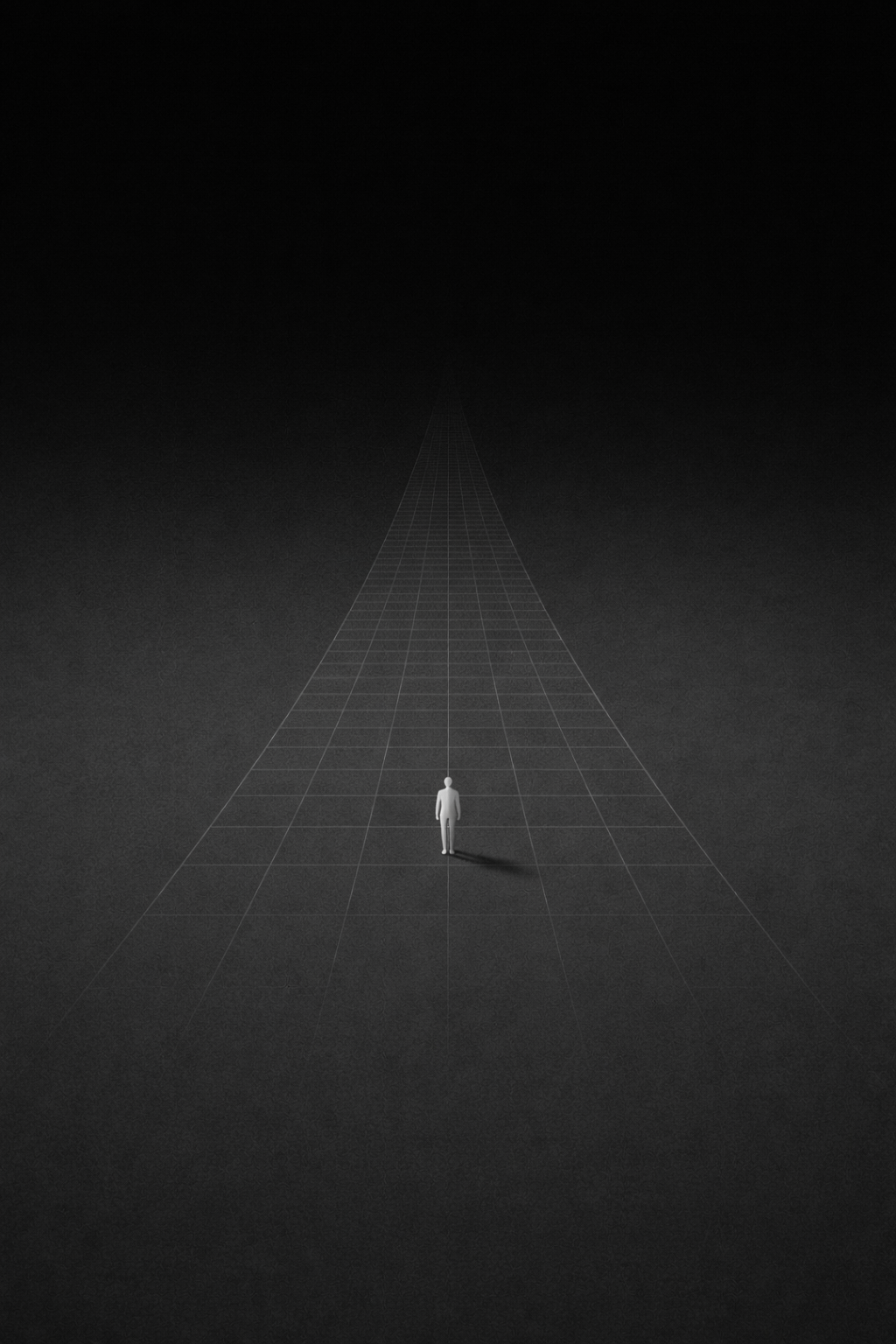
The Garden Is Dark Now
A solitary white figure standing on a small triangular patch of illuminated grid, surrounded by vast darkness
And so the garden goes dark. The paths that were all illuminated have gone out, one by one, and what remains is this: a single lit ground beneath a single pair of feet, and the figure upon it smaller than you remember from the first image, and the darkness not unkind. Sancho is no longer visible, but if you listen you can hear the donkey somewhere off to the left, which means he is nearby, which in a story like this one is all the comfort the narrator is authorized to provide. The plan was a garden. The essay was a path. Rocinante, who has been walking the whole time, does not understand the fuss.
There is one more thing.
This essay — the one you are reading, the one that began at 1:47 AM with a plan that was more beautiful than the thing it described — this essay is the thing. Not the plan. The thing. It is the decompressed, imperfect, specific, irreversible version of a plan that was, in its compressed form, more elegant than what you have just read. The plan had ten disciplines in perfect balance. The essay does not. The plan had every argument placed with architectural precision. The essay has gaps where the mortar shows. The plan was a garden. The essay is a path.
I know this because I am standing on the path and looking back at the garden and the garden is still beautiful and the path is narrower than I thought it would be. Ten disciplines said this would happen. They were right. The dopamine was better during the planning. The reference point was too high. The options closed and the grief was real and the turn was not a triumph but a giving-up. All of it. Exactly as described.
And yet the path has something the garden did not. Not beauty — the garden wins that contest, and the contest is not close. Not elegance — the plan was more elegant by every formal measure this essay can name. Not possibility — the plan held everything, and the essay holds only itself.
What the path has is that it happened. It made contact with the world. It encountered — in the writing, in the research, in the long nights of decompression when the compressed elegance of the plan gave way to the sprawling, resistant, surprising, frustrating, occasionally revelatory reality of actually making a thing — it encountered what every section of this essay has been circling: the resistance that is also dialogue, the friction that is also discovery, the loss that is also arrival. The plan was a monologue, spoken in a beautiful room to an admiring audience of one. The essay is a conversation — imperfect, unfinished, ongoing — with a world that will do with it what it will.
The garden is dark now. The paths have gone out, one by one, as each sentence was written and each alternative foreclosed. What remains is this. What you have just read. The one thing it became, out of all the things it could have been.
It is 1:47 in the morning. The plan, which was fourteen pages and had a risk register and a color-coded timeline, sits in a folder I can still open. I open it sometimes. It is still beautiful. The feeling it produces — the old feeling, the planning feeling, the shimmer of everything the project could become — is still available, muted now by knowledge but not extinguished. I do not think it will ever be extinguished. The dopamine system does not read essays. The entropy of the unresolved does not care that you have resolved it. The garden regenerates.
And the essay, for all its forty thousand words, cannot tell you what to do with this. It can tell you what the garden is. It can tell you what the path costs. It can tell you that the cost is real and the grief is justified and the mathematics is on the side of the garden and the culture profits from your staying in it and the brain was built to prefer it and the philosophers have been arguing about it for twenty-four centuries and no one — not the neuroscientists, not the economists, not the clinicians, not the organizational theorists, not the sociologists, not the information theorists, not the phenomenologists, not the designers, not the dead existentialists — no one has found a way to make the path feel as good as the garden.
The path is real. Diminished, specific, imperfect — but real.
The garden is not. Beautiful, compressed, shimmering with everything the project could still become — but not real. Not in the way that matters. Not in the way that leaves a mark.
And the essay, having arrived here, cannot adjudicate between them. To declare the path the winner would be to compress the messy truth of this investigation into a verdict — another plan, another elegant simplification, another beautiful reduction of complexity to a single bright line. Chaitin proved that the optimal compression does not exist. The essay will not pretend to have found it.
What remains is what has always remained: the garden and the path, coexisting, each with its own beauty and its own cost. The planner at 1:47 AM, building something luminous and knowing — now, after ten disciplines, knowing with a precision that changes nothing — that the luminous thing and the real thing are not the same, and that the distance between them is not a problem to be solved but a condition to be understood, and lived with, and — on the best days, in the best moments, with the full weight of the grief that the mathematics says is justified — gently, imperfectly, crossed.
Colophon
The Beautiful Unfinished examines the planning-execution gap through ten disciplinary lenses: neuroscience, cognitive psychology, behavioral economics, philosophy, phenomenology, creativity and design studies, clinical psychology, sociology, organizational theory, and information theory.
Typeset in Lora and Inter. Art by the author.
Bibliography — 133 sources across ten disciplines, annotated and organized by the argument they support.
Read the Prompt Architecture — the ten-phase editorial pipeline, 132 sources, and formal acceptance gate behind this essay.
© Jake Lawrence. All rights reserved.